Dates
AD 960–1127
The Northern Song (960–1127) was a civilizatio...
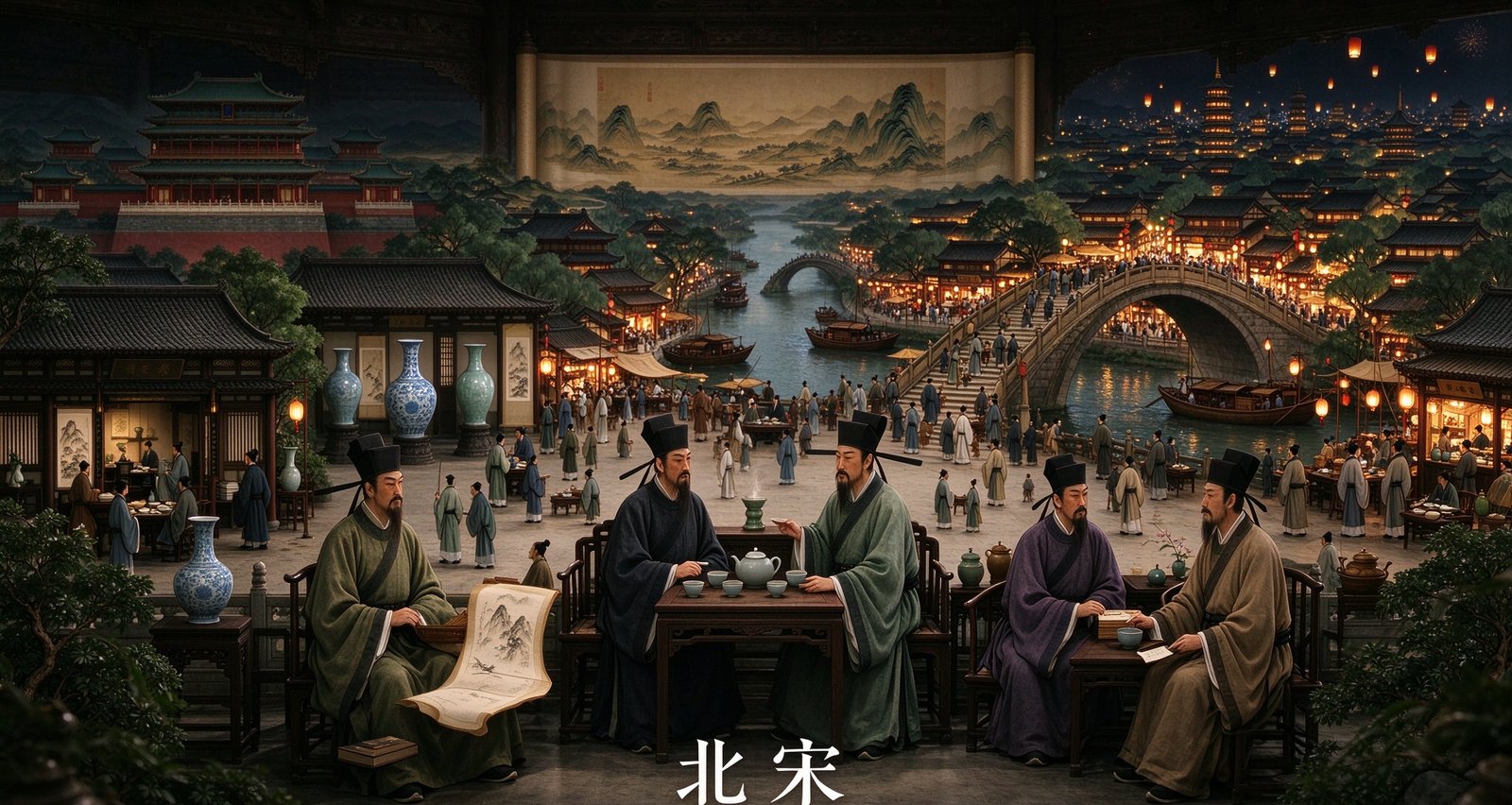
The Northern Song (960–1127) was a civilizational peak veiled by military weakness. Founded by the Chenqiao mutiny, Zhao Kuangyin relieved his generals of command over a cup of wine and, by strengthening the center and thinning the branches, honoring the civil and slighting the military, ended the age of soldier-emperors — and sowed the seeds of frontier weakness, with Liao and Western Xia pressing and peace bought with annual payments. But the covenant to "govern together with the scholar-officials" made the golden age of Chinese civil governance: expanded examinations, mature bureaucratic politics, movable-type printing, the compass at sea, gunpowder weapons, jiaozi — the world's first paper money; three of the four great inventions took final or popular form here. Kaifeng in *Along the River During the Qingming Festival* was a million-strong international city, night markets and playhouses running round the clock. In thought, Zhou Dunyi, Zhang Zai, and the Cheng brothers opened Neo-Confucianism; the Wang Anshi–Sima Guang debate was antiquity's deepest policy argument; in letters, Song lyric stood beside Tang poetry, and Su Shi alone was a universe. In 1127 the Jingkang catastrophe carried Emperors Huizong and Qinzong north, and a hundred and sixty-seven years of civil governance stopped short — Chen Yinke's "zenith under the Zhao Song" is its fairest epitaph.
Zhao Kuangyin's design dosed each Five Dynasties pathology in turn: command relinquished over wine; the Military Council and the Three Head Offices splitting the power to order troops from the power to lead them; rotating garrisons so that "soldiers knew not their generals, generals not their soldiers"; civil governors, controlling supervisors, and fiscal commissioners stripping the provinces — no region again had the material base for separatism. He also left the ancestral instruction never to kill scholar-officials or remonstrators, and the examinations passed hundreds each sitting — "the whole court's crimson and purple: all men of letters."
The cost was equally clear: bloated armies and offices, rigid command, weak frontiers — the "three redundancies" weighing on Song finance. Wars with Liao and Xia repeatedly failed, and peace was kept by the Chanyuan and Qingli payments — civil-over-military bought nearly a hundred and seventy years of internal peace and civilizational splendor, and pre-booked the Jingkang catastrophe. A double-edged sword: the Song chose the civil edge.
The Northern Song saw ancient China's deepest economic revolution: the ward-market system broken, Kaifeng's night markets running to the third watch; population past one hundred million, urbanization beyond any previous age; coin minting several times Tang's and still falling short, so Sichuan issued jiaozi — the world's first paper money, six hundred years before Europe. Iron output, shipbuilding (watertight compartments), coal-smelted iron, and the mass production of silk, porcelain, and tea all led the world.
The trappings of a commercial society appeared together: guilds, advertising (the bronze plate of the Liu Family Needle Shop of Jinan is the world's oldest surviving trademark advertisement), employment brokers, an entertainment industry of playhouses and booths. *Along the River During the Qingming Festival* is but one slice of Dongjing — Ray Huang's "the commercial society closest to modernity in Chinese history" is no flattery: by economic and technical parameters, eleventh-century Kaifeng was the nearest place on earth to "modern."
In 1069 Wang Anshi pushed reform with the daring of "fear no heaven's omens, follow no ancestral precedent, heed no men's murmurs": the Green Sprouts loans to undercut usurers; commutation of corvée to cash; the Market Exchange to steady prices; land surveys for fair taxation; the baojia to embed soldiers in the villages — a systemic reform against the three redundancies, and China's most complete experiment in state interventionism.
Sima Guang's old party opposed not the problems but the plan: government lending must breed forced quotas; the administration would turn "reform" into "harassment." The new-old struggle ran near half a century, policy swaying with faction — the Yuanyou restoration abolished the New Laws wholesale, and Cai Jing then looted under their name. The true legacy is a political-science specimen: without a neutral, competent bureaucracy, even the best-designed policy deforms in execution.
Jin rose, allied with Song to destroy Liao — and saw through Song's weakness in the waging. In 1127 Jin stormed Kaifeng and carried off Emperors Huizong and Qinzong with the imperial clan, consorts, artisans, and archives — a hundred thousand people — north, the treasuries and libraries emptied: the Jingkang catastrophe. "The shame of Jingkang, not yet avenged; a subject's grief — when will it end?" — Yue Fei's *Man Jiang Hong* became the thousand-year echo of that national shame.
Jingkang's lessons are multiple: allying with Jin against Liao replayed, in advance, the later naivety of allying with the Mongols against Jin; Huizong's artistic genius (slender-gold script, Ru ware) set against his governance disaster is history's most striking personal inversion; and Bianjing's splendor proved that wealth without arms is merely the invader's spoils. Prince Kang, Zhao Gou, crossed south and rebuilt the Song — the ember of civilization crossed south again, and this time Jiangnan would become Huaxia's new heart.