Dates
AD 907–960
The Five Dynasties and Ten Kingdoms were the f...
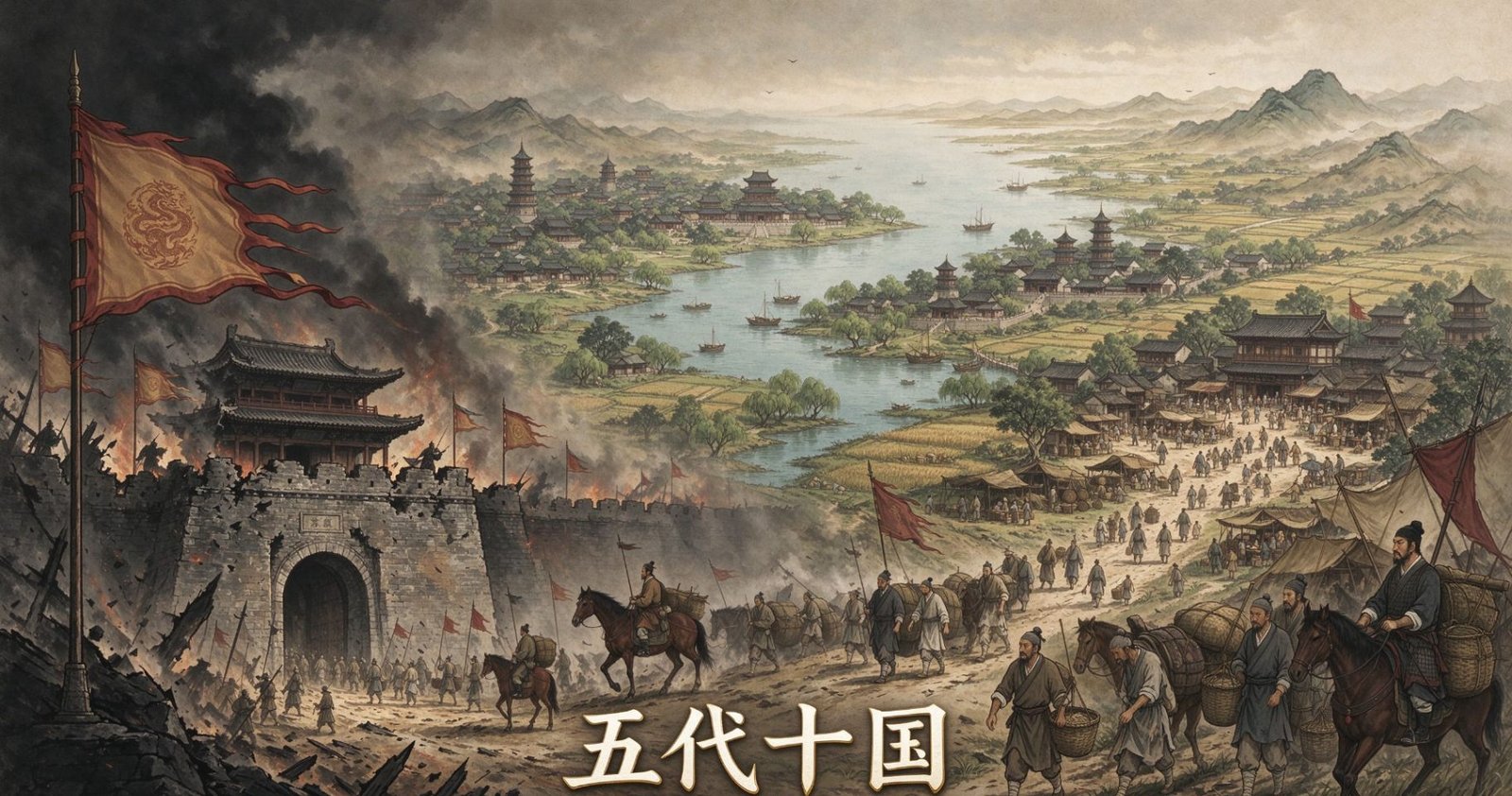
The Five Dynasties and Ten Kingdoms were the fifty-three-year interlude between Tang and Song (907–960): the Central Plains ran through the five short houses of Later Liang, Later Tang, Later Jin, Later Han, and Later Zhou — "Zhu, Li, Shi, Liu, Guo; Liang, Tang, Jin, Han, Zhou; fifteen emperors in all, sowing fifty autumns of chaos" — while the south and Hedong held Wu, Southern Tang, Wuyue, the two Shus, Min, Chu, Southern Han, Southern Ping, and Northern Han. It was the logical extreme of garrison warlordism: soldiers on thrones, regimes changing like lantern slides — yet the embryos of the Military Council and the palace armies matured here. In 936 Shi Jingtang ceded the Sixteen Prefectures of Yan-Yun to the Khitan — a nightmare for four hundred years of Central Plains dynasties. But in the chaotic south economy and culture advanced apace: Wuyue guarded its borders and its people; Southern Tang's lyric poets (Li Yu); the Shus' woodblock printing and among-the-flowers lyrics; Wuyue's Leifeng Pagoda and mise porcelain. In 960 Zhao Kuangyin staged the Chenqiao mutiny and the Five Dynasties closed; the Northern Song later absorbed the southern states, mostly by peaceful surrender — at chaos's end stood Zhao Song.
The Five Dynasties' rules of the game were simple and brutal: whoever held the strongest palace army was emperor. Zhu Wen usurped Tang as jiedushi of Xuanwu; Li Cunxu's Shatuo cavalry from Hedong destroyed Liang; Shi Jingtang borrowed Khitan troops to found Jin; Guo Wei donned the yellow robe (a rehearsal for Zhao Kuangyin) — in fifty-odd years a dozen emperors came and went. "Is the Son of Heaven born to it? He with the strongest soldiers and horses becomes so" — An Zhongrong's line is the epitaph of Five Dynasties politics.
The social cost was terrible: constant war, crushing levies, moral collapse. Feng Dao served four dynasties and ten emperors untoppled, styling himself the "Ever-Cheerful Elder" — measure of how chaos dissolved scholarly integrity. Yet institutions grew in the ashes: the Military Council held military administration, the Three Fiscal Commissions held revenue, the palace-army system matured — the Northern Song's centralization was built on foundations the Five Dynasties dug.
In 936 Shi Jingtang, to buy Khitan arms for his throne, ceded the Sixteen Prefectures of Yan-Yun (the line from Beijing and Tianjin to Datong in Shanxi) and styled himself "child emperor." This mountain-fortressed land was the Central Plains' natural rampart; it now belonged to Liao — the North China Plain lay open, and Khitan cavalry could reach the Yellow River in days. Later Zhou and the Song made recovering the Sixteen Prefectures a matter of national destiny: Chai Rong died mid-campaign; Zhao Kuangyin banked silver in the Sealing-Purse Treasury to buy them back; Taizong's two northern campaigns were routed — the debt was paid only four hundred years later by the Ming's northern expedition.
The lesson entered Chinese military thought: the political ownership of geographic barriers decides national security more than military technology does. After the Chanyuan Covenant, Song and Liao traded annual payments for peace — a substitute for the unattainable barrier: mocked as complacency, yet it held a broad peace for over a century.
Most southern states kept to the policy of "guard the borders, comfort the people": the Qian clan of Wuyue "served China well while guarding its realm" — building sea walls, dredging West Lake and Lake Tai — Hangzhou rose from then on; Min developed Fuzhou and Quanzhou as sea trade grew; Southern Tang and the Shus were stable, and fleeing scholars shifted the cultural center south. Northern refugees poured across the river; polder fields, double-cropped rice, commercialized tea and mulberry — the southward shift of China's economic center made its decisive leap in the Five Dynasties.
Culture flourished southward too: Shu's *Huajian Ji* was China's first literati song-lyric anthology; Southern Tang's Li Jing and Li Yu raised lyric from banquet entertainment to "gentlemen's verse," and Feng Yansi opened the Northern Song style; Chengdu's and Hangzhou's woodblock printing led the realm — "the archives' holdings doubled from Tang." The half-century of division was exactly the half-century in which the south caught and passed the north — foreshadowing the Southern Song's capital at Lin'an.
The real turning point came from Later Zhou's Shizong, Chai Rong: in five and a half years he beat Later Shu in the west for Qin and Feng, took the fourteen northern prefectures from Southern Tang, struck the Khitan and took three passes in the north — vowing "ten years to open the realm, ten years to nourish the people, ten years to bring peace"; he rebuilt the palace army, equalized the land tax, and repaired the waterways — Zhao Song's base was his work. Heaven grudged him the years: dead at thirty-nine, his young son succeeded.
In the first month of 960, Zhao Kuangyin, commander of the palace guard, was "draped in the yellow robe" by his troops at Chenqiao station; he marched back to Kaifeng and changed dynasties without a drop of blood — the last mutiny of the age ended the age of mutinies. Zhao knew the disease: command relinquished over a cup of wine, rotating garrisons, strengthening the trunk and thinning the branches — the systematic demolition of military interference in politics. The Five Dynasties demonstrated the death-loop of "the strongest becomes emperor"; the Song proved by design that the loop can be dismantled.