Dates
AD 1127–1279
The Southern Song (1127–1279) held half the re...
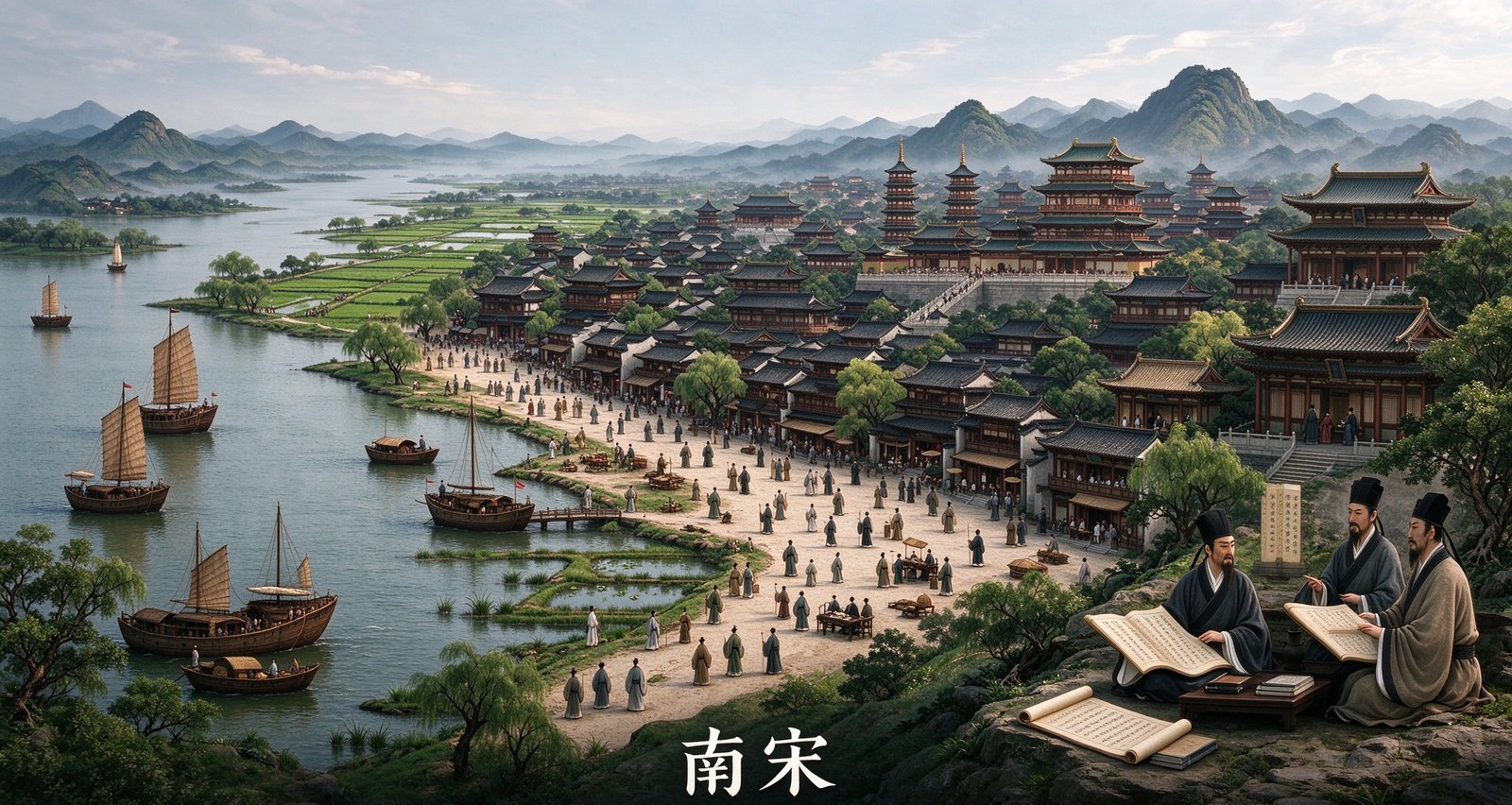
The Southern Song (1127–1279) held half the realm yet delivered a complete civilization. With the capital at Lin'an (Hangzhou) the economic center settled decisively south: "when Suzhou and Huzhou ripen, the world is fed"; the Maritime Silk Road entered its golden age, Quanzhou became the world's greatest port, and customs revenue propped up half the budget; in culture and science the age peaked — Zhu Xi crowned Neo-Confucianism, Lu Jiuyuan opened the School of Mind, Xin Qiji and Li Qingzhao set the twin summits of Song lyric, Lu You's near ten thousand poems recorded the age's pulse, and after Shen Kuo came Qin Jiushao's and Yang Hui's mathematics and the engineering of the *Yingzao Fashi*. In statecraft, Yue Fei's wrongful death, Han Tuozhou's failed northern war, Jia Sidao's dominance — war and peace wavering throughout; yet Xiangyang held out against the Mongols for six years, and at Yashan a hundred thousand soldiers and people followed their emperor into the sea — the Southern Song died, and died most heroically. Japanese scholarship even sighed "after Yashan, no China" (the claim is inaccurate, but it measures the Southern Song's weight). One hundred fifty-three years, half a realm, a condensed and consummate Huaxia.
Lin'an topped a million people, its playhouses and teahouses as splendid as Dongjing's; behind "warm winds breeding drunken wanderers" stood mature urban finance and a consumer society. But the Southern Song's true strategic turn was seaward: Maritime Trade Commissions at Quanzhou, Mingzhou, and Guangzhou, customs revenue at times past fifteen percent of the state's income; at Quanzhou "amid the roaring tide, merchants of ten thousand lands" — Arab, Persian, and Southeast Asian traders thronged, and Fujian ships with fireproof lacquer, watertight bulkheads, and compass navigation plied the Indian Ocean.
This was Chinese history's first true opening to the ocean: had the course held, East Asian history might have been rewritten. Yuan and Ming inherited Song shipbuilding and navigation (the technical roots of Zheng He's fleet lie in Song-Yuan), but the on-and-off sea bans repeatedly interrupted the ocean age the Southern Song opened — making it the coordinate from which the Chinese gaze back at "another possibility."
Yue Fei's army "froze rather than pull down houses; starved rather than plunder"; at Yancheng it broke the Jin's iron cavalries, and Zhuxian Town lay a step from Kaifeng — "driving straight to Huanglong" in sight. But Gaozong and Qin Hui had him granted death at Fengbo Pavilion on the charge of mo xu you — "perhaps perhaps." The peace bought vassalage and payments, and with them decades of respite and reconstruction. Yue Fei's death remains an eternal question mark in Chinese political ethics: war or peace, loyalty to the sovereign or to the state — where lies the boundary between personal integrity and national interest?
Afterwards the Kaixi northern war (Han Tuozhou) failed and the Duanping entry into Luoyang (alliance with the Mongols against Jin) misfired again — every Southern Song initiative met defeat, and every complacency bought a greater next crisis. The war-peace dispute was at bottom the mismatch of national strength and ambition: that mismatch is the underlying tension of Southern Song political history.
The Southern Song was thought's decisive age: Zhu Xi crowned the line of Zhou Dunyi, the Cheng brothers, and Zhang Zai — li (principle) as the substance of the cosmos, "the investigation of things to extend knowledge" as the path of work, "preserve the principle of heaven, extinguish selfish desire" as the program of self-cultivation — a system of vast compass; the Goose Lake Meeting's divergence with Lu Jiuyuan ("the piecemeal" versus "the simple") preset six hundred years of Confucian fault lines. The Qingyuan proscription briefly damned it as "false learning" before reversal — from Emperor Lizong on, Neo-Confucianism became state doctrine, ruling the examinations until the end of the Qing.
Its influence pierced East Asia: the Joseon dynasty was founded on Zhu Xi's learning; the Tokugawa official school and Vietnam's examinations ran on the Zhu-annotated Four Books. Militarily the Southern Song was on the defensive; intellectually it was in absolute offensive — it reset the spiritual operating system of all East Asia.
Against the mightiest war machine on earth, the Southern Song resisted for forty-five years — the longest of all the regimes the Mongols conquered: at Diaoyucheng they killed the Great Khan Möngke (indirectly changing the war's course across Eurasia), Xiangyang held six years, and at last "a lone city without relief" fell. In 1279 at the sea battle of Yashan, Lu Xiufu bore the child emperor into the sea and a hundred thousand soldiers and people died after him — "Since of old, who escapes death? Let a loyal heart shine in the annals" — Wen Tianxiang's last lines closed the dynasty in tragic grandeur.
Yashan's tragedy opened the Yuan unification, and left a cultural proposition: the Southern Song made the gentlest exit in the most unyielding pose. Its economy, science, thought, and letters were inherited whole by Yuan, Ming, and Qing; "Jiangnan" became thereafter the economic-cultural heart of China — the Southern Song spent a hundred fifty-three years forging that heart complete.