Dates
AD 25–220
Eastern Han is Western Han's sequel and the fo...
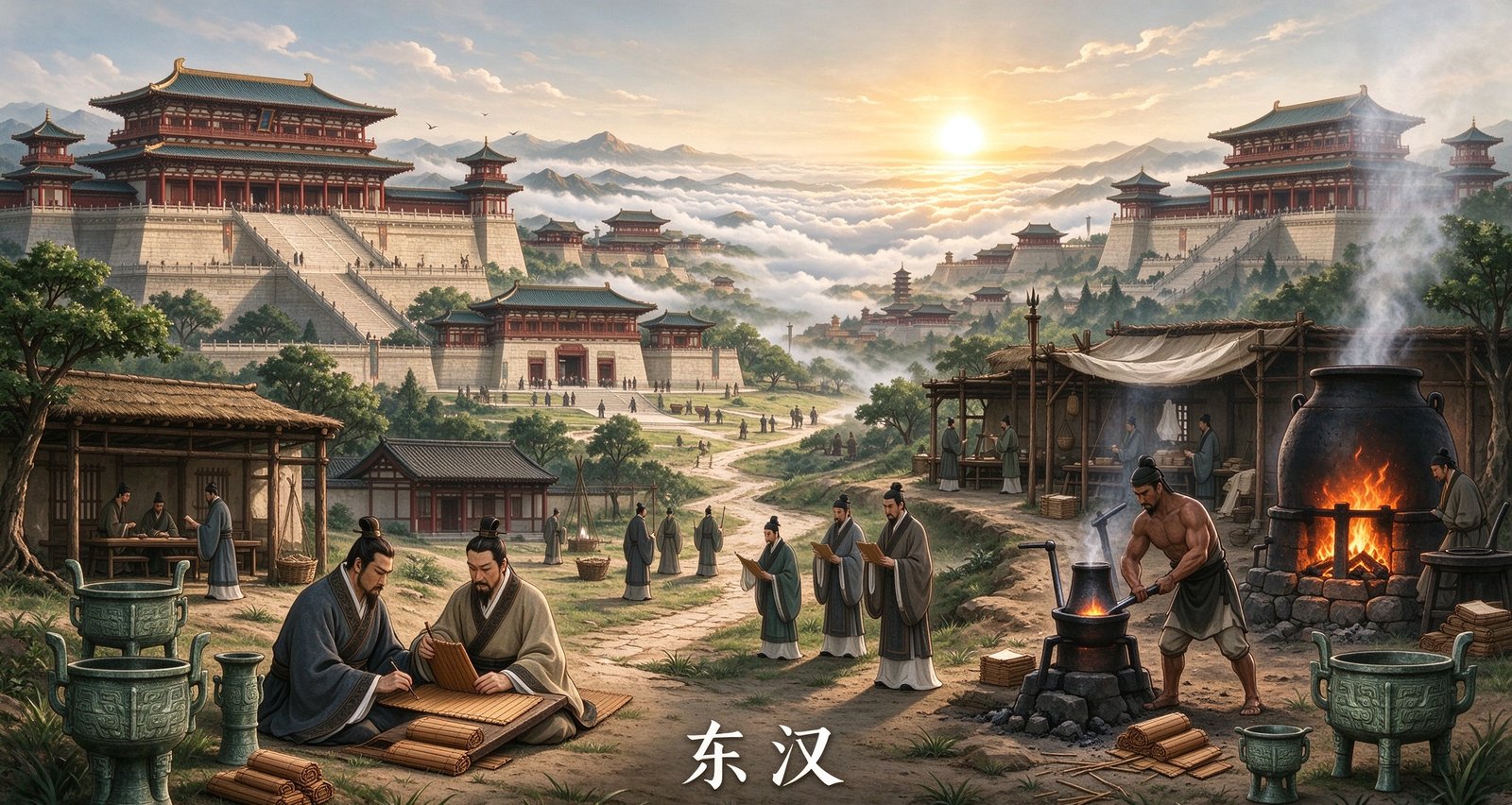
Eastern Han is Western Han's sequel and the formative era of the scholar-official spirit. Liu Xiu, of the Nanyang imperial clan, rose from Chunling and won at Kunyang against overwhelming odds, then swept the contenders aside in little more than a decade — the Guangwu restoration; he killed none of his meritorious officers, and the twenty-eight generals of the Cloud Terrace died honored — a rare template of coexistence between emperor and founders. Eastern Han's character was double: on one side, papermaking matured and spread, Ban Chao managed the Western Regions, Buddhism formally arrived, Zhang Heng built the seismoscope, the *Shuowen Jiezi* was completed, Cai Lun was enfeoffed — science and letters in full flower; on the other, great estates swelled, consort clans and eunuchs alternated in power, the Partisan Prohibitions purged the scholars, and "pure critique" and moral fame became the religion of the scholarly world. At the end the Yellow Turban uprising broke the empire's foundations, provincial governors turned warlords, and the curtain rose on the Three Kingdoms. Eastern Han's two hundred years are a complete record of Huaxia civilization's first attempt at self-repair and self-dismantling within the imperial frame.
Liu Xiu was the best-educated founding emperor in history (a graduate of the Imperial Academy) and the gentlest to his meritorious officers: high rank and generous stipends, honored retirement — he took neither their power nor their lives. "He retired the generals and advanced the civil officials," solving the founder problem with institutions rather than the blade. He freed slaves, audited the land, cut taxes and corvée, built academies — governing by "the gentle way." "A man should serve as commander of the imperial guard; a man should wed Yin Lihua" — the emperor with history's most romantic life plan turned restoration into a low-intensity social repair.
The gentleness had its limits: the land audit touched the great clans' interests, and he compromised — the seeds of Eastern Han's great-family dominance were sown then. The descendants of the twenty-eight generals merged with local magnates into the great aristocratic houses that would define the next four hundred years of politics.
After Wang Mang abandoned the Western Regions, the Xiongnu retook the Silk Road. Ban Chao went out as an acting colonel and with thirty-six men surprised and slew the Xiongnu embassy — whence the proverb "How can you catch tiger cubs without entering the tiger's den?" For thirty-one years thereafter, as Protector of the Western Regions, he kept the Silk Road open with local forces, never troubling the main Han armies, petitioning in old age only, "I dare not hope to reach Jiuquan; I ask only to enter the Jade Gate alive." Ban Chao's diplomacy was the ultimate art of nerve, arms, and interpersonal trust — individual heroism at its brightest in imperial history.
Alongside Ban Chao ran civilization's imports: Buddhism formally entered China under Emperor Ming (the White Horse Temple dates from then), with the *Sutra of Forty-two Chapters* first translated; Emperor Huan already worshipped the Buddha and Laozi within his palace. A religion that would reshape Chinese inner life for two thousand years landed in just this era.
Cai Lun systematized and improved papermaking, using bark, hemp ends, rags, and worn-out nets to make cheap, good paper — "from then on none failed to use it." The cost of transmitting knowledge fell off a cliff: a watershed in world information history (paper's westward journey rewrote Europe's too). Zhang Heng built the seismoscope: when an earthquake struck Longxi a thousand li away, a bronze ball dropped from a dragon's mouth into a toad's — and the event checked out against fact. His *Rhapsody on the Two Capitals* and armillary sphere show science and letters coexisting in one man.
Xu Shen's *Shuowen Jiezi* analyzed more than nine thousand characters and invented lookup by radicals — the founding work of Chinese philology; Wang Chong's *Lunheng*, dedicated to "hating the baseless," opened fire on every superstition — Eastern Han's rational spirit is often veiled by the fog of prophecy-mongering, but its light pierces the fog.
Eastern Han's political dead knot was the palace: regent empresses → consort-clan dominance → emperors using eunuchs to claw back power → eunuchs entrenched → emperor dies, and around again. The scholars made the Imperial Academy their base for "pure critique," judging characters and lancing the eunuchs; Li Ying and Chen Fan led the scholarly world. Under Emperors Huan and Ling, two rounds of Partisan Prohibitions banned hundreds of scholars for life or killed them — the honeymoon of scholar-officials and throne ended, but the scholar's character of "taking the moral judgment of the realm as one's own charge" was fixed from then on.
At the end, disasters natural and man-made converged; Zhang Jue gathered hundreds of thousands under the Way of Great Peace, and the cry "The Azure Sky is dead; the Yellow Sky shall rise" rang through eight provinces. The Yellow Turban main force was crushed, but the military-civil powers granted to provincial governors to fight it bred warlordism — Dong Zhuo entered Luoyang, held the Son of Heaven, and Han existed in name only. Eastern Han did not collapse in a day; it was slowly eaten by regional warlords — a model replayed at the dusk of every later great empire.