Dates
AD 220–280
Strictly, the Three Kingdoms lasted only sixty...
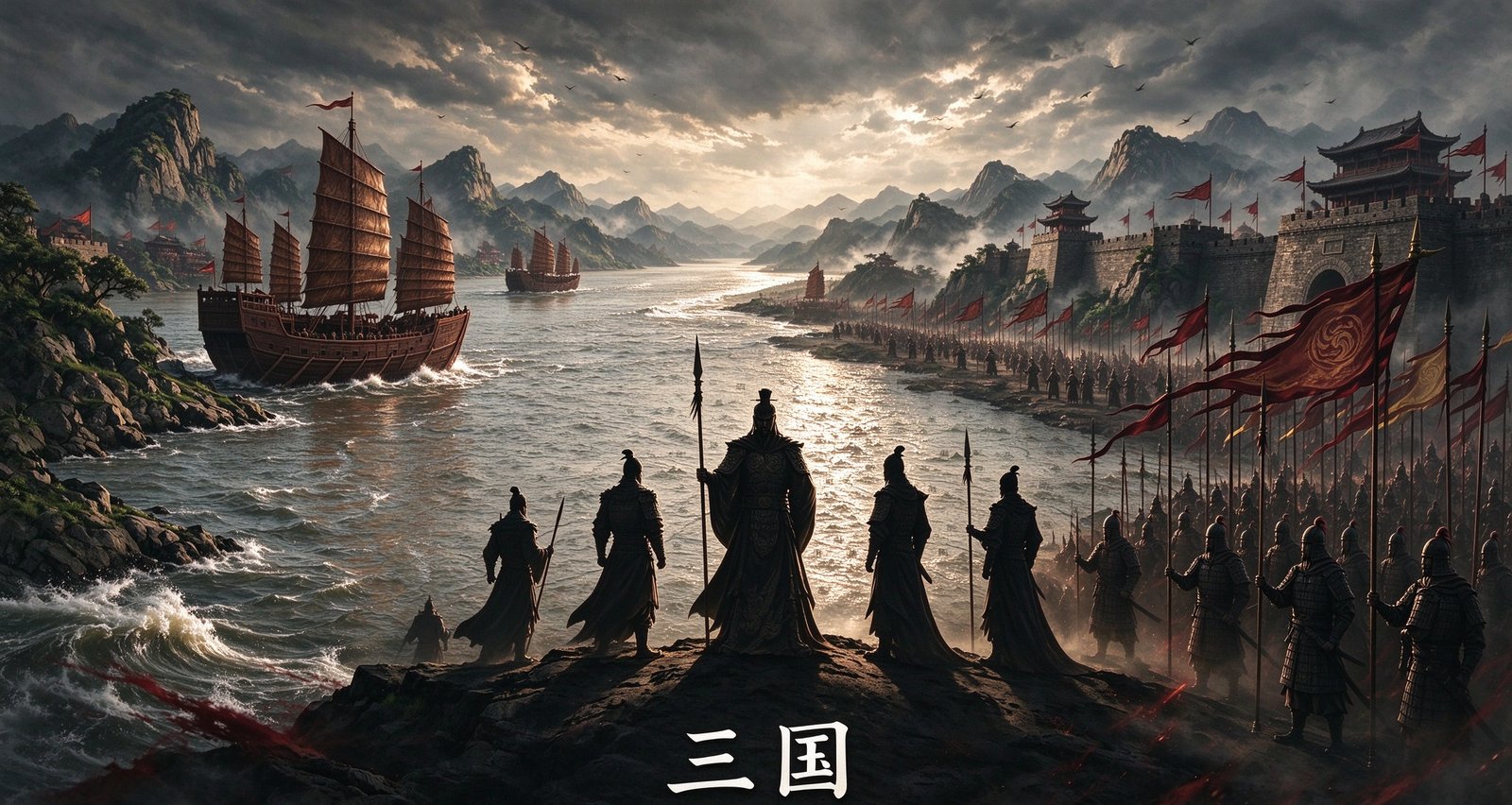
Strictly, the Three Kingdoms lasted only sixty years (220–280), yet it may be the most famous era in Chinese history. Cao Wei held the Central Plains, Sun Wu the Yangtze, Shu Han Yi Province — standing like the legs of a tripod. It was a laboratory of military history: Guandu's few defeating many, Red Cliffs' fire attack, Yiling's burning of the linked camps; and an incubator of institutions: Wei's tuntian colonies revived the northern economy, the Nine-Rank system opened the age of the aristocratic clans, Shu's pacification of the south and Wu's maritime reach each played its strength. Culturally, the Jian'an spirit rang out generous and mournful — "face the wine and sing: how long is life?" is recited still — while the Seven Sages of the Bamboo Grove sought a third path between doctrine and nature. What truly made the Three Kingdoms immortal were the *Romance of the Three Kingdoms* and centuries of opera and storytelling: a history narrated for seven hundred years became the shared heroic universe of the Chinese people — "name the heroes, and men startle." The Three Kingdoms' history lasted one sexagenary cycle; its stories have eternal life.
In AD 200 at Guandu, Cao Cao with twenty thousand beat Yuan Shao's hundred thousand, raiding Wuchao to burn the granaries, and unified the north — a classic victory of strategy over mass, proving that in contested times organization and intelligence are deadlier than numbers. In 208 at Red Cliffs, the Sun–Liu allies with fifty thousand broke Cao Cao's two hundred thousand, Huang Gai's feigned surrender and fire attack — "amid talk and laughter, masts and oars vanished in smoke and ash." The Yangtze became an imperial frontier for the first time, and Chinese history turned formally to tripartition.
After the two battles the north could not be unified again: Cao Pi took the Han throne, Liu Bei declared himself emperor, Sun Quan set his own era — the tripod's political frame was set. Zhuge Liang's five northern campaigns and Jiang Wei's nine invasions were struggles of attacking to defend — Shu's tragedy lay not in military error but in the contradiction between the geopolitical fact of "Yi Province's exhaustion" and the ideological goal of "Han and the usurpers cannot stand together under Heaven."
The true protagonists of the Three Kingdoms were institutions. Wei's tuntian registered refugees as soldier-farmers, and within a decade the Central Plains of "white bones in the fields, no cock crows for a thousand li" had grain enough and soldiers strong — lesson one of wartime economics: whoever re-settles the refugees wins the war. The Nine-Rank system replaced the failed recommendations amid the wars, with "impartial" officials grading talent — meant as a stopgap, it was captured by the great clans: "no poor house in the top ranks, no humble clan in the bottom," and the door of aristocratic politics opened.
Shu Han governed the southwest through a Pacification Directorate, soothing the southern tribes and folding Yunnan into Huaxia's economy; Eastern Wu opened the Jiangnan, sent Wei Wen by sea to Yizhou (Taiwan), and led East Asia in shipbuilding. The Three Kingdoms were not only blades and shadows but a great geographic expansion toward frontier and sea.
Jian'an literature is the coming-of-age of Chinese poetry: the three Caos and the Seven Masters of Jian'an faced chaos squarely — "white bones in the fields, no cock crows for a thousand li" (Cao Cao); "I give my body to the realm's peril, viewing death as going home" (Cao Zhi) — generous, mournful, vigorous. This "Jian'an spirit" became the banner under which later poets lashed honeyed verse; Li Bai and Du Fu claimed its lineage.
In the Wei-Jin transition, political pressure bred an aesthetics of dissent: Ji Kang played the *Guangling San* at his execution, Ruan Ji wept at the road's end, Liu Ling drank without measure — the Seven Sages of the Bamboo Grove opposed the hypocrisy of doctrine with uninhibited living and rebuilt spiritual freedom in metaphysical conversation. "Transcend doctrine and follow nature": the first awakening of the individual Chinese intellectual happened in a bamboo grove.
In 280 Wang Jun's tower-ships came down from Yi Province, Jinling's royal aura dimmed, and the three houses returned to Jin. But the Three Kingdoms' true life began after: Chen Shou's *Records of the Three Kingdoms* wrote history with a "Wei-first" brush, Pei Songzhi's commentary added legions of anecdotes; Tang-Song storytellers remade the characters and Lord Guan began his apotheosis; the Yuan's *Pinghua* fixed the folk version, and Luo Guanzhong's *Romance* — "seven parts fact, three parts fiction" — completed the final shaping: Zhuge Liang's wisdom, Guan Yu's loyalty, Cao Cao's villainous heroism — fixed ever after as archetypes of the national character.
What the stories exported was more than characters — a whole political ethics: the brotherhood of the Peach Garden oath, the minister's loyalty of "bending to the task till death," the warlord's creed of "better I betray the world than it me," the fatalism of "long divided, must unite." Korea, Japan, and Southeast Asia still live within the radiation of the Three Kingdoms narrative — a sixty-year dynasty became East Asia's shared cultural operating system.