Dates
AD 9–23
The Xin dynasty was a fifteen-year interlude b...
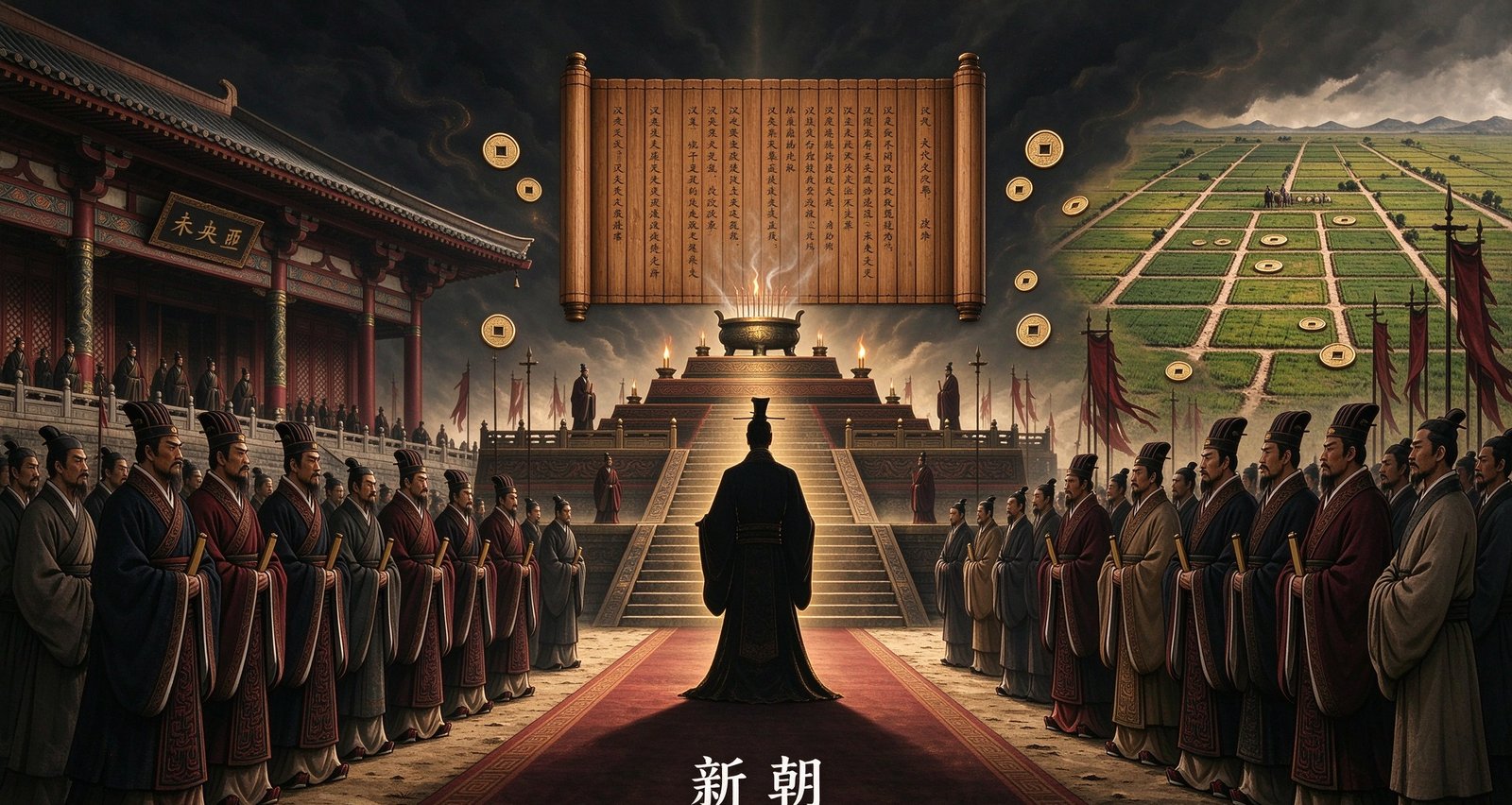
The Xin dynasty was a fifteen-year interlude between the two Hans, yet ancient China's boldest experiment in social restructuring. The consort clansman Wang Mang climbed to the top with a near-perfect reputation: modest, frugal, generous, unflinching toward his own kin — the realm acclaimed him, and he "peacefully" replaced the Liu Han, the classic script of bloodless usurpation. Once enthroned he rebuilt on the blueprint of the *Rites of Zhou*: all land declared "king's fields," sale forbidden; slaves renamed "private dependents," trading banned; the Five Equalizations and Six Monopolies to regulate prices and nationalize key trades; repeated currency reforms — each aimed at late-Western-Han land concentration and inequality, a socialist experiment two thousand years early. But the reforms outran reality, officialdom rotted, the coinage chaos multiplied, the frontiers rebelled, and the Yellow River changed course; the Lülin and Chimei uprisings rolled over everything, and in AD 23 Wang Mang died amid the melee. Ban Gu's memoir branded him "the rebellious minister who usurped Han" for two thousand years — until modern times, when Hu Shih rehabilitated him: "China's first socialist."
Wang Mang's road to power saw not one battle: nephew of the empress Wang Zhengjun, he lived like a poor scholar, his wife dressed as a servant; he personally tasted his dying uncle's medicine, and forced his own son to kill himself for slaying a slave. Four hundred eighty thousand people petitioned for him; fourteen thousand marched on Chang'an to plead his cause — he harvested power with the Confucian "sage's personality." It revealed a classical law: in a Confucian ideological society, reputation itself is the hardest political currency; cultivating a name is cultivating power.
The script of "peaceful transition" was studied ever after: Cao Pi replacing Han, the Simas replacing Wei, Zhao Kuangyin donning the yellow robe — all followed Wang Mang's playbook with better stagecraft. Chinese politics gained an iron law: the usurper must first play the sage — at once an imitation of and an inoculation against Wang Mang.
At the end of Western Han, land concentration meant "the rich own fields stretching field beyond field; the poor lack ground for an awl." Wang Mang's prescription was radical beyond its era: all land renamed "king's fields," sale banned; households of fewer than eight males holding more than one "well" must distribute fields to clan and neighbors; slaves renamed "private dependents," trading banned. The Five Equalizations and Six Monopolies set officials in Chang'an's five great markets to steady prices and extend credit; salt, iron, liquor, coinage, and the mountain-marsh resources became state-run — the state itself descending to manage the economy from the top.
The blueprint is startlingly similar to certain twentieth-century policies, but it was born in the wrong century: no modern administrative technology, no reliable statistics or enforcement — reform depended on corrupt officials and brute force. Within three years land sales resurged under pressure and the reform collapsed. One step ahead makes a prophet; ten steps ahead makes a tragedy.
In little more than a decade Wang Mang reformed the currency four times, issuing exotic denominations — the gold-inlaid knife, the "great spring fifty," five substances, six names, twenty-eight grades of treasure — with forced exchange at unequal rates: each recoinage was a nationwide raid on wealth; merchants and farmers alike were ruined — "agriculture and trade unemployed, food and money alike abolished." Add systemic bureaucratic corruption (the finer the reform, the greater the graft), provocative renamings that provoked wars with the Xiongnu and Goguryeo, and the Yellow River's course change with locusts and drought — man-made and natural disasters resonated, and the world fell into chaos.
Xin's lesson was cited for centuries: the greatest risk of reform is not the wrong direction but the failure of the machinery of execution; pass a good institution through a broken bureaucracy and the output is always disaster. When Wang Anshi's Song reforms were tarred with the "Wang Mang" label, it was the echo of exactly this fear.
Ban Gu's *Book of Han* set the tone with "rebel minister"; Bai Juyi's verse — "Wang Mang, humble and courteous, before he usurped" — warned how hard it is to read men; for two thousand years he was the byword for the hypocrite. But judgment flipped in modern times: Hu Shih called him "a socialist nineteen hundred years ago," and Qian Mu and Lü Simian regarded his reforms with sympathetic understanding — the land-concentration problem he tried to solve was indeed the core pathology of the dynastic cycle.
The fifteen years of Xin left three legacies: a specimen of failed radical reform; the political lesson that gradual beats radical; and a methodological warning that history must be judged apart from success and failure. Its place in history mirrors its reforms — so far ahead of its time that it looks displaced.