Dates
AD 317–420
In 317 Sima Rui ascended at Jiankang (today's ...
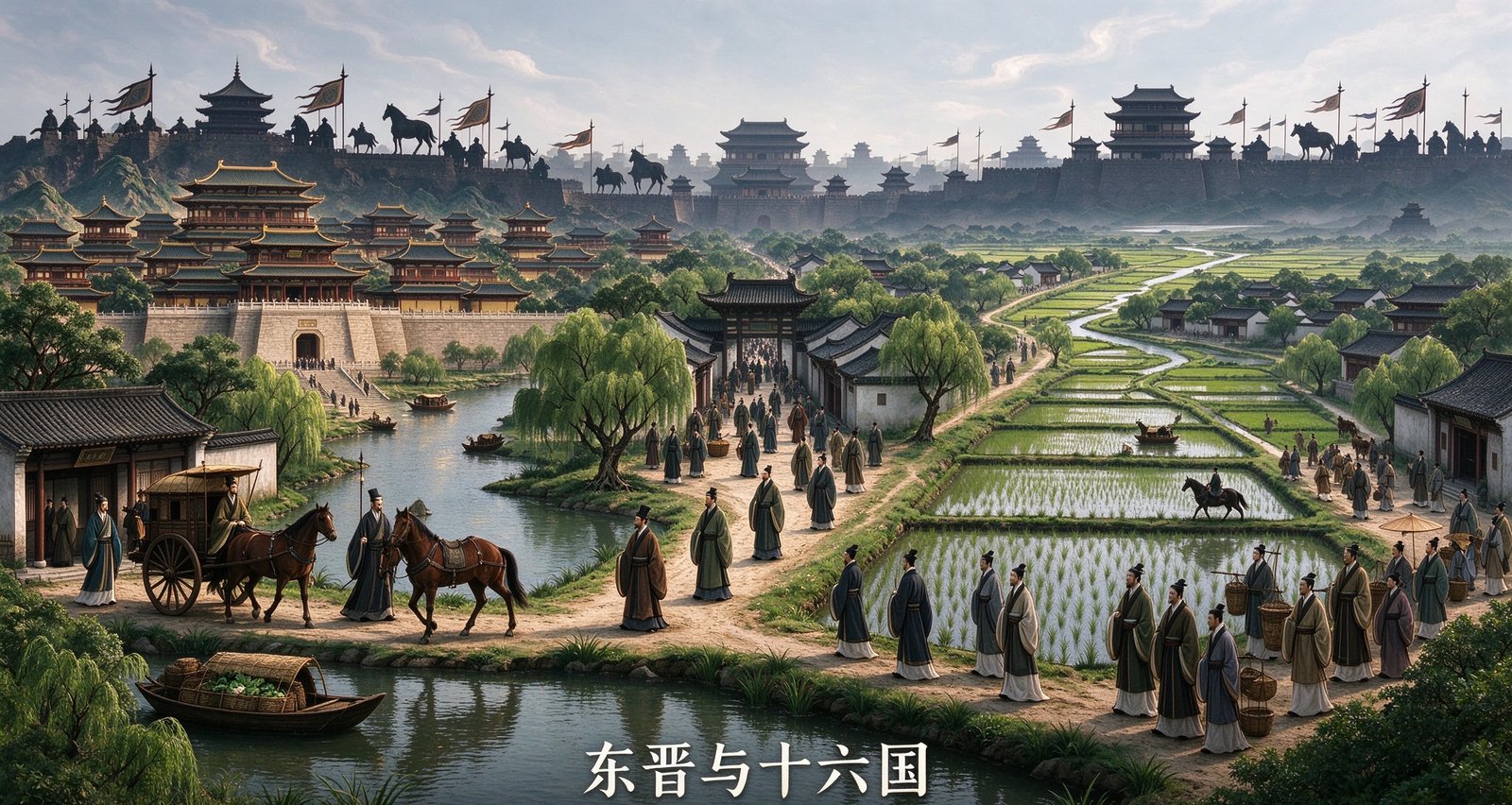
In 317 Sima Rui ascended at Jiankang (today's Nanjing), rebuilding Jin on an alliance of the émigré gentry and Jiangdong's native magnates — the Eastern Jin. It was the age of "the Wangs and the Ma share the realm": Wang Dao governed, Wang Dun held the armies, and afterwards the Yu, Huan, and Xie clans took turns sharing power with the throne — a uniquely weak monarchy beside a supremely strong gentry, without parallel in Chinese history. The north fell into the wars of the Sixteen Kingdoms: the Xiongnu Liu clan's Han-Zhao, the Jie Shi Le's Later Zhao, the Di Fu Jian's Former Qin rising in turn. In 383 at the Fei River, Xie An managed the crisis behind the scenes while Xie Xuan's Beifu army of eighty thousand broke Former Qin's host of "a million" — "the wind sobs and the cranes cry; every bush a soldier" entered the language — and Huaxia's legitimate line survived in Jiangnan. In this reign came the Orchid Pavilion gathering, Tao Yuanming's homecoming, Gu Kaizhi's theory of spirit-resonance — a cultural spring blooming in a political autumn. In 420 Liu Yu replaced Jin and the Southern Dynasties began; the north did not leave the Sixteen Kingdoms until Northern Wei unified it in 439.
Six characters — "the Wangs and the Ma share the realm" — sum up Eastern Jin's political constitution: Sima Rui crossed south weak and friendless and could found the dynasty only thanks to the Langye Wangs — Wang Dao at the center of government, Wang Dun holding the armies upstream. For a century after, the Yingchuan Yu, the Qiao Huan, and the Chen Commandery Xie clans governed in turn, the throne merely the fulcrum of gentry balance. Emperors could be mediocre; the clans had to coordinate — the only experiment in aristocratic politics in Chinese history.
The clans' golden age had its grace: gentry sons mastered zither, chess, calligraphy, painting, metaphysics, and letters — "the realm is governed without going to court." It had its fragility: poor houses and soldiers gathered strength outside the system, and the Beifu soldier Liu Yu ended it all. Aristocratic politics was made by the gentry and unmade by men of arms.
After unifying the north, Former Qin's Fu Jian marched south with a host styled a million — "cast our whips into the river and they would dam it." In Jin's crisis Xie An stayed serene, playing Go over a wagered villa; Xie Xuan and Xie Shi led the Beifu army, attacking fiercely as the Qin array shifted back, while Zhu Xu shouted from the rear, "Qin is broken!" — and a million-strong host collapsed overnight: the wind sobbed, the cranes cried, every bush a soldier.
Feishui ranks with Red Cliffs: it saved Jiangnan's Huaxia legitimacy and prevented an early "reunification" — one that would have been accomplished by a foreign regime. The north splintered again, the south gained precious respite, and "Xie An reclining on East Mountain" became the archetype of the Chinese gentleman's composure.
Eastern Jin's military power hid at Jingkou: Xie Xuan's Beifu army, raised from refugee leaders, made its name at Feishui and became the gravedigger of the clans. When Huan Xuan usurped, the humble-born Liu Yu rose from Jingkou and twice marched north — destroying Southern Yan, breaking Lu Xun, recovering Ba-Shu, taking Guanzhong and destroying Later Qin — "swallowing ten thousand li like a tiger," the greatest feats of arms of the entire Eastern Jin. In 420 this emperor of "iron horses and gleaming spears" accepted abdication and founded Liu Song — the age of the Southern Dynasties began.
Liu Yu's rise marked a switch of political logic: the age of clans discoursing on the Mystery ended; military merit and practical administration became the new hard currency. He pushed the tuduan land-register reform to curb the magnates and the Yixi reforms to clean government — the south's royal revival began with Liu Yu. The gentry's grace remained, but history's steering wheel had changed hands.
Political winter was cultural high summer: in 353 Wang Xizhi and forty-one worthies met at the Orchid Pavilion in Shanyin, Kuaiji, floating winecups down a winding stream, and in one burst wrote the *Preface to the Orchid Pavilion Gathering* — "the finest running script under heaven," born in Eastern Jin's spring breeze. Gu Kaizhi proposed "portraying the spirit"; Xie He then set down the Six Principles — the autonomous aesthetics of Chinese painting established; the calligraphy schools of the Wang and Xie houses made calligraphy for the first time a self-aware art.
Tao Yuanming was the age's deepest voice: "picking chrysanthemums by the eastern hedge, at ease I see South Mountain" — he brewed career's frustrations into pastoral poetry and turned despair at the times into the vision of Peach Blossom Spring — a land "that knew not Han, let alone Wei-Jin," the archetype of the Chinese refuge of the spirit. Eastern Jin proved a cultural proposition: politics may fail; civilization must not.