Dates
AD 266–316
Western Jin was the brief unification after th...
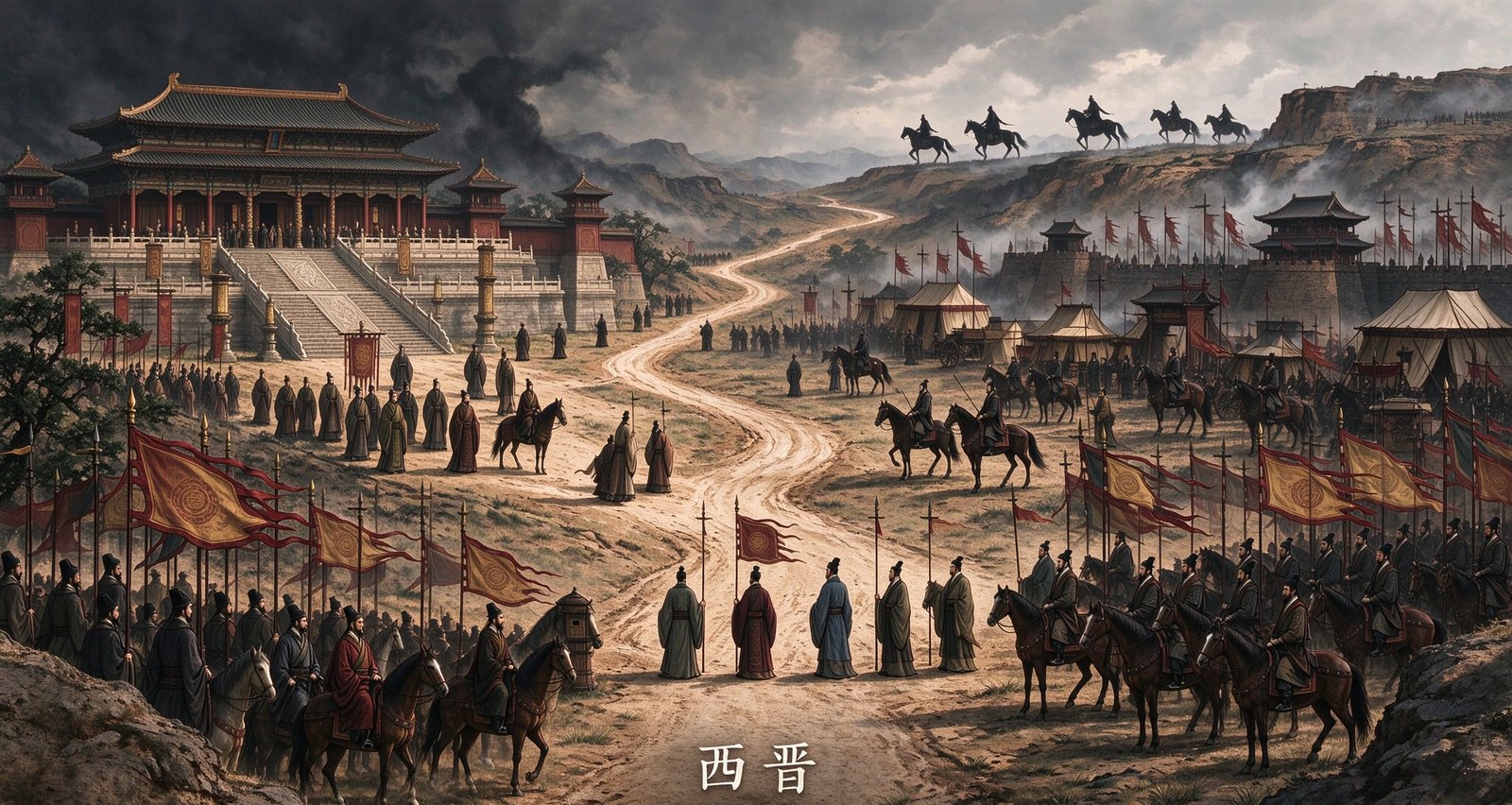
Western Jin was the brief unification after the Three Kingdoms' wars — and a peace that dissolved almost at once. Sima Yan replaced Wei with Jin and destroyed Wu in 280, unifying the realm; in the Taikang years there was a spell of "no affairs in the world, taxes even" — the Taikang order; in letters, Zuo Si's *Rhapsody on the Three Capitals* made paper dear in Luoyang, and Pan Yue and Lu Ji blazed with talent. But under the prosperity the cracks ran deep: princes were enfeoffed to screen the throne and bred civil war; the Nine Ranks fell wholly to the great clans, whose metaphysical talk, five-mineral powder, and wine hollowed out the bureaucracy. After Emperor Wu died, the simple-minded Emperor Hui reigned while Empress Jia wrecked the court; sixteen years of the War of the Eight Princes saw the elite slaughter one another, and the settled Xiongnu, Jie, Xianbei, Di, and Qiang rose in the borderlands. In 311 came the Disaster of Yongjia: Luoyang fell and Emperor Huai was captured; in 316 Chang'an was lost and Western Jin ended. The courtly world crossed south, the Central Plains shook — China entered nearly three hundred years of north–south division, and this very fusion was quietly preparing the soil of the Sui-Tang rebirth.
The Sima clan worked three generations: Sima Yi seized power at the Gaoping tombs; Sima Shi and Sima Zhao held it in turn — "Sima Zhao's intent is known to every passerby" — until in 265 Sima Yan received abdication and took the throne. Abdication thereby completed its fall from "ideal of sage kings" to "script of usurpation." In 280 Wang Jun's tower-ships came down from Yi Province and the Wu ruler Sun Hao bound his hands behind him, bearing his own coffin; unity after sixty-odd years of division came easily — Wu and Shu were already spent.
In the Taikang years the field-allotment system was tried and the registers cleaned — "oxen and horses covered the wilds, surplus grain lay on the threshing floors" — the very air of a well-ordered age. But the prosperity stood on the fragile base of aristocratic monopoly and princes commanding troops: the force of unity came from the great clans' support, and the sparks of division from their arrogance.
Emperor Wu judged that Cao Wei fell because its princes had no power, so he enfeoffed his kinsmen lavishly and let them keep armies — answering one historical lesson with another, and brewing deeper disaster. He died in 290; Emperor Hui was simple-minded ("Why not eat meat porridge?"); Empress Jia meddled and killed the regents, triggering a chain war of princes — the Princes of Runan, Chu, Zhao, Qi, Changsha, Chengdu, Hejian, and Donghai — sixteen years of war, Luoyang changing hands again and again, hundreds of thousands of elite troops slaughtering one another.
The war's greatest consequence was gutting the frontier defenses and the standing army: the princes borrowed barbarian troops as allies (the Prince of Chengdu borrowing the Xiongnu Liu Yuan — opening the gate to the wolf), and the settled armed communities of Xiongnu, Jie, Di, Qiang, and Xianbei grew mighty — half the script of the "Uprising of the Five Hu" was written by the Han themselves.
The Western Jin gentry's style clashed grotesquely with the times: they flourished whisk-tails, discoursed on Laozi and Zhuangzi, took the five-mineral powder, ranked one another's brilliance — "in office, no concern of office; in affairs, no heart for affairs." Wang Yan held the chancellorship while chanting metaphysics; Shi Chong and Wang Kai competed in wealth, burning candles in place of firewood — elite small talk and extravagance rising together as the bureaucracy rusted in aesthetics. Pure conversation per se did not doom the state, but once it became the ruling class's whole way of being, it became the crisis's microscope.
The aristocratic system fully matured in Western Jin: the Nine Ranks guaranteed "dukes beget dukes, ministers beget ministers," gentry and commoner separated as by heaven. The design traded mobility for stability — and when crisis came it proved that a self-enclosed elite lacks the capacity to defend its own privileges.
In 304 the Xiongnu Liu Yuan rose at Zuoguo City and styled himself Prince of Han — the first time a Hu power claimed a Chinese dynastic name within the Central Plains. In 311 Liu Yao and Shi Le took Luoyang, killing over thirty thousand nobles, officials, and citizens and capturing Emperor Huai — the Disaster of Yongjia; in 316 Chang'an fell, Emperor Min surrendered, and Western Jin ended. The gentry and people of the Central Plains crossed south en masse — "six or seven of every ten of the Central Plains gentry sheltered in Jiangzuo" — the first great southward shift of Huaxia civilization's center of gravity.
The crossing was a hinge of Chinese history: Jiangnan, hitherto a fringe of slash-and-burn agriculture, entered deep development, laying foundations for the splendor of the Six Dynasties and the Tang-Song shift of the economic center south. The northern gentry who stayed coexisted with the Hu regimes, opening nearly three centuries of Hu–Han fusion — in this very calamity the bloodline of the Sui-Tang empires was quietly conceived.