Dates
AD 420–589
The Southern and Northern Dynasties (420–589) ...
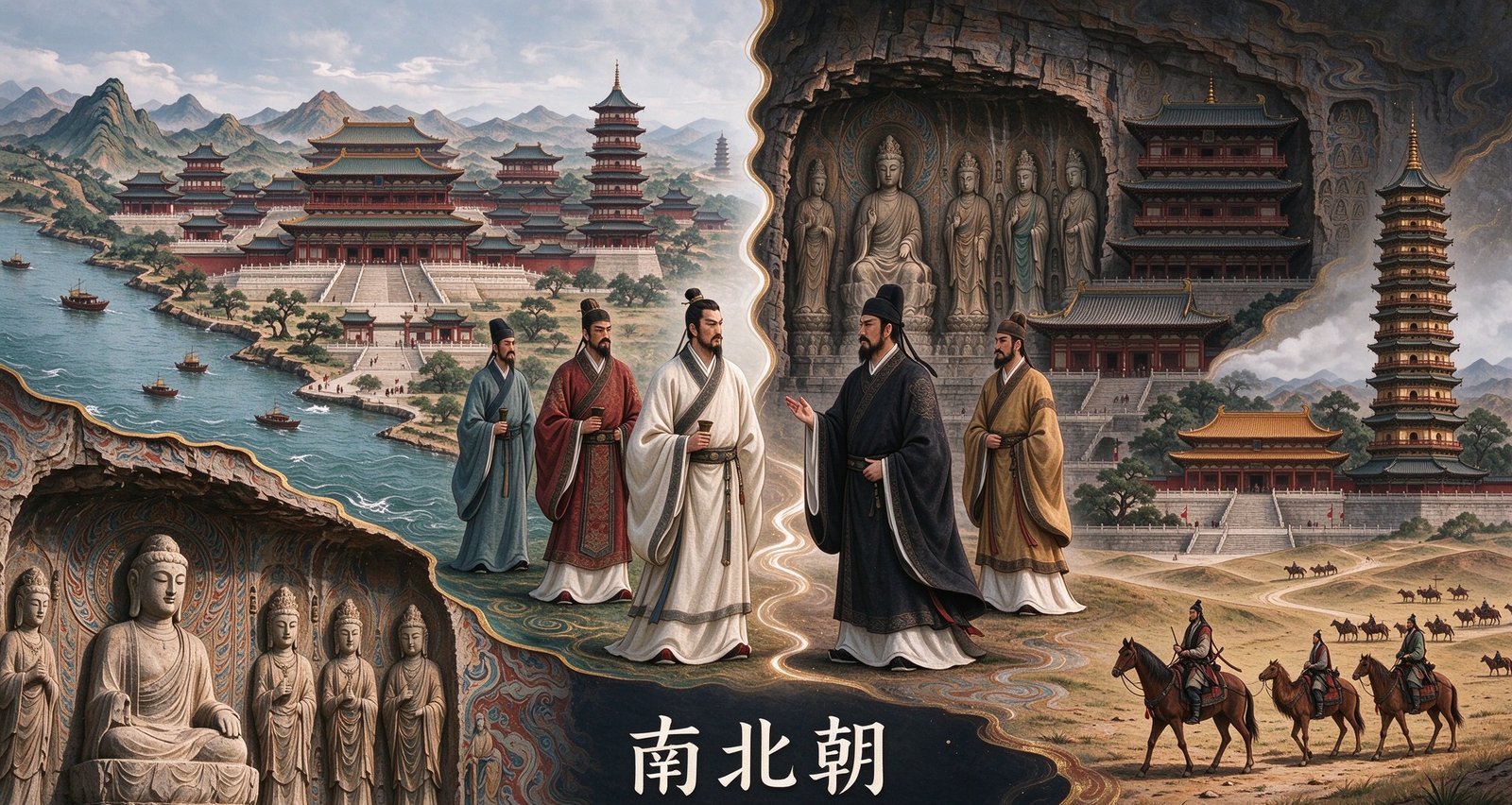
The Southern and Northern Dynasties (420–589) were Chinese history's longest division and its deepest crucible of ethnic and cultural fusion. In the south, Song, Qi, Liang, and Chen succeeded one another as Jiangnan's economy opened and gentry culture peaked: Xie He's Six Principles, the *Wenxin Diaolong*, the *Shipin*, landscape poetry, the Yongming meter — the golden age of literature's and art's self-awareness; Emperor Wu of Liang four times "donated himself" to the Tongtai Temple, and Buddhism reached fanatic heights in the south — "four hundred eighty temples of the Southern Dynasties, how many towers in the misty rain." The north was unified by Northern Wei; Emperor Xiaowen moved the capital to Luoyang, adopted Chinese surnames and dress, intermarried with the Chinese gentry — fusion pushed by main force; the Yungang and Longmen grottoes were carved here, and after the revolt of the Six Garrisons the north split in two, then into Northern Qi and Northern Zhou. At last the Guanlong group bred Sui and Tang: Yang Jian replaced Zhou and destroyed Chen, and a unification like 280's came again. A surface of turmoil over deep gestation: without the fusion of the Southern and Northern Dynasties there would have been no grandeur of Sui-Tang.
The Southern Dynasties were the age of literature's self-awareness: Liu Xie's *Wenxin Diaolong* systematized criticism in fifty chapters; Zhong Rong's *Shipin* graded the poets; Xiao Tong's *Wenxuan* anthology endured; Xie Lingyun founded landscape poetry, Bao Zhao recharged the yuefu with defiance, and the Yongming meter's "four tones and eight faults" directly gestated Tang prosody. In painting Xie He set the Six Principles; in calligraphy Wang Sengqian discoursed on the brush — art acquired, for the first time, its own theory and historical consciousness.
Jiangnan opened in depth at the same time: lakes were diked into paddies, irrigation prized, and Jiankang became a world city of a million souls with sea trade reaching Southeast Asia. The Hou Jing Rebellion (548–552) destroyed the gentry and Jiankang together — "a thousand li without smoke, human traces rare" — the southern clans lost their spine thereafter, and the Chen could lean only on low-born soldiers and generals.
In 471 the five-year-old Xianbei emperor Tuoba Hong ascended; once he ruled in person he achieved a top-down transformation of civilization rare in the ancient world: in 493, on the pretext of a southern campaign, he moved the capital to Luoyang, ordered the Xianbei nobles to take Chinese surnames (Tuoba became Yuan), wear Chinese dress, speak Chinese, and intermarry with the Chinese gentry — "cut off the northern tongues; follow the correct speech alone." Customs, language, dress, names — a people's identity system was deliberately swapped, for one aim: to turn conquerors into civilization's heirs and integrators.
The reform outlived the dynasty: a Hu-Han merged gentry society; the equal-field and three-elders systems (inherited by Sui-Tang); and the Guanlong group fusing Xianbei vigor with the Han literary line — Yang Jian and Li Yuan both rose from it. The revolt of the Six Garrisons toppled the sinicized dynasty at Luoyang, but the direction of fusion was irreversible — the contest of Northern Qi and Northern Zhou was in essence a race between two speeds of sinicization.
The Northern Dynasties were Buddhism's golden age: the Five Caves of Tanyao carved buddhas with the faces of five emperors — the church-state aesthetic of "the emperor is the Tathagata" frozen on the Wuzhou cliffs; after the move to Luoyang, the Longmen grottoes took up the work along the banks of the Yi River, the Binyang caves and lotus capitals passing from heroic mass to slender elegance — the complete arc of Buddhism's sinicization in art.
The south glowed with Buddha-light too: Emperor Wu of Liang annotated the *Nirvana Sutra* and four times donated himself to the Tongtai Temple — "five hundred monasteries in the capital, magnificent beyond measure." Fan Zhen's treatise *On the Annihilation of the Spirit* met them head-on — "while the body endures the spirit endures; when the body decays the spirit dies" — and Buddhism's century of debate with native thought closed at last in the Chinese flower that is Chan.
In 534 Northern Wei split into Eastern and Western Wei under Gao Huan and Yuwen Tai; Northern Qi and Northern Zhou succeeded them, and in 577 Emperor Wu of Zhou destroyed Qi and unified the north. In 581 Yang Jian accepted abdication and founded Sui; in 589 he crossed the river and destroyed Chen — a "domesticated" Hu-Han regime reunified the realm after nearly three hundred years — the Yangtze was no longer a border but an imperial river.
The true legacy of the Northern and Southern Dynasties is a "fusion inventory": Hu horsemanship poured into Huaxia (trousers, stirrups, the fubing militia); Indian Buddhism sinicized (Chan, the grottoes); Jiangnan transformed from margin to granary; gentry culture settling into the soil of Tang poetry. Chaos ends not in ruins but in a greater hall — the greatest lesson the Southern and Northern Dynasties left Chinese history.