Inventor
Bi Sheng, a commoner of the Northern Song
Movable type was the next leap after woodblock...
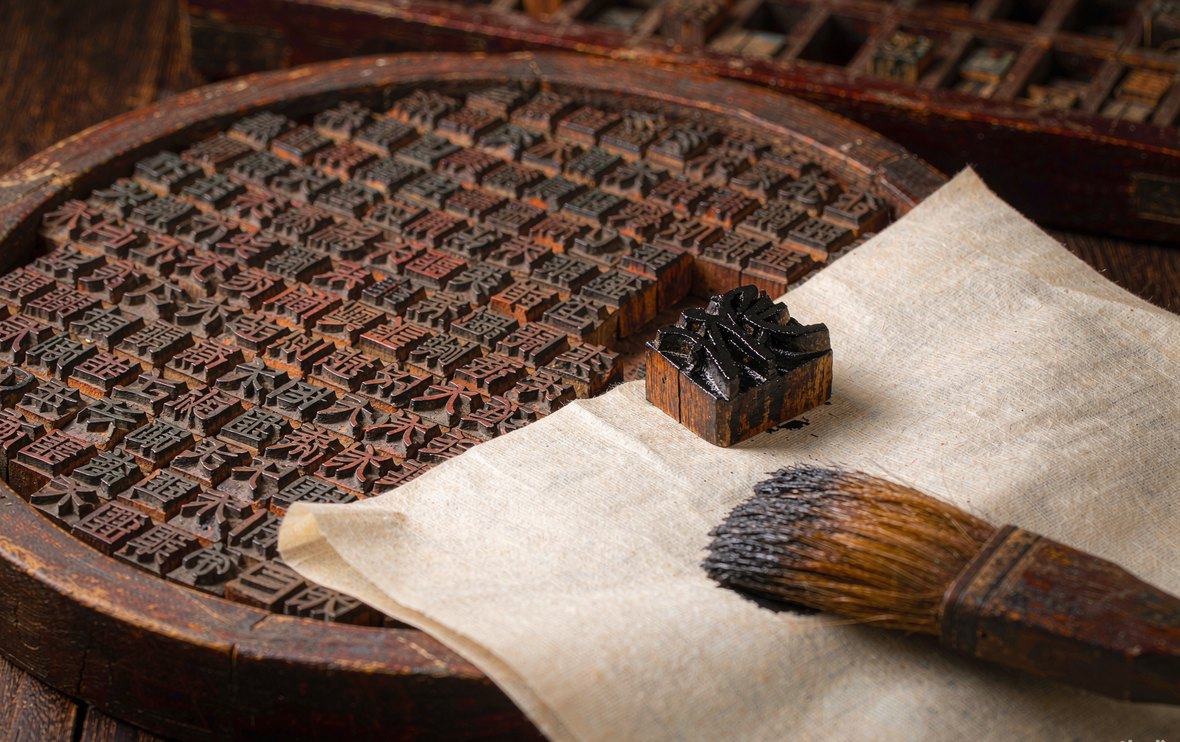
Movable type was the next leap after woodblock printing. In the Qingli era of the Northern Song, 1041 to 1048, the commoner Bi Sheng invented clay movable type: each character cut in clay, hardened by fire, set, printed and redistributed, a method Shen Kuo records in detail in the *Dream Pool Essays* — for printing hundreds or thousands of copies, it is extraordinarily fast. Wang Zhen of the Yuan then made wooden type and invented the revolving typecase, metal type spread in the Ming, and the Qing *Complete Collection of Illustrations and Writings* was printed in copper type. In the 1450s Gutenberg's lead alloy type and press set off the European printing revolution. It should be said that in China movable type long ran alongside a mature woodblock tradition and never became absolutely dominant, since Chinese has so many characters and woodblocks were economically strong. Yet its conceptual value is beyond measure: it proved for the first time that writing could be broken into the smallest recombinable units, the intellectual ancestor of modern typesetting, typewriting and character encoding. Bi Sheng's name stands at the beginning of the history of human information.
The *Dream Pool Essays*, in the chapter on skills, records: in the Qingli era there was a commoner, Bi Sheng, who made movable type. His method was to cut characters in clay, thin as the rim of a coin, one piece to a character, and harden them by fire. Two formes were kept, one printing while the other was set, used alternately so that the work goes in a breath; common characters were kept in several copies, pasted with paper labels and stored in wooden cases. The sequence is almost identical to Gutenberg's workshop six hundred years later.
Bi Sheng was a commoner: the invention came from a working artisan, not from an office. This is a reminder of the thickness of Song technological society, in which the accumulated knowledge of ordinary craftsmen could produce world-class innovation. Sadly almost nothing is known of his life; a man who changed the world survives in a few lines of Shen Kuo.
In the history of Chinese printing, woodblock printing, matured in the Tang and at its height in the Song, remained dominant. One set of blocks could print ten thousand copies and be used again, and the block page suited the aesthetics of Chinese layout. Movable type was strong for new books and new settings, weak in the sheer size of a Chinese font — thousands of common characters, an enormous investment — and in the labour of composition. The two technologies coexisted for centuries, each in the books it served best.
This economics explains the divergence of East and West. The European alphabet has some twenty letters, so type is bought once and reused forever, and the Gutenberg model struck home at a blow; under a Chinese character system, woodblocks had the lower marginal cost. Victory in technology never depends on the invention alone but on its fit with a writing system, the deepest lesson in the history of technology.
Materials kept changing. Wang Zhen of the Yuan made more than thirty thousand wooden characters and invented a revolving typecase that brought the type to the compositor, raising output, and wrote *Methods of Making Movable Type*, one of the world's earliest technical accounts of the craft. Copper type appeared in the Ming Hongzhi reign, and the Qing *Complete Collection* of the Yongzheng reign was printed in copper, one of the largest metal-type projects anywhere.
The spread of movable type within East Asia was equally deep: Korea printed the *Jikji* in metal type in 1377, the earliest surviving metal-type book in the world; Japanese wooden-type books flourished in the Momoyama period. Movable type is a shared East Asian invention, and the European printing revolution is the alphabetic version of the same idea.
The deepest contribution of movable type is conceptual: it broke the text into reusable, recombinable minimum units, the elementary logic of modern information processing. From movable type to the typewriter, to phototypesetting, to character encoding, the architecture of character, composition and reproduction is one line. Bi Sheng accomplished a digitisation of writing in the eleventh century.
The social history is equally large: books moved from the luxury of the scriptorium to a mass commodity, knowledge flowed vertically, and popular literature and scholarly communities rose on print. Printing has been called the great invention that announced the coming of modern society. From the clay of Bi Sheng to the lead of Gutenberg, humanity took four hundred years to build the infrastructure of universal knowledge.