Innovator
Cai Lun, Eastern Han, d. 121
Papermaking is one of China's Four Great Inven...
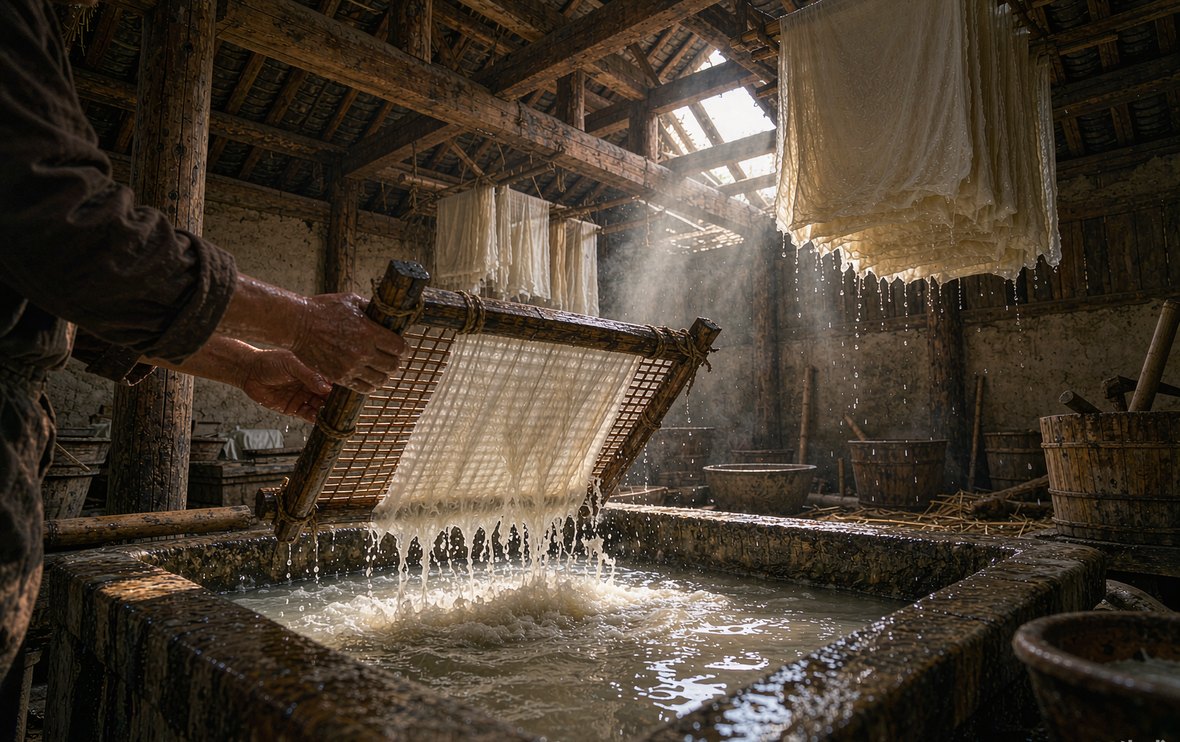
Papermaking is one of China's Four Great Inventions and the most important cost revolution in the history of human information. Hemp paper of the Western Han survives in the archaeological record, at Fangmatan and Xuanquanzhi in Gansu, and in AD 105 Cai Lun systematically improved the process, using tree bark, hemp ends, rags and worn fishing nets to make paper both cheap and fine: thereafter all used it, and all honoured Marquis Cai's paper. The technique then spread along a route of learning, trade and travel. In the Tang it reached Samarkand with captured Tang soldiers after the Battle of Talas in 751, then Baghdad, Cairo and Spain, and Europe in the twelfth century — the Renaissance and the Reformation rested materially on cheap paper. Paper and printing together released knowledge from the hands of nobles and monks. Cai Lun was made a marquis because he truly changed the world.
Before paper, Chinese writing depended on bamboo slips and silk. Bamboo was bulky — five cartloads of learning describes the cost of transport — while silk was light and soft but dear, a bolt costing several bushels of grain. The cost of the medium determines the distribution of knowledge: to write a book required wealth and labour, and knowledge was naturally monopolised by courts and great families. Hemp paper appears in the Western Han, but coarse and not yet dominant. The problem was never whether paper existed, but whether it could be cheap and good.
Cai Lun's breakthrough was systemic: cheap raw materials, since bark, hemp, rags and nets were all waste; standardised steps of soaking, pounding, lifting and drying; and consistent quality at scale. Marquis Cai paper was cheap, light and took ink well. Presented to the throne in 105 and promoted throughout the empire, it was a successful state programme of technology diffusion.
The physics of traditional papermaking is plain and elegant. Plant fibres are boiled and cleaned, pounded into pulp, suspended in water and lifted on a bamboo screen, where the fibres interlace at random; drained and dried, they become a sheet. Random interlacing gives even strength, exactly the principle of modern papermaking: two thousand years have changed only the equipment.
The family of Chinese handmade papers grew with the centuries: xuan paper of blue sandalwood bark and sandy-field rice straw, through more than a hundred steps and famous for lasting a thousand years; bamboo paper, the bulk product after the Song; bark paper and hemp paper. Xuan paper separates ink into layers and does not embrittle, becoming itself a medium of painting and calligraphy. Paper is not only a container of information; it shaped the aesthetics of the Chinese brush — without xuan paper there would be no bloom of wet ink.
The landmark of the westward journey is the Battle of Talas in 751, when Tang and Abbasid armies met in Central Asia and captured Tang craftsmen carried papermaking to Samarkand. Baghdad, Damascus, Cairo, Morocco and Spain followed. The first paper mill in Europe appears at Fabriano in 1276, and the explosion of Gutenberg's press in the 1450s stood on the ground of cheap paper.
The chain demonstrates the dynamics of technological spread: a war, a few craftsmen, a trade route, and civilisation completes a relay by accident. Samarkand paper was known across Central Asia for centuries as Eastern paper, and Talas has been called the post station of papermaking on its way west.
Paper cut the cost of record by two orders of magnitude, and the production and spread of knowledge changed gear: the examination documents of China, the translation movement of the Arabs, the university and the press of Europe. Wherever paper arrived, the literate class grew by an order of magnitude. The manuscripts of the Renaissance, the pamphlets of the Reformation and the papers of the scientific revolution all stood on paper shoulders.
Paper was also a tool of administrative revolution: household registers, archives, edicts and ledgers moved imperial governance from word of mouth to documentary administration. A single sheet changed personal memory, imperial government and the transmission of civilisation at once. Among the Four Great Inventions, none reaches deeper into daily life or wider across the world.