Date
Late Shang, from c. 1300 BC
Oracle bone script is the writing of the Shang...
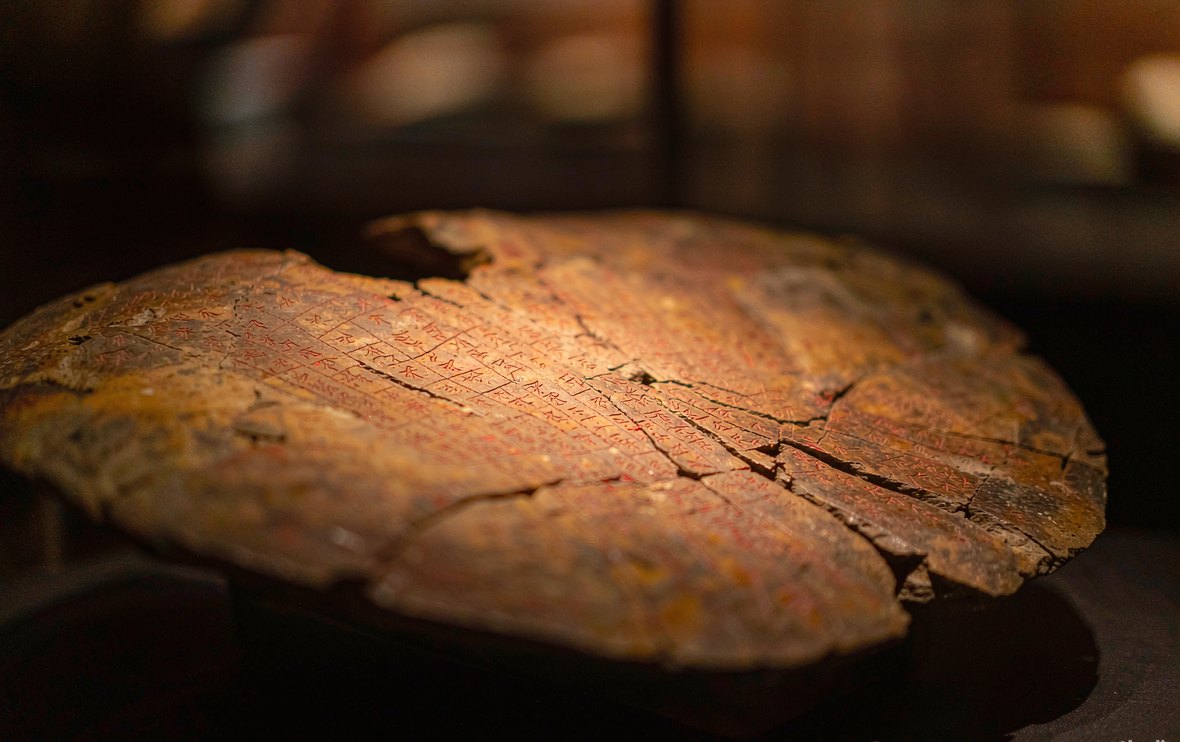
Oracle bone script is the writing of the Shang dynasty, incised on turtle plastrons and animal bones and used mainly for royal divination and record. At 3,300 years old it is the earliest mature form of Chinese writing. Wang Yirong's chance recognition in 1899 brought this lost discipline to birth out of the “dragon bones” of a medicine shop; some 150,000 inscribed pieces have since come from Yinxu at Anyang, bearing about 4,500 distinct characters, of which roughly a third have been deciphered. The script commands the full range of formation principles — pictographic, indicative, compound-ideographic and phonetic-semantic — with phonetic-semantic compounds making up more than eighty per cent: a mature system, not primitive scratching. Its significance is threefold. It made the Shang a documented dynasty; it pushed the history of Chinese writing more than a thousand years before the *Shuowen Jiezi*; and it is itself an encyclopaedia of the Shang, holding politics, war, astronomy, medicine and childbirth. In 2017 oracle bone script entered UNESCO's Memory of the World register.
The discovery has the shape of legend. In 1899 Wang Yirong, chancellor of the Imperial College, recognised ancient characters cut into “dragon bones” sold as medicine: one bone, and the world was astonished. Until then the bones had been ground to powder and swallowed, and countless characters had gone into the stomachs of patients. Afterwards Liu E published the first reproduction, Sun Yirang the first study, Luo Zhenyu identified Anyang as the source, and Wang Guowei used the inscriptions to verify the Shang royal genealogy in the *Records of the Grand Historian*. The four halls of oracle studies — Luo, Wang, Dong Zuobin and Guo Moruo — founded the discipline.
A discipline was born in twenty years. From a pharmacy counter to an international field, the discovery of the oracle bones is itself a miniature of China's passage into modern scholarship, where the old epigraphy handed over to scientific archaeology.
The formation principles are all present: pictographs for sun and moon, indicative marks for above and below, the compound for rest, a man beside a tree, and phonetic-semantic characters in river and sacrifice. More than eighty per cent are phonetic-semantic, close to the proportions of modern Chinese. The strokes are lean and sharp, squared by the knife, and a single character often has dozens of variants: the script was still growing.
This writing runs unbroken into the characters of today: a primary school child can still recognise the oracle forms of person, mouth, mountain and water. Most ancient scripts of the world have died — cuneiform, hieroglyph, Linear A — and only Chinese has crossed three thousand years without a break. Oracle bone script is the clear beginning of that continuous line.
A complete inscription has four parts: the preface, when and by whom; the charge, what was asked; the omen, the reading of the scorched cracks; and the verification, what came of it. The subjects cover campaigns, hunting, weather, harvest, sacrifice, illness and childbirth. The king divined daily and on every matter; divination was the decision process, and the bones were the state archive. The diviners, masters of writing and of divine intent, were China's first knowledge bureaucrats.
The culture of divination reflects a distinctive Shang religious sense: between the ancestral spirits and the king lay a relationship that could be addressed, plied with offerings and questioned — a practical contract between human and divine. The Zhou turn towards human culture, keeping the spirits at a respectful distance, was a reform built on this inheritance.
Decipherment has been a marathon. Luo Zhenyu and Wang Guowei laid the foundations, Dong Zuobin's *Yin Calendar* established periods and dates, and Yu Xingwu, Qiu Xigui and others carried the work forward. Of some 4,500 characters about a third are read; the rest are clan names and proper nouns, hard bone. The Chinese Museum of Writing once offered a bounty for undeciphered characters, and few have ever claimed it.
In recent years artificial intelligence has begun to join the work of rejoining fragments — piecing tens of thousands of shards back together — and of comparing glyph forms, and technology is shortening the marathon. The history of decipherment suggests that reading the writing of one's ancestors is a civilisational promise renewed in every generation: each character recovered is a handshake with three thousand years ago.