Date
c. 3300–2300 BC
Liangzhu (c. 3300–2300 BC) lies at Yuhang in H...
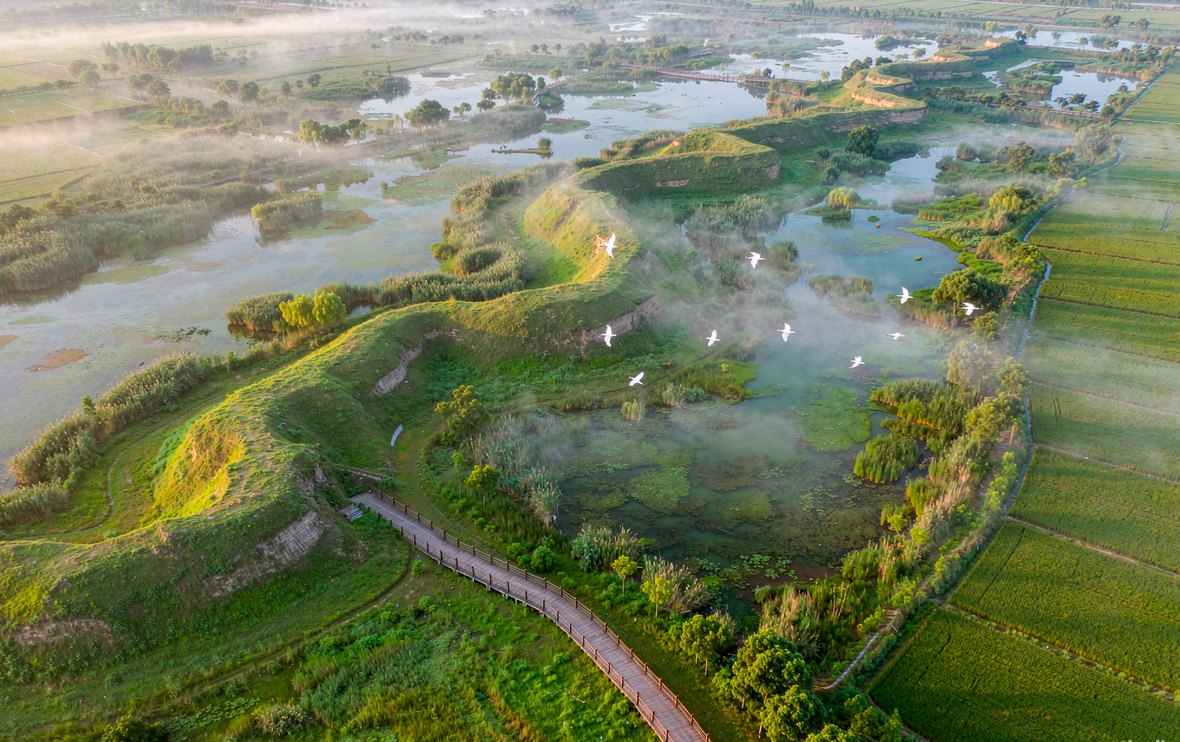
Liangzhu (c. 3300–2300 BC) lies at Yuhang in Hangzhou, Zhejiang, and is the site that gave five thousand years of Chinese civilisation its material proof. It has an inner city of some three million square metres, an outer suburb of eight square kilometres, and one of the earliest large hydraulic systems in the world — eleven dams controlling a catchment of more than a hundred square kilometres. The Mojiaoshan palace terrace rises high above the plain, and the “King of Cong”, a jade tube of 6.5 kilograms unearthed from the Fanshan royal cemetery and carved with a god-and-beast mask in micro-relief, still leaves modern craftsmen astonished. In 2019 the site entered the UNESCO World Heritage List, and international scholarship now accepts that an early state had already taken shape here: the five-thousand-year history of Chinese civilisation at last has a proven coordinate.
The outer hydraulic system is made of eleven dams in two tiers, high and low, forming a large reservoir that controlled floods, irrigated fields and moved goods, and governed a catchment of more than a hundred square kilometres — a thousand years before the legendary Yu tamed the waters, and among the earliest large-scale hydraulic works known anywhere. The dams were raised from grass-wrapped mud: each clod was bundled in reed grass, the oldest known form of the geotextile bag.
What the system reveals is organisational genius. Millions of cubic metres of earthwork demanded thousands of labourers working together over years, which means authority, division of labour, scheduling and logistics already existed. A state is, at bottom, an organisation; Liangzhu wrote the full definition of an early state in its dams.
Thousands of cong tubes, bi discs and yue axes came from the elite cemeteries at Fanshan and Yaoshan. The cong is square without and round within, its four faces carved with a god-and-beast motif — a deity in a feathered crown riding a beast — in lines finer than a hair, four or five incised strokes inside a single millimetre. The same iconography appears with astonishing consistency on every jade, which means a shared faith had formed across many settlements: the cong was a ritual vessel linking heaven and earth, and the Chinese tradition of “serving the spirits with jade” begins here.
The jade yue stood for military and royal command, the bi for wealth and its sacred charge. Cong, bi and yue together form a complete order of divine right, kingly right and wealth, a materialised ideology achieved a thousand years before writing. Liangzhu jades have therefore been called a declaration of civilisation carved in stone.
The walled city is a rounded rectangle, with the palace zone of Mojiaoshan at its centre on a gigantic artificial platform; the royal cemetery at Fanshan, the altar at Yaoshan, graves and villages fall into clear ranks, and waterways lead out from the gates. The population within and beyond the walls is estimated in the tens of thousands, and settlements form a pyramid — hundreds of jades in an elite tomb, a few pots in a commoner's. Social stratification is legible at a glance, and that is precisely what separates a state from a tribe.
At the 2019 World Heritage session, ICOMOS judged that Liangzhu bears witness to “a city civilisation of the late Neolithic in China, economically based on rice cultivation”. The proof of five thousand years of civilisation entered, at last, humanity's common list of heritage.
Around 4300 years ago the culture declined abruptly, probably under the pressure of floods, marine transgression and ecological strain: a flourishing society stopped short, its script never maturing. Yet the ritual jade tradition did not vanish. The forms of cong and bi passed into the Yellow River valley and became the direct ancestors of Shang and Zhou ritual jades, and the grammar of civilisation that “the great affairs of the state are sacrifice and war” had already been rehearsed at Liangzhu.
Its significance reaches far beyond archaeology. It shows that among the myriad stars of Chinese origins the lower Yangzi was one of the brightest; it pushes the proven horizon of Chinese civilisation from three thousand years, at Yinxu, back to five; and it reminds us that Chinese civilisation was plural from the first. Read Liangzhu, and you read the beginning of “plurality in unity”.