Dates
AD 1636–1912
The Qing was China's last imperial dynasty and...
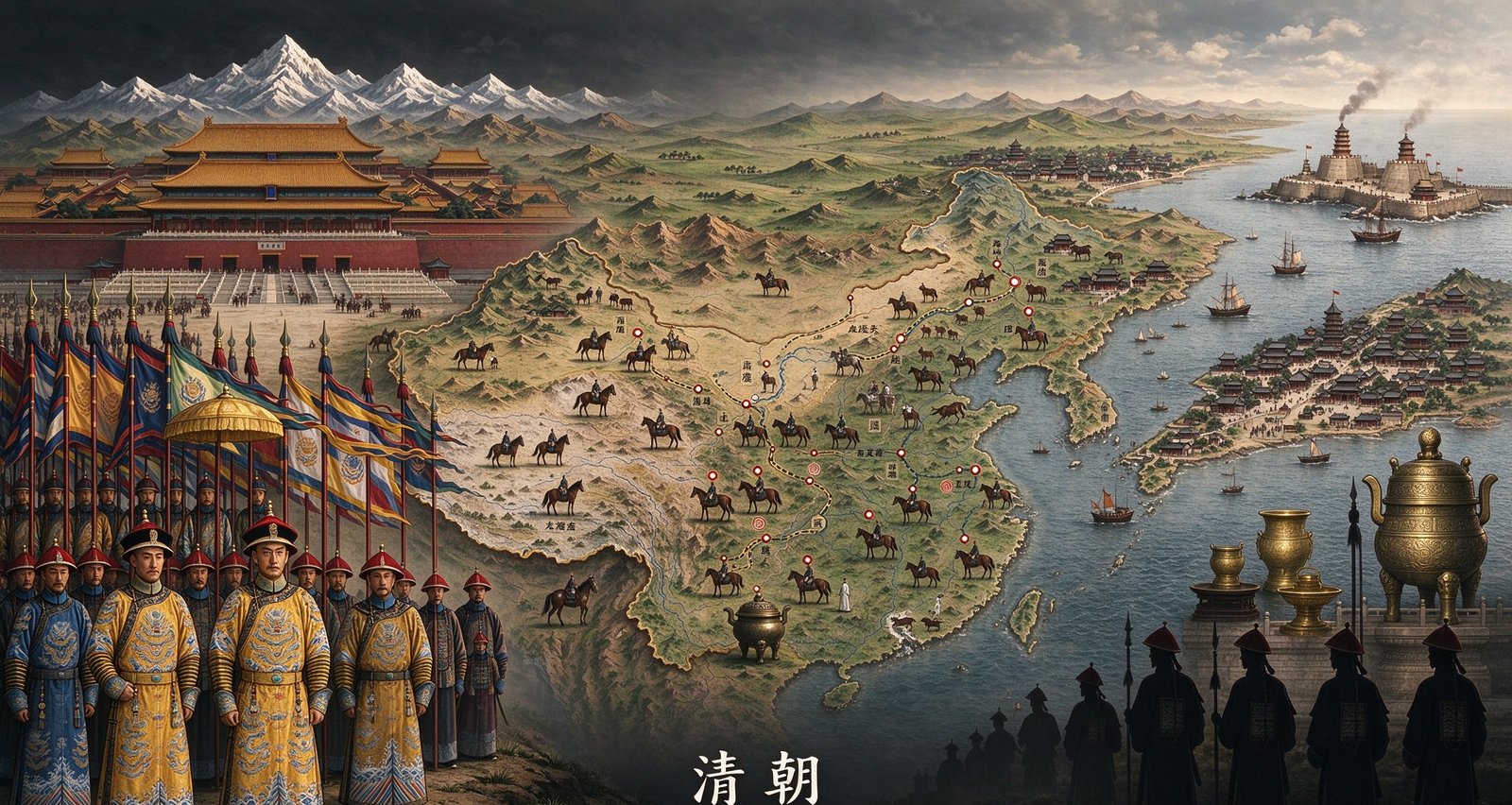
The Qing was China's last imperial dynasty and the direct founder of modern China's map. After the Manchu entry, the Kangxi–Yongzheng–Qianlong High Qing pacified the Three Feudatories, took Taiwan, fixed Xinjiang, stationed Residents in Tibet, and signed the Treaty of Nerchinsk — the forty-eight banner lands and the eighteen interior provinces composed a new form of "grand unity": the territorial frame of today's China took shape in the eighteenth century. Under the High Qing the population surged from one hundred million to three hundred million; the poll tax was merged into the land tax; evidential scholarship (the Qian-Jia school) peaked classical learning. But the golden age had shadows: literary inquisition froze thought, closure missed the Industrial Revolution, and the failed Macartney mission presaged the East-West collision. In 1840 the Opium War's guns opened "the greatest transformation in three thousand years": the Taiping Rebellion, the Self-Strengthening Movement, the Hundred Days' Reform, the Xinhai Revolution — in seventy years the old empire peeled away under internal and external siege, and in 1912 the Xuantong Emperor abdicated: imperial China ended, modern China began. The Qing fell, but its multiethnic territorial-state framework was inherited whole by Republic and People's Republic alike.
The hundred and thirty-four years of Kangxi, Yongzheng, and Qianlong were imperial China's final flourishing: Kangxi pacified the Three Feudatories, took Taiwan, thrice campaigned against Galdan, signed the Treaty of Nerchinsk with Russia (China's first modern international treaty), and reigned sixty-one years, the longest on record; Yongzheng founded the Grand Council, merged the poll tax into the land tax, extended direct administration in the southwest, and was famed for diligence (vermilion rescripts by the million characters); Qianlong counted ten great campaigns, saw the population pass three hundred million and the empire hold roughly a third of world GDP — by traditional measures, a near-perfect report card.
The golden age also imported a twin miracle of finance and population: "never add to the tax" and the tax merger fueled a population boom, and the land-people tension began to pile up; making gentry share corvée and taxes touched the interest blocs. In the traditional golden-age toolbox there were no tools for the next stage — the physics of afterglow: brightest at the very fall.
The Qing's greatest gift to China is the map: the pacification of the Dzungars and the Khojas, with the Ili General administering Xinjiang (Qianlong named it "New Frontier" and raised a stele there); in 1727 the Resident Minister in Tibet, with the Golden Urn fixing central approval of the Dalai and Panchen reincarnations; Inner and Outer Mongolia bound by the league-banner system and Manchu-Mongol marriage; chieftains replaced by regular administration in the southwest; Taiwan made a prefecture in 1684. "Grand unity" became, in the Qing, precise administrative practice — for the first time the Han, Manchu, Mongol, Hui, and Tibetan blocks were governed by one state system.
This multiethnic framework is modern China's direct inheritance: the Republic's "five races in one republic" and the People's Republic's regional autonomy both presuppose Qing territory and practice. Though the late Qing ceded land, the legal territory it founded (including internationally confirmed sovereignty over Tibet) preserved modern China's base — the historical key to today's map.
The golden age's other face was an intellectual winter: the *Nanshan Ji* case under Kangxi, the Zeng Jing case under Yongzheng, over a hundred and thirty inquisition cases under Qianlong — "the clear breeze cannot read; why does it flutter the pages?" could convict; the *Siku Quanshu* compiled and banned books in one breath, three thousand titles destroyed. Qian-Jia philology flourished as scholars fled into old texts and rhymes — scholarship refined as thought withered; Gong Zizhen's later cry — "ten thousand horses all muted — what sorrow!" — said it all.
Abroad, ever more conservative: one port of trade (the Cohong of Guangzhou); Macartney's request for equal trade refused (1793), Qianlong answering the English king, "Our Celestial Empire possesses all things in abundance" — as Industry's wheels turned in Britain, China chose to remain the Celestial Court. Fifty years on, the Opium War's gunboats would price that judgment: from the tianxia view to a world view, China was dragged into the modern state system — at a ruinous tuition.
After 1840 the Qing entered seventy years of humiliation and self-rescue entwined: two Opium Wars, the Taiping Rebellion (a civil war of unprecedented loss), defeat by Japan in 1894, the Boxer calamity — each blow peeling away the Celestial dignity; the Self-Strengthening Movement's "learn the foreigners' strong points to control them," the Hundred Days strangled at a hundred, the late-Qing New Policies rehearsing constitutionalism — self-rescue slow and partial. In 1911 one shot at Wuchang, and the provinces fell like dominoes; on 12 February 1912 Empress Dowager Longyu, for the six-year-old Xuantong Emperor, issued the abdication edict, "yielding the ruling power to the whole nation" — twenty-one centuries of empire closed with a sheet of paper.
The Qing's final meaning is double: bearer of the humiliations of modern history, and founder of modern China's territory and ethnic framework. The edict's words — "the complete territory of Manchu, Han, Mongol, Hui, and Tibetan shall continue as one great Republic of China" — the empire transferred its realm to the republic by law. After dusk came not abyss but dawn: an ancient civilization's long march to modernity began.