Date
c. 1800–1500 BC
Erlitou lies near Yanshi in Henan and dates fr...
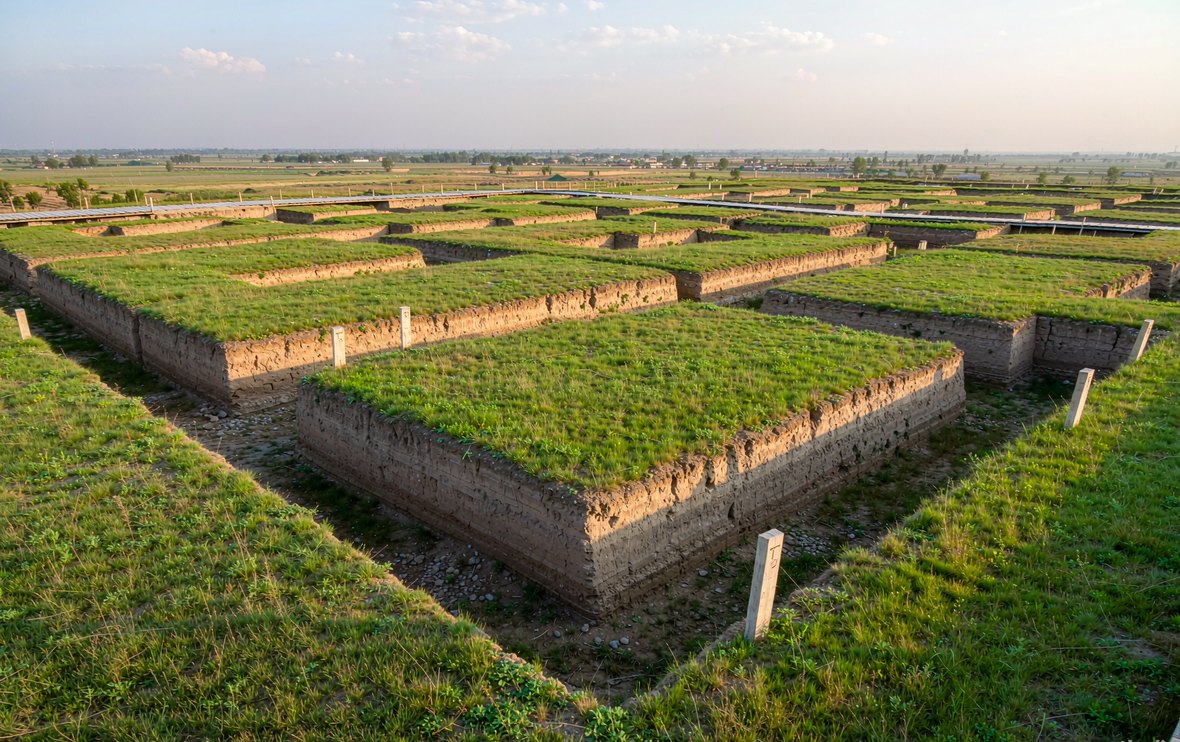
Erlitou lies near Yanshi in Henan and dates from about 3800 to 3500 years ago; some three million square metres survive, and most scholars identify it as the late capital of the Xia. Here are China's earliest palace enclosure — ancestor of the Forbidden City — its earliest grid of arterial roads, its earliest set of bronze ritual vessels and a turquoise workshop; a noble tomb holding a great turquoise dragon pushes the ritual tradition of the dragon back to the very beginning of dynastic rule. Erlitou's influence radiated outward, south to the Yangzi and west to eastern Gansu: for the first time a territorial kingship rose above the individual city-state, and the archaeologist Xu Hong has called it “the earliest China”. It follows the Longshan cultures and precedes the bronze civilisation of Shang and Zhou — the crucial step from ancient kingdom to dynasty.
The palace enclosure covers more than a hundred thousand square metres, ringed by walls, with great halls set along a central axis to form courtyard after courtyard — court in front, residence behind. The plan was inherited by the Shang cities of Yanshi and Zhengzhou and persisted all the way to the Ming and Qing Forbidden City. A grid of avenues more than ten metres wide divided the city into palace, ritual and workshop zones: the idea of the functionally zoned capital took shape here.
Hence “the earliest China”: the word here is not a place name but a political form — a kingship centred on a palace and binding a vast territory through cultural radiation. Every Chinese capital of the following four thousand years is Erlitou enlarged and rewritten.
In 2002 a large turquoise dragon came from a noble tomb: more than two thousand tiny turquoise flakes inlaid into a body some seventy centimetres long, curving in easy undulation, with a huge snout and almond eyes of real presence. It has been called a super national treasure. Laid across the body of the dead and buried with a bronze bell, it is the dragon's first appearance as a ritual object of the highest order.
From Erlitou to Shang and Zhou bronze motifs, to Han dragon designs, to the Chinese dragon of today, this turquoise creature is one of the earliest identifiable links in the genealogy. Belief in the dragon was not born in a night; it accumulated over millennia, and Erlitou is where the accumulation begins.
Erlitou has yielded China's earliest group of bronze ritual vessels: jue, jia and ding, spare and grave in form, cast in piece moulds — the dawn of the Chinese Bronze Age. The turquoise and bronze workshops stood beside the palace and were run directly by royal authority; the state monopoly on the vessels of the realm begins here.
The spout, the posts and the three legs of the bronze jue became the prototype of Chinese wine vessels, and the word jue rose from vessel to title of nobility — a drinking cup that helped shape the political language of China. Technology, ritual and power were fused for the first time at Erlitou.
Whether Erlitou was the Xia capital is still debated. Those who affirm it argue from date, from location — the Yi and Luo valleys where the texts place the Xia — and from scale; the cautious observe that no self-identifying writing has been found. Either way its historical weight is unchanged: objectively, this is where Chinese territorial kingship begins.
Matching excavation with text is the methodological heart of early Chinese history. The Xia problem reminds us that the documented record of Chinese civilisation has been verified step by step: the Shang were confirmed by oracle bones, the Xia await their proof. That condition of being between belief and doubt is itself the honesty, and the charm, of archaeology.