Date
AD 493 into the Northern Song
The Longmen Grottoes stand on both banks of th...
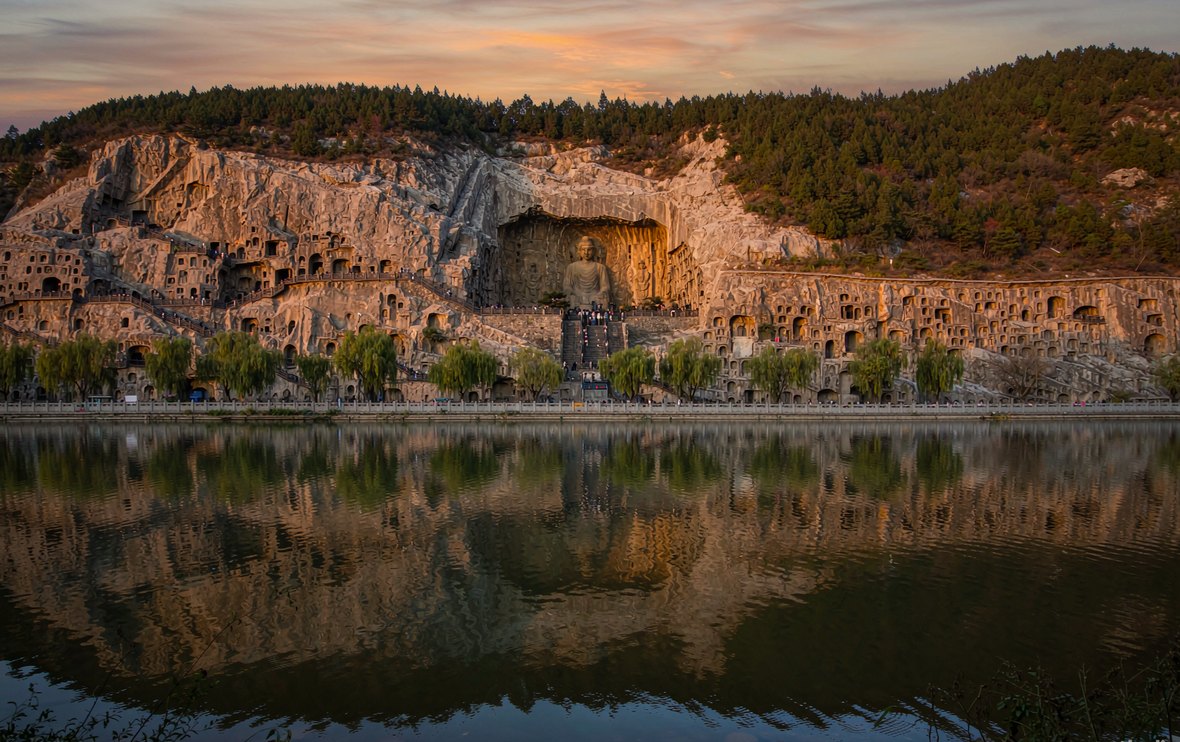
The Longmen Grottoes stand on both banks of the Yi River at Luoyang in Henan, the ancient pass of Yique. Cutting began around the Northern Wei move of the capital to Luoyang in 493 and continued through Eastern and Western Wei, Northern Qi, Sui and Tang into the Song, more than four centuries of work. Some 2,300 caves and niches, nearly 110,000 images and 2,800 inscriptions survive, and the site was inscribed in 2000. Northern Wei images are slender and clear-boned in flowing robes, led by Guyang and Binyang Middle Cave; Tang images are full-bodied and opulent, led by the Vairocana Buddha of Fengxian Temple, a royal commission 17.1 metres tall, said to have taken the features of Empress Wu Zetian as its model: the smile of an Eastern Mona Lisa has watched the river for a thousand years. Longmen is also a shrine of calligraphy. The Twenty Inscriptions of Longmen, vigorous and plain in the Northern Wei manner, are a living specimen of the passage from clerical to regular script. After Yungang, Longmen completed the sinicisation of Buddhist art: the face of the Buddha became a Chinese face.
The great Vairocana niche of Fengxian Temple was a royal project overseen by Emperor Gaozong and Empress Wu between 672 and 675. The Buddha stands 17.1 metres tall; the head alone measures four. The face is full and round, long brows sweeping to the temples, the corners of the mouth faintly lifted — an Eastern smile poised between authority and compassion. Inscriptions of the Wu Zhou period show image and political persona reflecting one another.
This Buddha marks the completion of sinicisation. The deep eyes and high nose of Gandhara are gone; the face is Chinese, Tang, opulent — a foreign Buddha grown into Chinese features. The Vairocana smile has been read as High Tang confidence made visible: the composure of a civilisation written on the face of the god it made.
Guyang is the earliest cave at Longmen, cut under the Northern Wei and dense with votive inscriptions; the Twenty Inscriptions of Longmen, among them the records of Shi Pinggong and Sun Qiusheng, all come from it. The Northern Wei stele style, with its decisive square strokes and powerful structure, is the key link between clerical and regular script. When stele studies revived in the Qing, the Twenty Inscriptions were held up as the model, and Bao Shichen and Kang Youwei both bowed to their virile force.
The history of calligraphy owes Longmen a considerable debt: without these craftsmen's cuts in the cliff, one whole page of Chinese calligraphy could not be written. The caves are at once a history of images, a history of votive records and a history of script — three histories in one, and only at Longmen.
Set the two sites side by side and the whole trajectory appears. The early colossi of Yungang have square shoulders and thin clinging drapery, their faces carrying a Gandharan and Liangzhou exoticism; Northern Wei images at Longmen turn slender and clear-boned, faces thin, necks long, robes flowing like a Southern Dynasties gentleman; under the Tang they turn full and gorgeous. Taste shifts three times, and the Buddha is always alive in his own age.
The deeper force is the awakening of a cultural subject: a foreign religion, to take root in China, had to put on native aesthetic dress. Longmen is the busiest workshop of that translation, and it proves the digestive power of Chinese civilisation — to absorb everything, and then grow a shape of its own.
Longmen has survived the Huichang persecution of Buddhism, centuries of looting and the depredations of the modern age; the relief of emperors and empresses worshipping the Buddha in Binyang Middle Cave was cut out whole and carried abroad, a wound in the history of cultural property. Since inscription in 2000, conservation, digital reconstruction and international cooperation on the return of dispersed objects have continued. The hundred thousand Buddhas on the two banks have witnessed faith, sovereignty, art and catastrophe entire.
Today the Vairocana smile still greets the sunrise over the Yi. It has been reproduced on stamps, on commemorative coins and in national image films. The caves were begun as a work for the next world and have become a legacy of this one — the last thing the emperors and craftsmen who vowed these images could have expected.