Date
202 BC–AD 8, Western Han
Han Changan lay northwest of the modern city o...
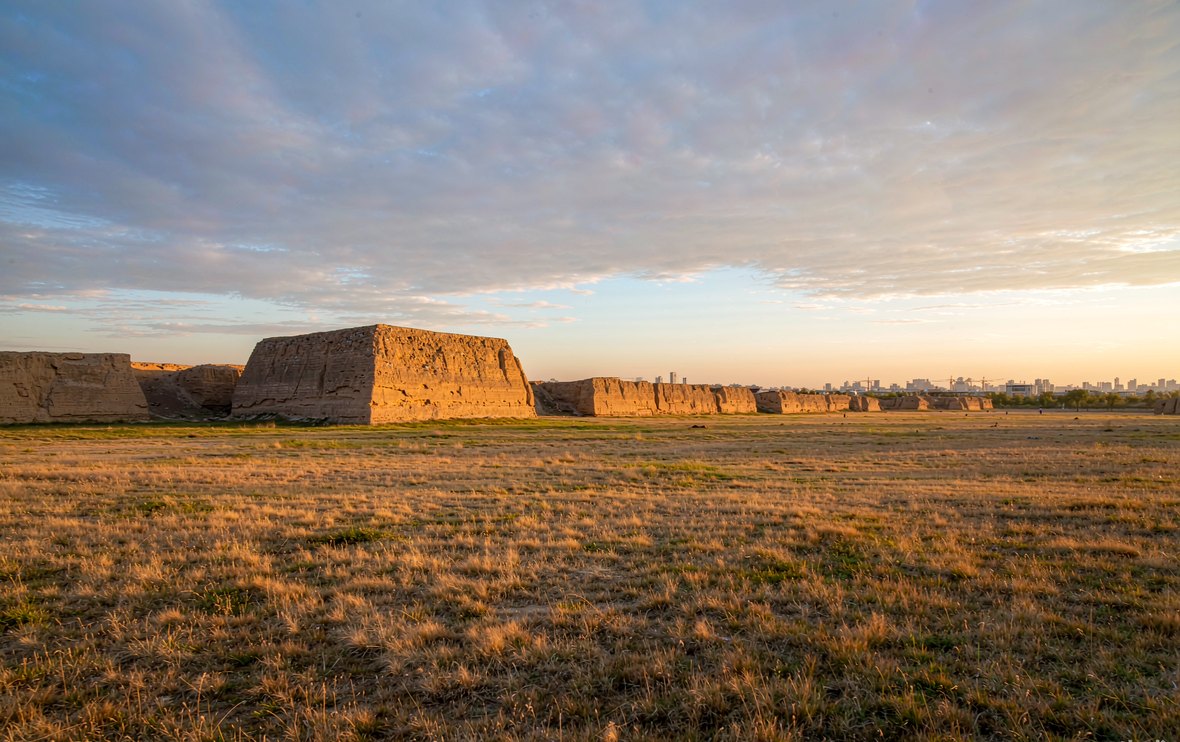
Han Changan lay northwest of the modern city of Xi'an and served as the Western Han capital for more than two centuries, from 202 BC to AD 8. It was among the largest cities on earth: the wall ran some 25.7 kilometres around, the area covered about 36 square kilometres, four times the Rome of its day. The rammed-earth walls still stand, in places more than ten metres high, and the vast platform of the Weiyang Palace front hall still rises from open fields. In 2014 the site was inscribed as the starting point of the Silk Roads: the Chang'an–Tianshan Corridor network. Zhang Qian set out from here to open the Western Regions, so the eastern origin of the Silk Road lies before the Weiyang Palace; here too were taken the decisions behind the maxim that whoever dares offend the mighty Han shall be pursued however far. Han Changan has no legend like the Epang Palace, but something solider: the skeleton of an imperial capital, preserved entire.
Han Changan was built to the lie of the land, on the footing of a Qin detached palace: the southern wall bends like the Southern Dipper, the northern wall winds like the Northern Dipper, and the ancients called it the Dipper City. This was not a lapse from the square ideal but a city growing along watercourses and around existing palaces. Weiyang and Changle formed the core, with eight streets, nine avenues and a hundred and sixty wards; ritual buildings, the Bright Hall and the circular moat, ringed the southern suburbs. The grammar of the Chinese capital — palace at the centre, markets and wards beside it, suburban sacrifices as a screen — was settled here.
The plan shaped every capital that followed: the framework of Sui Daxing and Tang Chang'an is a regularised upgrade of the Han arrangement of palace core and ritual ring. Only by understanding the irregularity of Han Changan can one understand the whole passage of the Chinese capital from building to the land to building to the axis.
Weiyang was the principal palace of the Western Han, its name meaning unending, from the phrase long joy without end: the names of Han palaces are all blessings. The front hall stood on the highest ground in the city, its rammed-earth platform still more than ten metres high; Emperor Wu added halls and built the Jianzhang Palace, linked across the city by covered walks. The mission of Zhang Qian, the unbroken envoy's staff of Su Wu, the campaigns of Emperor Wu — the decisions were all taken here. Weiyang is where the very name of the Han people was produced.
In 2014 the Weiyang site was inscribed as the eastern terminus of the Silk Roads, one heritage anchoring two ideas at once: the unified imperial capital and the origin of the Silk Road. Standing on the front hall platform and looking west, one sees the footprints of humanity's first globalisation, left by the caravan that set out from Changan two thousand years ago.
Han Changan was among the first great sites to be systematically excavated in the People's Republic. Work has continued since 1956 for more than seventy years, revealing the walls, twelve gates, the Weiyang, Gui and Changle palaces, the arsenal, the markets and the workshops. Tiles stamped long joy without end and bricks inscribed boundless as heaven bring the air of the Han house down to every potsherd.
The difficulty of protecting a great site among living villages has been worked out here over decades: the Weiyang area was planted and opened as parkland, and the model of an archaeological park in which the platforms remain visible matured. Han Changan proves that a capital need not be rebuilt to be protected — rammed earth is itself the most honest history book.
Changan became a spiritual place name for the Chinese. Ban Gu praised it in his rhapsody on the two capitals, Zhang Heng answered with his rhapsody on the two metropolises, and every generation of writers since has sung of it and dreamed of it: Changan out of sight, and sorrow comes, in Tang verse; looking northwest towards Changan, in Song lyrics. As a physical city it is a ruin; as a symbol it is immortal. It defined what a capital means to Chinese civilisation — the summit of politics, the cover of the civilisation.
Xi'an still tells its story in Han and Tang colours: the subway detours around the site, and the rammed-earth wall runs beside the airport expressway as it always did. A capital two thousand years old is still shaping a modern city of twenty million. This is the contemporaneity of ruins.