Date
c. AD 460–525
The Yungang Grottoes, cut into the southern fl...
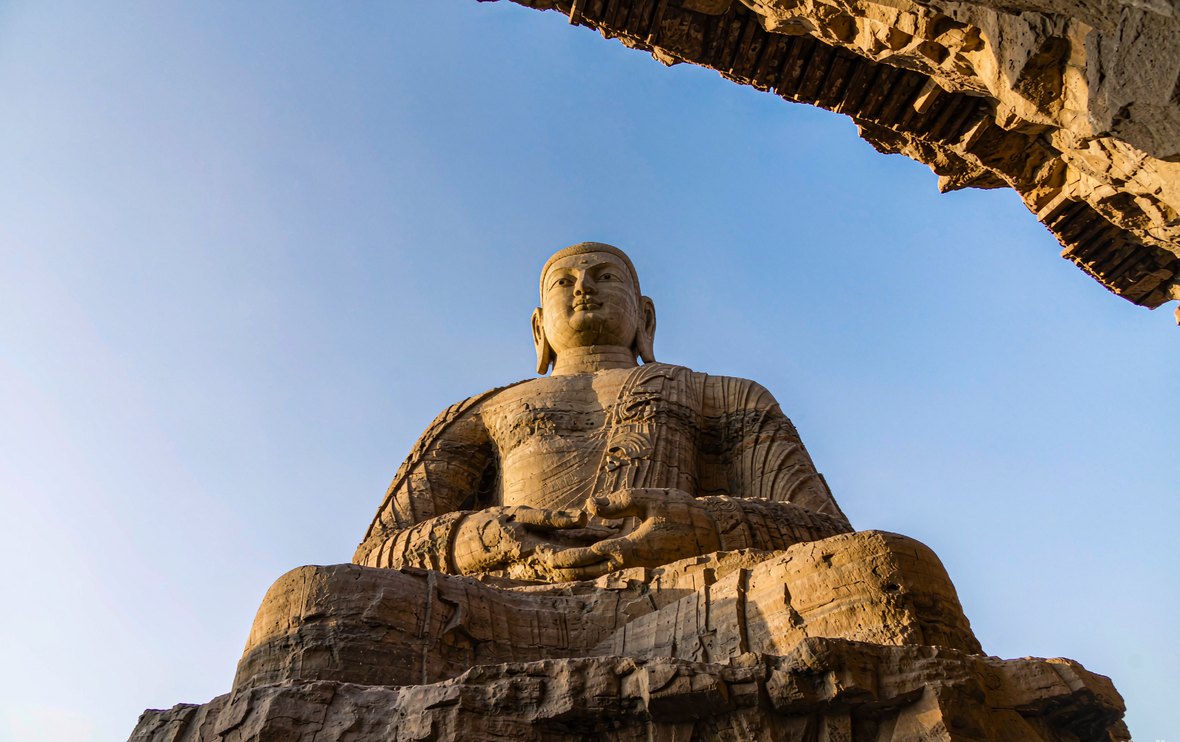
The Yungang Grottoes, cut into the southern flank of Wuzhou Mountain near Datong in Shanxi, were begun in the middle of the Northern Wei period, from about 460. Forty-five major caves and more than 59,000 images survive, and the site entered the World Heritage List in 2001. It was the first great cave-temple complex in Chinese history to be sponsored by the throne. Guided by the doctrine that the emperor is the Tathagata of the present age, the court had the monk Tan Yao open five caves in the cliff, their five great Buddhas embodying five emperors — the tallest at seventeen metres, its stone feet a footnote to imperial power. The style is a marriage of East and West: Greek columns, Persian beasts, Indian Gandharan and Central Asian Sogdian ornament share a single cave, and the idiom then travelled inland to the Central Plains and gave birth to Longmen. Yungang is the first stop in the sinicisation of Buddhist art, and the gift a steppe dynasty left to China.
At the suggestion of the monk Tan Yao, Emperor Wencheng of Northern Wei ordered that five caves be opened in the cliff and a Buddha carved in each. The five colossi stood for five emperors from Taizu onward. The doctrine that the emperor is the Tathagata transferred the power of the Buddha to the throne: to worship the image was to worship the sovereign, and a steppe dynasty used Buddhism to bind a multi-ethnic realm. The Buddhas were a visual proclamation of church and state made one.
The open-air Buddha of Cave 20, exposed when its façade collapsed, stands 13.7 metres high, shoulders square, eyes deep-set, nose straight — Gandharan bone married to Tuoba bearing. It has become the face of Yungang and of Northern Wei. With a whole mountain for canvas and the resources of a dynasty for chisel, the sheer scale of Yungang is itself politics.
The decorative programme of Yungang is a Silk Road exhibition: Greek Ionic capitals and acanthus scrolls, Persian bead roundels and royal beast crowns, Indian lotuses and Gandharan drapery, Central Asian paired beasts in medallions, Chinese dragon niches in the form of gate towers — all at peace within one cave. This is the ornamental repertoire of Eurasia entire, carried by Buddhism and planted at Pingcheng.
Yungang is thus called the first stop in the sinicisation of Buddhist art. Early images are massive, with thin drapery clinging to the body in the Liangzhou manner; later ones turn to slender, clear-boned figures in flowing robes, in the Chinese manner. From Yungang to Longmen runs a legible line of the Buddha taking on Chinese custom, which makes these caves a chapter in the history of East-West exchange as much as in the history of religion.
The grandeur of Yungang rested on the Pingcheng era. The Northern Wei held Datong as its capital for nearly a century, from 398 to 494, and this dynasty of the Xianbei Tuoba clan, integrating steppe and plain, paid for the royal works. After Emperor Xiaowen moved the capital to Luoyang, small and medium caves continued to be cut for decades, and their votive inscriptions are precious slices of Northern Wei social history.
From Pingcheng to Luoyang, from Yungang to Longmen: the route of the capital's removal is also the route along which Buddhist art shifted south. Caves are the growth rings of a dynasty. Read Yungang, and you understand how Northern Wei turned from a steppe empire into a Chinese dynasty.
A millennium of weathering is Yungang's great enemy: the sandstone takes up water, freezes and flakes, and some images have lost their features. From systematic photography in the early twentieth century to three-dimensional documentation today, Digital Yungang preserves the great Buddhas in data at millimetre accuracy; drainage and environmental works advance alongside, and the cave park and museum have made Yungang a cultural signature of Datong.
The lesson of Yungang is that exchange is never an abstraction: Greek columns, Persian patterns, Indian Buddhas and Chinese gateways have been collaborating on this cliff for fifteen hundred years. To guard Yungang is to guard the material evidence of that exchange.