Dates
AD 581–618
The Sui replayed Qin: it ended centuries of di...
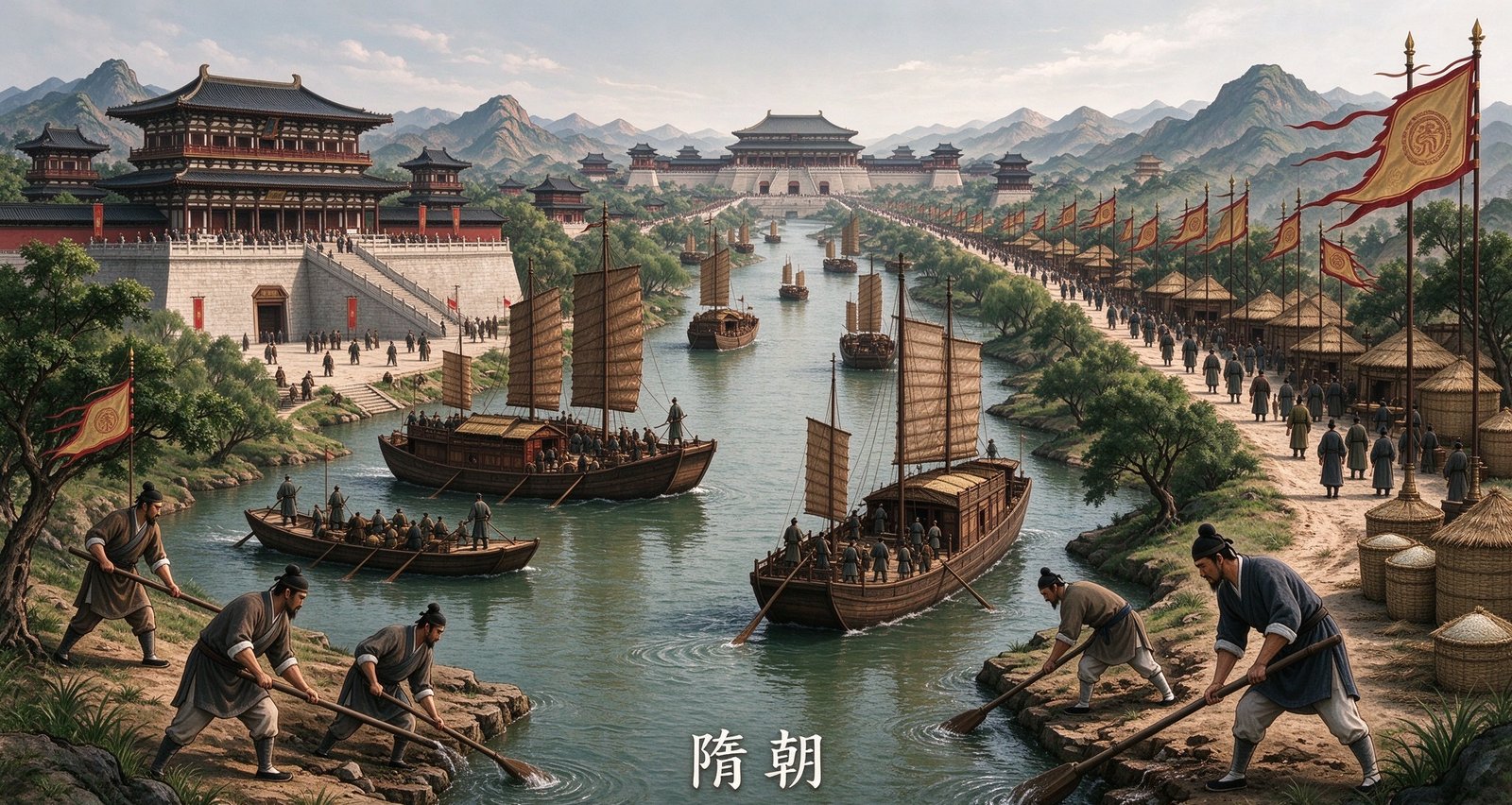
The Sui replayed Qin: it ended centuries of division, built unprecedented institutions, and died in the second generation from overdrafting the people's strength. Yang Jian accepted abdication and founded Sui, destroyed Chen in 589 to unify the realm, and created the Kaihuang order — equal fields, light taxes, simplified offices, codified law, granaries richer than any reign's; his Three Departments and Six Ministries and the examination system are two great inventions of Chinese political history. His second son Yang Guang took the throne (reportedly by fratricide), dug the Grand Canal linking five great water systems, built the eastern capital Luoyang, created the jinshi degree, toured west to Zhangye to meet the kings of the Western Regions, and attacked Goguryeo three times without success — achievement and tyranny both peaking in one man. In 618 the mutiny at Jiangdu killed the emperor at his guards' hands, and the thirty-eight-year-old Sui fell. Tang inherited Sui's institutions and pardoned its people: the examinations, the departments, the canal, the codes — seeds Sui planted grew into towering trees in Tang. Pi Rixiu's verse is the fair verdict: "All say Sui perished for this river, yet a thousand li of traffic still ride its waters."
Yang Jian's record is often eclipsed by his son's showpieces: the equal-field system enforced, taxes lightened (an adult male owed but twenty days' corvée a year), the "grand muster and face-reading" of household registers netting millions of hidden people, granaries packed — grain banked in the charity granaries of the Kaihuang years was still in use in Tang's Zhenguan years. The *Cambridge History of China* judges Emperor Wen of Sui "one of the greatest and most underrated of rulers."
Institutional invention was equally dense: the Three Departments and Six Ministries split the chancellor's power three ways, both more efficient and better checked; the Kaihuang Code cut the cruel punishments — "light for heavy, life for death" — becoming the mother text of Tang law; equal fields plus the zu-yong-diao levy gave peasants, for the first time, a predictable tax. A bureaucratic empire framed on "light" and "simple" stood finished.
From 605 Yang Guang conscripted a million laborers, and in six years cut the Tongji, Han, Yongji, and Jiangnan canals, linking the Hai, Yellow, Huai, Yangtze, and Qiantang systems across more than 2,700 kilometers — the longest and greatest ancient canal on earth. Its political meaning is plain: Jiangnan grain could reach the garrisons of Zhuojun, and the southeast's wealth fed every later northern capital. "Half the realm's revenue enters by this road" — for thirteen hundred years the canal was the empire's aorta.
The price was glaring: overseers were pitiless, "four or five of ten laborers died," and willow-catkin drifts of white bones floated along the channel. The canal became evidence of the emperor's tyranny and the economic lifeline of the Tang — merit for a thousand autumns, guilt in its own day: a dilemma Chinese mega-projects still face.
Emperor Wen abolished the Nine Ranks and ordered each province to send three men yearly; Emperor Yang created the jinshi degree, selecting by examination — the iron curtain of aristocratic monopoly on office was torn open at its first seam. The possibility that "a farm boy at dawn may stand in the Son of Heaven's hall at dusk" now existed; though the Tang-Song examinations were far from equal, once the principle "select by test" was set there was no going back. The institution later reached Europe and directly inspired the modern civil-service examination.
Examinations matched with the Three Departments formed the empire's twin engines: tests supplied talent, departments rotated administration — China completed bureaucratic "modernization" in the seventh century. The great clans withdrew slowly over the next five hundred years, and social mobility became the key trait distinguishing Chinese civilization from contemporary Europe.
Yang Guang's three campaigns against Goguryeo were the last straw: the first, in 612, fielded 1,133,000 men with camp followers several times more; the army stalled beneath Liaodong's walls, and at the Salsu River nine armies were annihilated — of over three hundred thousand who crossed, fewer than three thousand returned. The second and third campaigns failed in turn, and revolts flared across the land — Yang Xuangan at Liyang, the Wagang army in the Central Plains. In 618 the abandoned emperor was strangled at Jiangdu by Yuwen Huaji's men, leaving behind the black jest, "Such a fine head — who will cut it off?"
Sui's fall is nearly isomorphic to Qin's: mega-projects plus high-intensity war plus overdraft in ultra-short time equals system collapse. Yet history proved again: dynasties die; institutions do not. Li Yuan received almost wholesale Sui's frame, added a measure of leniency, and created the Zhenguan order. The Sui is the classic "paver's dynasty."