Dates
AD 1271–1368
The Yuan was the first unified dynasty founded...
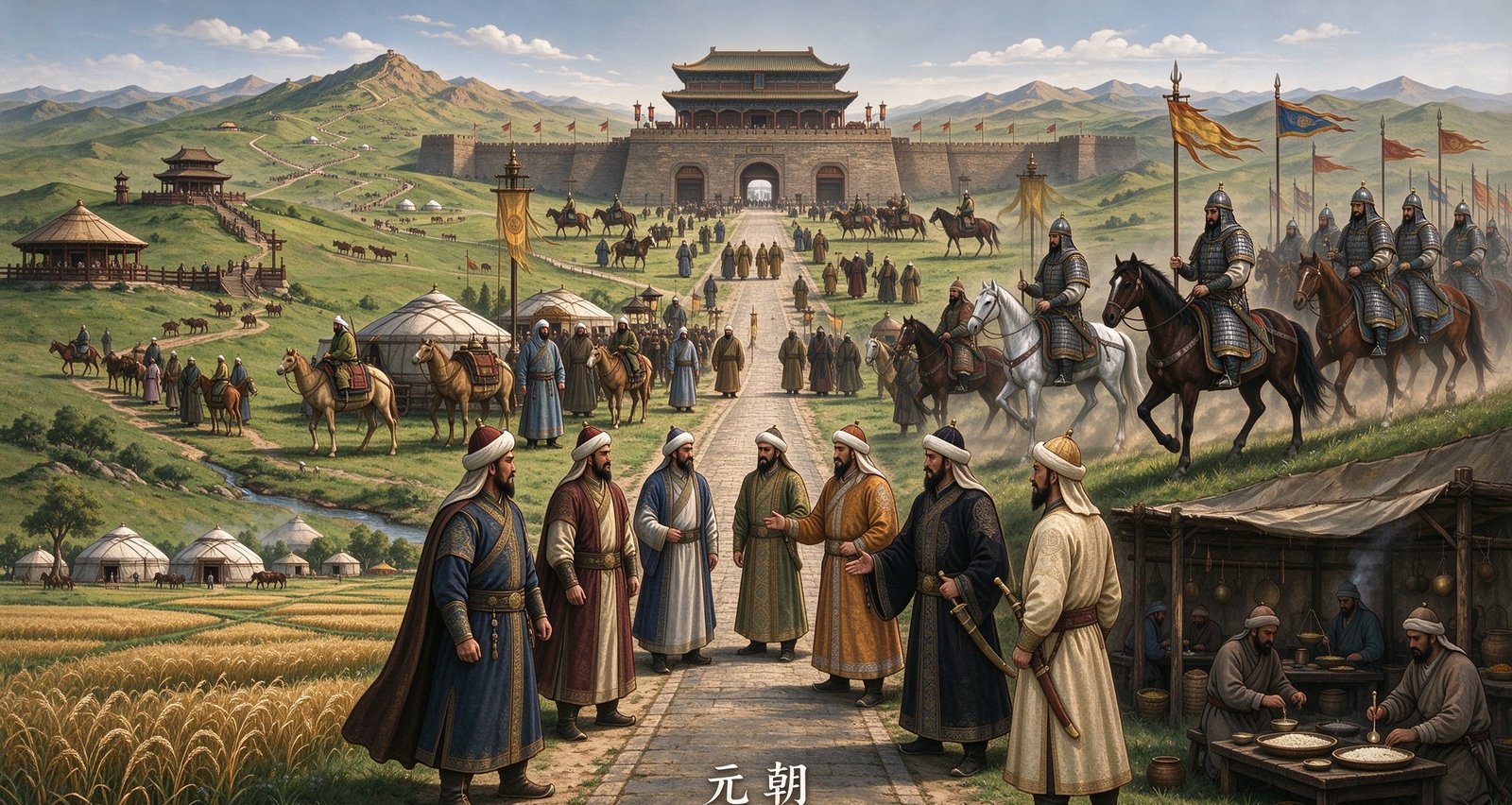
The Yuan was the first unified dynasty founded by a minority people, and the China-piece of the Mongol world empire. Kublai proclaimed the Great Yuan in 1271 and destroyed the Southern Song in 1279; the realm "reached past the Yin Mountains in the north, to the drifting sands in the west, through Liaodong in the east, and over the seas in the south" — the largest territory of any Chinese dynasty beyond Han and Tang. Yuan's institutional innovations ran deep: the province (sheng) system is the source of China's provinces today; the postal relay network amazed Marco Polo; Dadu (Beijing) became capital of all China for the first time; the economy ran grain by canal and by sea, spread cotton, and saw the birth of blue-and-white porcelain. The other face: ethnic hierarchy, whiplash successions (nine emperors in thirty-eight years), and Yellow River floods kindling man-made and natural disaster alike. Yet Yuan's openness was unprecedented: Marco Polo and Ibn Battuta visited in turn, Tibetan Buddhism gained imperial preceptors, Islam and the Jingjiao church coexisted — the "four classes" frame beside the multiethnic reality. In 1368 Zhu Yuanzhang's northern expedition drove Toghon Temür back to the steppe after ninety-eight years of rule over China — the Yuan rewrote the definition of "grand unity": not merely the unification of the Chinese lands, but the integration of steppe, plateau, Western Regions, and Central Plains.
The Yuan's Branch Secretariats (xingsheng) are a watershed of administrative history: provinces of Lingbei, Liaoyang, Shaanxi, Sichuan, Gansu, Yunnan, Jiangzhe, Jiangxi, Huguang, Henan-Jiangbei and more, with circuits, prefectures, sub-prefectures, and counties beneath — "sheng" as the name of the top local unit endures to this day. The design embedded checks: Hanzhong assigned to Shaanxi rather than Sichuan; Xuzhou withheld from Shandong — deliberately breaking natural boundaries to deny local strongholds. This wisdom of "interlocking teeth" is still legible in China's provincial map.
The relay network (jamchi) rose in step: some 1,500 stations nationwide carried military dispatches "morning out, evening arrived"; sea-borne grain from Liujiagang reached Zhigu by the millions of piculs a year. Before the telegraph, the Yuan built a remarkable logistics-and-information system — grand unity became daily operations, not a slogan.
Kublai abandoned Kaiping and made his seat at Yanjing, building Dadu — Beijing's first term as capital of all China, held through Yuan, Ming, and Qing for six hundred years; the north–south axis of Chinese political geography switched from the Xi'an–Luoyang era to the Beijing era. Dadu was laid out on the ideal-capital plan of the *Kaogongji*, a central axis running through a royal city at the center; Marco Polo's "Khanbaliq" strained European credulity.
Cultures coexisted in Dadu: the Imperial Preceptor system fixed Tibetan Buddhism (the marker of Tibet's formal incorporation into central administration); the Persian astronomer Jamal al-Din cast the Wannian calendar; the Jingjiao (Christian) church had its own Office for the Glorification of Bliss. Yuan Dadu was the first full muster of steppe, Chinese, and Western Regions civilizations — a plural legacy received whole by Ming-Qing Beijing.
The Yuan ranked its subjects as Mongols, Semu, Han, and Southerners, with unequal offices, legal treatment, and quotas — the most criticized part of Yuan institutions; scholars debate how codified it truly was (more an accretion of custom and policy than a statute), but discriminatory treatment is fact. The examinations were suspended, and when restored were smaller than Song's or Ming's, with separate papers by class — the scholar's ladder blocked, and the self-mockery "ninth the scholar, tenth the beggar" spread.
The paradox: the blocked ladder bred new culture among the people. Career-less literati flowed to the marketplaces; Guan Hanqing, Wang Shifu, and Ma Zhiyuan drove Yuan zaju drama to its first summit — *Romance of the Western Chamber* and *Snow in Midsummer* achieved "literature's descent and ascent" in the playhouses. The examinations' failure, by accident, made the theater.
The mid-late Yuan's dead knot was succession: no fixed primogeniture — nine emperors in thirty-eight years, averaging under five, with the strongmen El Temür and Bayan in turn monopolizing. From 1344 the Yellow River breached and plague and drought came together — "a stone man with one eye stirs the Yellow River and the realm rebels" — the Red Turbans spread like wildfire. In 1368 Zhu Yuanzhang sent Xu Da north; Toghon Temür opened the Jiande Gate and left for Shangdu — the Mongols returned to the steppe as they had come: the Northern Yuan.
Yuan's legacy list is longer than expected: the province system; Dadu (Beijing); the relays; the paper-money experience; Tibet's incorporation into governance; blue-and-white porcelain (one of the great export wares of Chinese ceramics); and the enlarged idea of "grand unity" — Ming and Qing governance of Tibet, Xinjiang, and Mongolia all built on Yuan precedent. The steppe came and went, but the institutions it rewrote stayed.