Time span
c. 2,000,000 – 2070 BC
Before writing and before dynasties, this land...
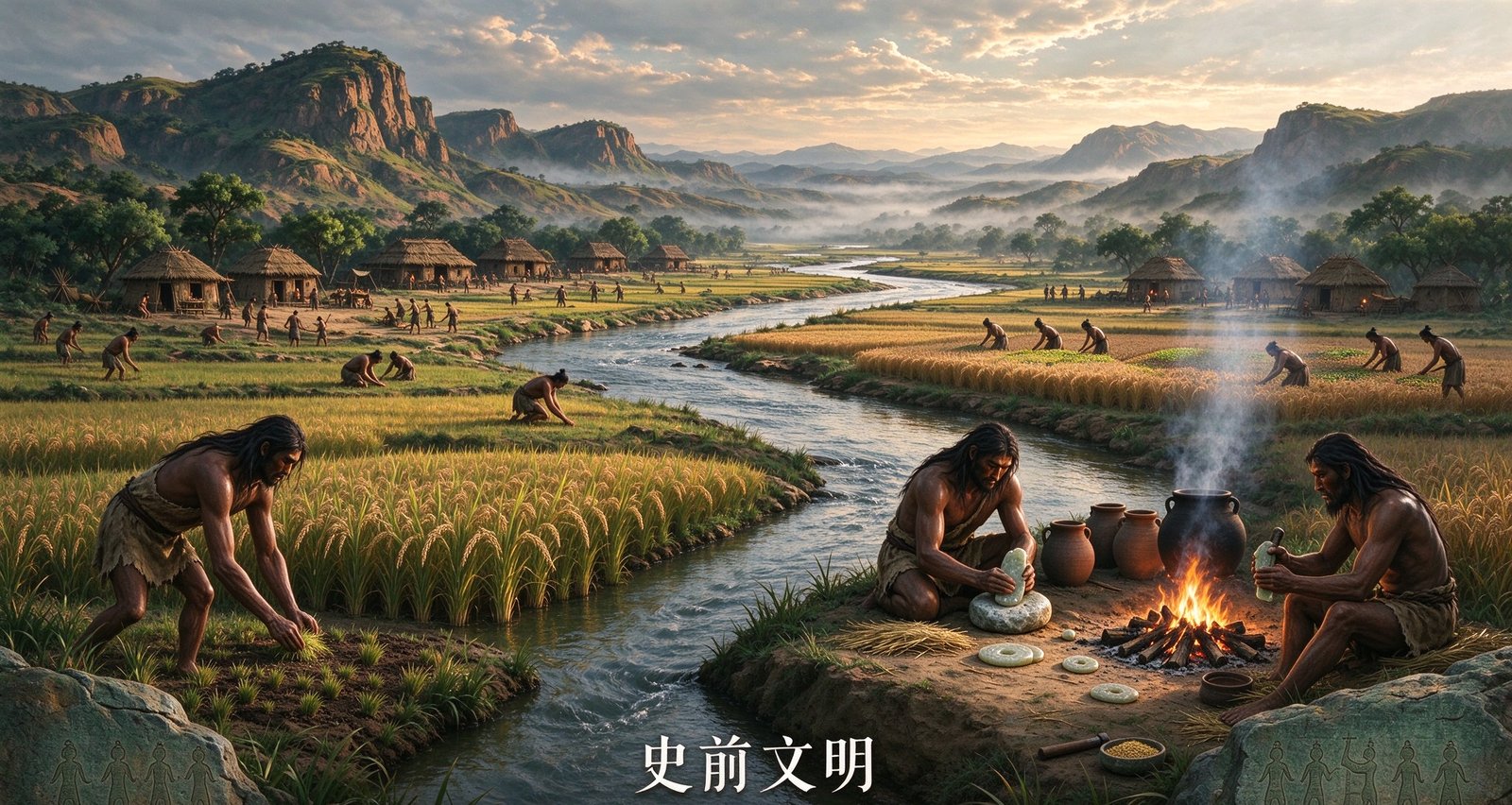
Before writing and before dynasties, this land already bore nearly two million years of human footprints. From the chipped stone tools of the Yuanmou Man to a grain of rice at Hemudu, a painted pot at Banpo, a jade cong at Liangzhu — across the long march from Paleolithic to Neolithic, the ancestors domesticated millet and rice, dogs and pigs, invented pottery and rammed earth, and raised towns and altars above their settlements. What archaeologists call the "stars across the sky" pattern means civilization did not begin at a single point: the Liao, Yellow River, and Yangtze basins flared up in parallel, lighting one another, before converging on the Central Plains through collision and fusion — the prehistoric rehearsal of China's "unity in diversity."
About ten thousand years ago, as the last ice age retreated, humans everywhere turned to farming. The people of North China domesticated drought-hardy foxtail and broomcorn millet; in the Yangtze basin they domesticated rice — rice remains unearthed at Xianrendong (Jiangxi) and Shangshan (Zhejiang) date back nearly twenty thousand years, among the earliest evidence of rice cultivation in the world. The domestication of a single seed set off settled life, population growth, surplus, and the division of labor — and with them, the crossing of civilization's threshold.
Farming fixed the baseline of Chinese civilization for the next ten thousand years: rice in the south, millet in the north — a twin-grain pattern that shaped sharply different village forms, foodways, and ways of life north and south. The painted pottery of Yangshao, the stilt houses of Hemudu, the semi-subterranean dwellings of Banpo are all material testimony to this first contract between people and land.
The archaeologist Su Bingqi proposed the "stars across the sky" thesis: around six thousand years ago, the Hongshan culture of western Liaoning astonished the scholarly world with its altars, temples, tombs, and jade; Lingjiatan and Liangzhu in the lower Yangtze built an order of god-kings out of ritual jade; Yangshao in the middle Yellow River and Dawenkou downstream each formed systems of their own; and Shijiahe in the middle Yangtze raised a walled city of over a million square meters. Civilization was no single bloom but a galaxy of shining stars, sparking one another.
This plural-origins view rewrote the old narrative of Central Plains centrality: the Central Plains became the center not because it was earliest, but because it sat at the crossroads where the regional cultures met, and proved the best at absorbing, integrating, and recreating. Inclusiveness was written into the genes of Huaxia civilization from the very start.
Jade was the spiritual cipher of prehistoric China. The jade dragon of Hongshan, the cong tubes of Liangzhu, the jade plaques of Lingjiatan were not ornaments but ritual objects for communion with heaven and earth — serving the gods with jade, marking rank with jade, an ideology transcending kinship arriving early on stage. The cong's square-outside, round-inside form has been read as the earliest material expression of a "round heaven, square earth" cosmology, more than a thousand years before writing.
The city was another language of power. The inner city of Liangzhu covered roughly three million square meters, and its outer hydraulic system was among the world's earliest large-scale water works; at Taosi in Shanxi archaeologists found a probable observatory and vermilion-written symbols, while Xinzhai and Wangchenggang, forerunners of Erlitou in Henan, rose step by step. Rammed-earth walls, palace foundations, graded burials — every element of the state was in place before the first dynasty.
In the written sources, prehistory appears as myth: Youchao building shelters of timber, Suiren drilling wood for fire, Shennong tasting the hundred herbs and sowing the five grains, the Yellow Emperor battling Chiyou at Zhuolu. Such orally transmitted memories cannot be read as chronicles, but they can be read as a "summary of civilization" — shelter, fire, agriculture, tribal war — mirroring, item by item, the prehistoric progress archaeology reveals.
To truly read prehistory you must hold two keys at once: the archaeologist's trowel and the legend. Legend gives archaeology its narrative warmth; archaeology gives legend its material skeleton. When the dams of Liangzhu come face to face with a world beyond the *Records of the Grand Historian*, China's five thousand years of civilization ceases to be a confident slogan and becomes a verifiable fact.