Dates
c. 2070–1600 BC
Xia is the first hereditary dynasty in the wri...
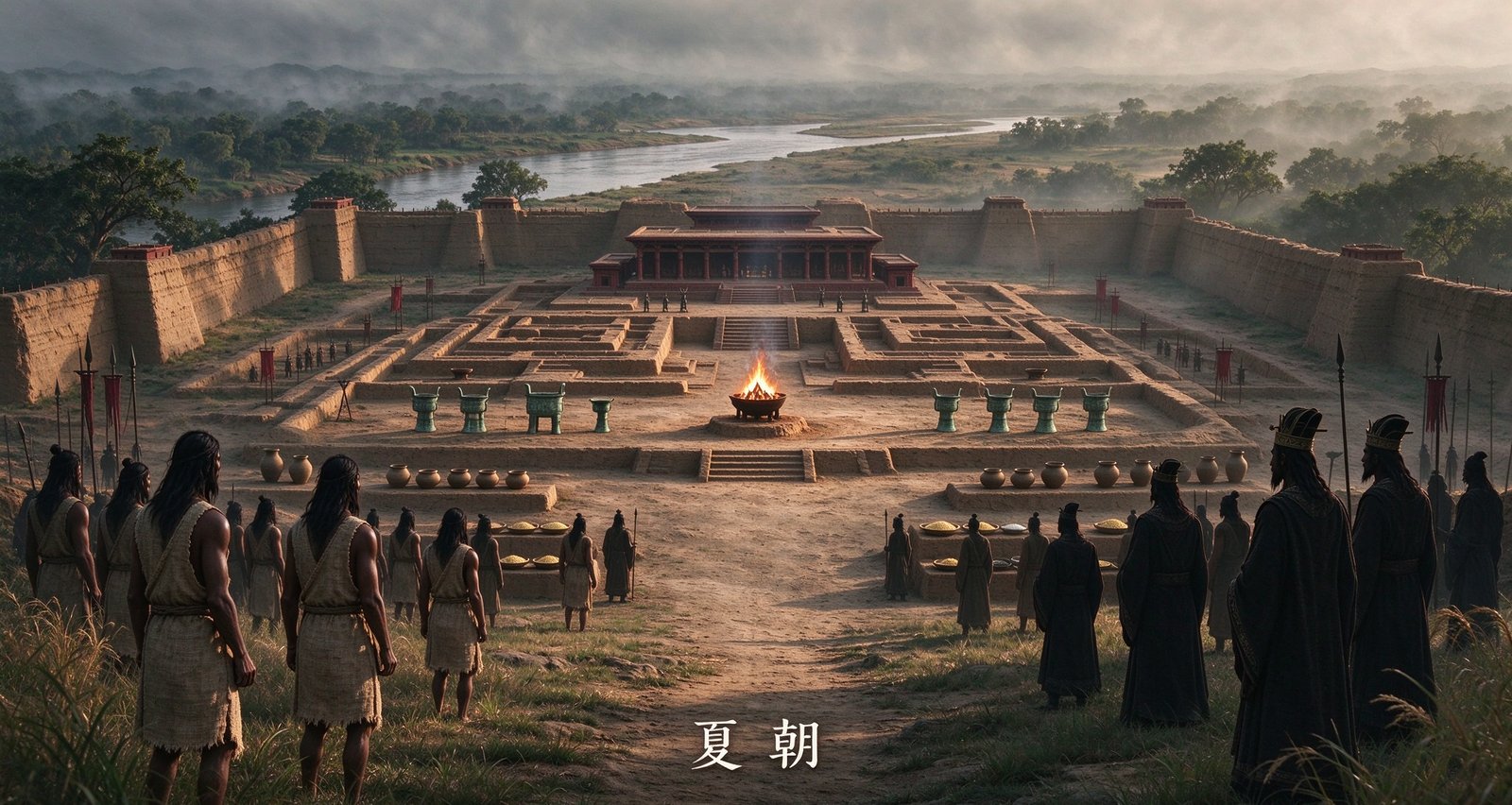
Xia is the first hereditary dynasty in the written record. When Yu the Great tamed the flood and Shun ceded the throne to him, Yu intended to return power to Yi — yet all the lords of the realm paid court instead to Yu's son Qi. Thus began "the world as a family possession" (jia tianxia); the abdication tradition of rule for all ended, and Chinese history entered the era of dynastic reckoning. Xia's capitals and migrations clustered in western Henan and southern Shanxi; the Erlitou culture (c. 3800–3500 years ago), with its vast palace city, palace foundations, bronze ritual vessels, and grid of avenues, is regarded by most scholars as a late-Xia capital — hence the label "the earliest China." Whether Xia existed, and how to define it, are still debated — but its standing in later imagination is beyond doubt: from Confucius to Sima Qian, all of Huaxia's imagining of "legitimate succession" began with Xia.
In legend the flood raged unchecked. Gun tried to dam it for nine years and failed; Yu switched to channeling, guiding the rivers to the sea, passing his own gate three times without entering, and after thirteen years finally subdued the waters. This legendary "mega-project" is at heart a charter of political legitimacy: organizing massive cross-tribal cooperation required authority, and whoever mastered the flood naturally became paramount. Some scholars call it an Eastern version of the "hydraulic society" — the symbiosis of great public works and state power was visible at the very origin of Huaxia civilization.
Yu's image was thus fixed: sweat rather than divine power, service rather than conquest. Chinese rulers were ever after expected to be "flood-tamers" — to labor for the people's benefit and shoulder their suffering — an expectation that began with Xia and never broke for two thousand years.
The abdications of Yao, Shun, and Yu were Huaxia's earliest political idealism: the world belonged to all, and the worthy were raised up. After Yu died, his son Qi killed Yi and took power, opening the hereditary system of "father dies, son succeeds" — what political historians call China's first "institutional revolution." Abdication did not vanish; it became a moral ideal: every later dynasty claimed to act on the Mandate of Heaven, and Cao Pi's remark at his usurpation of Han — "The affair of Shun and Yu — now I understand it" — was at once parody and homage to that memory.
The other side of family rule was a new problem of legitimacy: why should your house hold the world? The Xia answer was the Mandate of Heaven and virtue — "Xia received the Mandate of Heaven." Shang and Zhou inherited and developed this framework, which finally crystallized into the political theology of "Heaven has no favorites; it aids the virtuous" — ruling China for three thousand years.
The Erlitou site at Yanshi, Henan, covers about three million square meters and has yielded a grid of avenues, palace-city walls, multi-courtyard palace foundations, a turquoise workshop, and a corpus of bronze ritual vessels. The grid-pattern bronze ding and the turquoise-inlaid bronze plaques found here sound the dawn of China's Bronze Age; a noble tomb with a turquoise dragon hints at the earliest ritual of the "dragon" totem. Most scholars hold Erlitou to be a late-Xia capital, though some remain reserved — but this does not diminish its weight: Xia or not, this was already the seat of a state of wide-ranging royal power.
Erlitou's layout became the template of Chinese capitals: the axial planning of the palace city, south-facing halls, the ideal of kingship at the center — a lineage running from Erlitou to the Forbidden City. "The earliest China" is not just a chronological label but a birth certificate of urban planning and political space.
Xia fell at last to Jie, the legendary archetype of the tyrant; the people's cry "When will this sun perish? We would die with you!" became a classic citation for later ages admonishing rulers. Shang Tang's war on Jie set the precedent of changing the Mandate through revolution, and Mencius's "I have heard of the execution of the tyrant Zhou, but never of the assassination of a sovereign" rests on the Xia–Shang template.
What Xia left behind was a set of ideas: the starting points of legitimacy, the Mandate of Heaven, family and state, and rule by virtue. Confucius said "Yin followed the rites of Xia"; Sima Qian wrote the Annals of Xia. Whatever the state of the physical evidence, Xia's place as the fountainhead of civilization's orthodoxy was long ago confirmed by the votes of two millennia of historians.