Dates
221–207 BC
Qin is China's shortest-lived and most consequ...
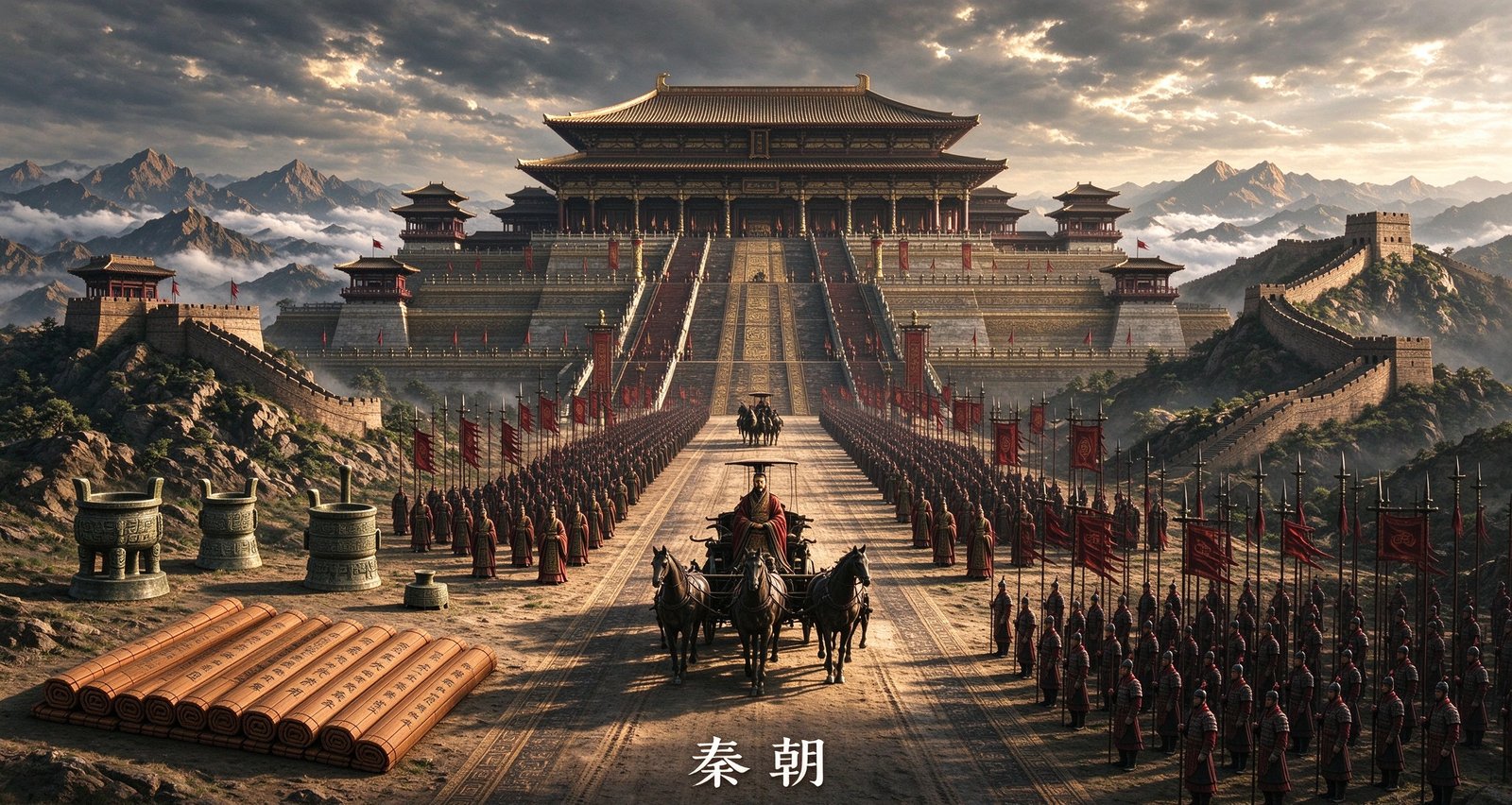
Qin is China's shortest-lived and most consequential dynasty. From destroying Han in 230 BC to destroying Qi in 221 BC, in a single decade Ying Zheng swept away the six states, ended more than five centuries of division, and founded the first centralized, unified empire. Judging himself "virtue matching the Three Sovereigns, merit surpassing the Five Emperors," he invented the title "huangdi" (emperor), abolished enfeoffment for commanderies and counties, standardized the script, axle widths, weights and measures, built the speedways and the Great Wall, struck the Xiongnu in the north and the Baiyue in the south. The imperial administrative skeleton — commanderies and counties, household registration, documents, appointed officials — was carried over by Han and run by every dynasty after. Yet the limits of Legalist logic also showed here: harsh laws, endless corvée, the burning of books and burial of scholars — gone in the second generation, fifteen years after its founding. Jia Yi's "Faults of Qin" asked, "Because benevolence and righteousness were not practiced, the balance of attack and defense changed" — the compulsory question for every later empire.
"Huangdi" (emperor) was no mere renaming but a whole political theology: huang, di, August Heaven — the ruler concentrated supreme earthly power and heavenly legitimacy in one person, styling himself zhen ("We"), his words "edicts" and "decrees," his seal passed down as the state's. The Three Lords and Nine Ministers at the center, commanderies and counties vertically below, an administration ruling the realm by paperwork — one of the most sophisticated bureaucratic states of the ancient world, two thousand years before the modern civil service.
Ying Zheng also completed "de-feudalization": when Wang Wan and others asked to enfeoff the princes, Li Si argued against repeating Zhou's ruin, and the First Emperor ruled: "The realm suffered endless war because of kings and marquises" — enfeoffment was the source of war. Under the commandery system, local governors were appointed and removed by the center and could not pass office to their sons; for the first time the realm truly belonged to the "state" rather than to a "family." This design split China's path permanently from Europe's feudal one.
Qin's unification went beyond territory: Li Si devised the small-seal script and "the writing was standardized," ending the era of variant regional scripts — the first national standardization in the history of Chinese characters, giving edicts, classics, and identity a single vehicle. Same axle gauges, same norms of conduct, same weights, same coinage — even axle width had a legal size. The Shuihudi Qin bamboo slips show Qin law regulating granaries, workshops, and post stations with astonishing granularity — a state of obsessive precision.
The standardization project included physical infrastructure: the speedways fifty paces wide, the Direct Road cutting seven hundred kilometers through the mountains, the Lingqu Canal linking the Yangtze and Pearl systems, the Great Wall joining the northern frontier. These super-projects were built with astonishing administrative capacity — and at a staggering cost in human labor: the empire's greatness and the empire's tyranny were two outputs of the same system.
In 213 BC Chancellor Li Si proposed that "all records not of Qin be burned," sparing the official academy's texts and works of medicine, divination, and horticulture, with discussing the Odes or Documents in public punishable by death — China's first nationwide thought control. The next year, when the alchemists Hou Sheng and Lu Sheng fled and slandered him, the First Emperor had more than 460 scholars buried alive at Xianyang. Later accounts may exaggerate the scale and details, but the symbolism is beyond doubt: the empire could unify writing — and tried to unify thought itself — a task beyond any regime's executive power.
Before the ash of the pits had cooled, rebellion rose east of the mountains. Thought-policing bred not loyalty but the extreme treachery of "calling a deer a horse" and the uprising of Chen Sheng and Wu Guang. Qin proved in fifteen years that force can win the world but cannot sit secure upon it — the lesson to which the Han's early recuperation and eventual elevation of Confucianism were the direct answer.
In 210 BC the First Emperor died on tour; Zhao Gao and Li Si forged the testament to enthrone Huhai, forcing Fusu and Meng Tian to die. Zhao Gao monopolized power, "called a deer a horse," and purged ministers and princes. Corvée and taxes did not lighten: Epang Palace, the Mount Li tomb, garrisoning the Five Ridges, wall-building — "the world had suffered Qin long enough." In 209 BC conscripts facing "death by law for missing the deadline" rose at Dazexiang; Chen Sheng cried, "Are kings and nobles born to their station?" — the first great commoner uprising in Chinese history. In 207 Liu Bang entered the Pass, Ziying surrendered, and the fifteen-year-old empire collapsed.
What died was the dynasty, not the institutions. Xiang Yu restored enfeoffment and was ruined in five years; Liu Bang carried over Qin's institutions tempered with leniency, and the imperial frame ran stable for two thousand years. Tan Sitong said, "Two thousand years of governance: all Qin governance" — Qin's contributions and its crimes were both inherited whole. To understand Qin is to read the low-level code of Chinese politics.