Dates
770–256 BC
In 770 BC King Ping moved east, the Zhou king ...
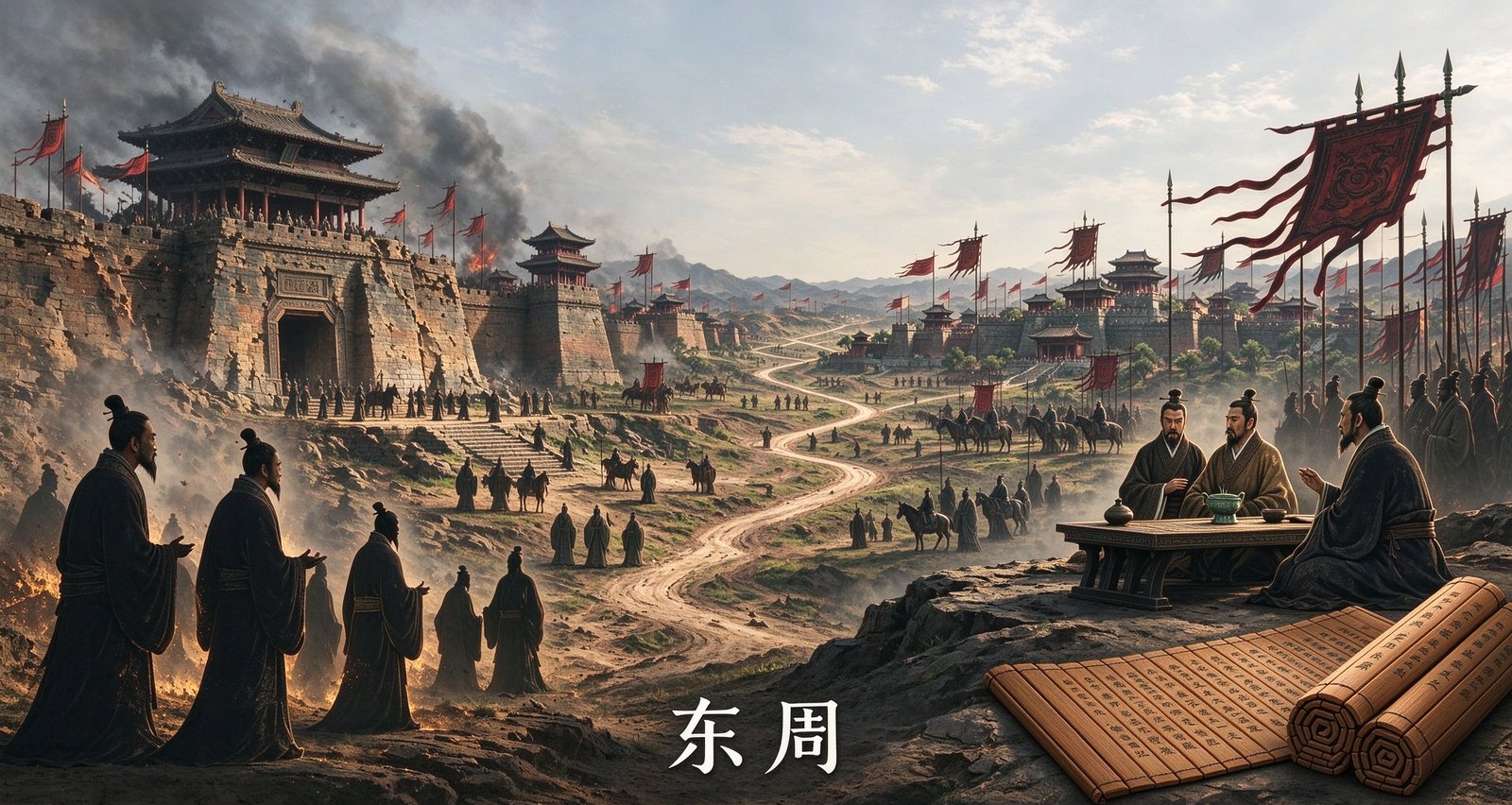
In 770 BC King Ping moved east, the Zhou king became a nominal overlord, and China entered five hundred years of Spring and Autumn and Warring States — an age of "collapsed ritual" in political history, and the "Axial Age" in the history of thought. Iron and the ox-plow unleashed productivity; the well-field dissolved, commanderies sprouted, the shi class rose; the relay of hegemons from Duke Huan of Qi to Duke Wen of Jin and the annexation wars of the seven powers tore the old order to shreds — and forced new thought out of the ground. Laozi wrote his five thousand characters at the Hangu Pass; Confucius wandered from state to state; Mozi led his disciples through fire and water; Shang Yang reformed the laws by the Wei River — the hundred schools offered utterly different diagnoses and prescriptions in the same troubled age. In 256 BC Qin destroyed Zhou; in 221 BC it swallowed the six states — five hundred years of upheaval were gathered at last into a more radical new order.
The Son of Heaven lost power; hegemons filled the gap. Duke Huan of Qi, with Guan Zhong, "honored the king and resisted the barbarians," convening nine assemblies of the lords without war chariots; Duke Wen of Jin yielded three stages of ground at Chengpu and covenanted at Jiantu; King Zhuang of Chu, after his startling rise, "asked about the tripods" of the Central Plains; Wu and Yue rose in turn, Goujian sleeping on firewood and tasting gall. The hegemon's political grammar was a mild version of "holding the Son of Heaven to command the lords": not touching Zhou's tripods, but rebuilding order through covenant — the Huaxia world first learned to keep an international order without an emperor.
The Spring and Autumn was also the key period in which Huaxia identity crystallized: the discrimination between "the southern Yi and the many Xia" pressed the central states into a cultural community under pressure from Chu, Wu, and Yue. "The many Xia are close kin; they cannot be abandoned" — an identity of civilization beyond any single state was born, more durable than any hegemon's glory.
The partition of Jin by its three great families and the Tian clan's replacement of the Qi ducal house — the Warring States opened with the bankruptcy of the old ritual order. Competition among the seven entered total-mobilization mode: Wei had Li Kui's reforms to wring the land's full yield; Chu had Wu Qi; Qin's Shang Yang reform went deepest — abolishing the well-field, rewarding military merit, instituting commanderies and counties — building a war machine in twenty years. Wars scaled up from the tens of thousands to the hundreds of thousands; at Changping over four hundred thousand surrendered soldiers were buried alive. This was China's first "modernization" race: the state with the most advanced institution survived.
Competition also paid an unexpected dividend: states needed talent, the shi class sold their skills on an open market, and the marketplace of thought flourished as never before. Mencius in audience with King Hui of Liang; Su Qin wearing the seals of six states; Xunzi thrice head of the Jixia Academy, which "held office without governing and only deliberated" — arguably the world's earliest zone of academic freedom. Chaos gave thought its living space; so it was then, so it is now.
Karl Jaspers called 800–200 BC humanity's "Axial Age" — Greece had Socrates, India had the Buddha, China had the masters. Beyond the Confucians, Mohists, Daoists, and Legalists: the Logician Gongsun Long's "a white horse is not a horse"; the Yin-Yang master Zou Yan's cycle of the five powers; Sun Wu's thirteen chapters on war; the Eclectics' *Lüshi Chunqiu* gathering the strengths of every school — this is the true Genesis of Huaxia thought; almost every question of the next two thousand years finds its original debate here.
The historical engine of the contention was precisely the chaos: the old order had failed, the new one was unbuilt, and every value had to be argued anew. The shi class broke free of bloodline attachment and lived by traveling and advising — "stay if they fit, leave if they don't"; freedom of thought came from independence of person. Once Qin-Han unity made a single doctrine official the contention ceased — but the conceptual frames the masters supplied remain the mother tongue in which Chinese still think about the world.
The material base of the intellectual boom is often overlooked: iron tools and the ox-drawn plow. Around the Spring and Autumn–Warring States transition, iron smelting broke through and cast-iron farm tools spread, making deep plowing possible; the spread of ox-plowing let "one man with five dependents till a hundred mu" replace mass communal hoeing. Rising yields, population growth, land reclamation, the collapse of the well-field, private land and its sale — a complete agricultural-revolution chain that started before the revolution in thought.
Great water works went up at the same time — Dujiangyan, the Zhengguo Canal — turning Shu and Guanzhong into a "land of heaven" and a granary on land. Three revolutions — material, institutional, intellectual — detonated in sequence within five hundred years, as Huaxia made the perilous leap from aristocratic enfeoffment to a registered empire. The Warring States was not an intermission in history but a gear change of civilization.