Dates
202 BC – AD 8
Western Han was the first mature run of the un...
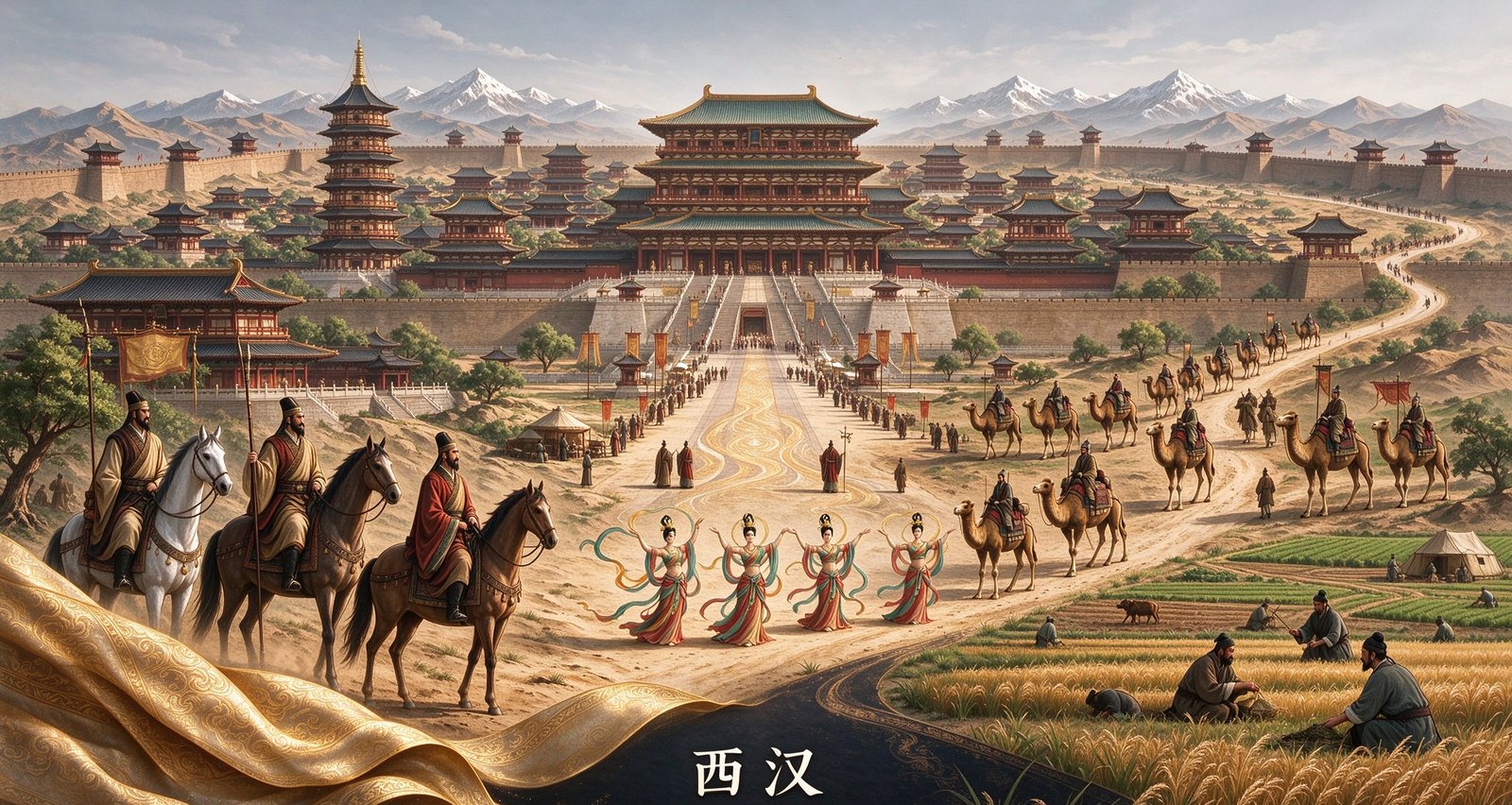
Western Han was the first mature run of the unified empire. Liu Bang, a commoner with a three-foot sword, won the world, proving that "are kings and nobles born to their station?" was no empty phrase; Emperors Wen and Jing lightened burdens and let the people rest, until "the capital's strings of cash rotted for want of counting"; Emperor Wu, of vast ambition, drove the Xiongnu north, opened the Western Regions, dismissed the hundred schools and honored the Confucians alone, monopolized salt and iron, created era names and the Taichu calendar — pushing the empire to its zenith. Zhang Qian reached the Western Regions, and the Silk Road joined Eurasia; Sima Qian, swallowing shame, wrote the *Records of the Grand Historian* and set the highest standard of Chinese historiography. Western Han also solved what Qin could not: wrapping the Legalist skeleton in Confucian warmth — "a mix of the kingly way and the way of force" — giving the empire a sustainable ideology. In 8 BC the consort clansman Wang Mang usurped the throne, ending two hundred and ten years of Han — but the character "Han" had become the name of a people.
Liu Bang was a neighborhood warden; Xiao He a county clerk; Han Xin ate at washing-women's tables; Fan Kuai butchered dogs; Guan Ying sold silks — a team of commoners and underlings beat the aristocrat Xiang Yu and founded Han. It is a rare complete commoner revolution in ancient history: power opened to every class for the first time, and "heroes are not asked their origins" became Chinese society's hidden rule. The kings of other surnames were soon removed, and the oath of the white horse — "if a king is not of the Liu clan, strike him down together" — pulled the regime back into the family track. The tension between commoner revolution and family rule ran through all of Western Han.
Liu Bang's other legacy was policy wisdom: entering Guanzhong he made the Three-Article Covenant, winning hearts after Qin's harshness; after unification Lu Jia asked, "Won on horseback — can it be governed on horseback?" and was set to write the *New Discourses* — win by force, govern by culture. The Han demonstrated this turning point of statecraft for the first time.
Early Han inherited the wreck of the Qin collapse: "the Son of Heaven could not furnish a matched team of horses; generals and ministers rode ox-carts." Emperors Wen and Jing made Huang-Lao "governing by non-action" their compass: light corvée and light taxes — the field tax cut to one-thirtieth or waived entirely; mutilating punishments abolished, laws against slander rescinded, the mountains and marshes opened to all. Forty years of rest filled the treasury until the strings rotted and the granaries overflowed with grain upon grain — the first model of good order certified by the histories.
The deeper meaning of Wen-Jing rule was a validation of Daoist political philosophy: governmental restraint is itself the most efficient policy. The experiment also bankrolled Emperor Wu's activism — no Wen-Jing savings, no Han-Wu spending; the pendulum between non-action and action became the enduring rhythm of Chinese statecraft.
In fifty-four years on the throne, Emperor Wu redefined "empire" almost single-handedly: Wei Qing and Huo Qubing led three great northern campaigns, and the decisive battle deep in the steppe reversed the Han–Xiongnu balance for good; Zhang Qian twice journeyed to the Western Regions, opening the Silk Road down which Chang'an silk traveled to Rome; the four commanderies of Hexi were set up, the southwestern tribes courted, the borders unmatched in scale. At home he dismissed the hundred schools and honored the Six Classics, founded the Imperial Academy and the recommendation system — the embryo of civil-service selection; salt, iron, and liquor became state monopolies, with price stabilization beside them — state capitalism in embryo too.
But grand designs have bills: the years of war exhausted Wen-Jing's savings — "the seas were drained, the households halved"; in his last years the witchcraft calamity cost the crown prince his life unjustly. Then the emperor issued the Repentance Edict of Luntai — "the task now is to stop harsh oppression and arbitrary levies" — a sovereign publicly confessing fault, a rare specimen of political self-cleansing. Ambition and lucidity closed their loop in one man.
What Western Han left China is the name itself: Han ethnicity, Han characters, Han language — a dynasty become a people's self-appellation, unmatched in world history. "Han" meant not blood but civilization: whoever spoke the Han language, wrote Han characters, kept Han rites was Han — an open definition by which the Huaxia community kept expanding.
Beyond institutions and concepts, Western Han bequeathed two spiritual assets: the *Records of the Grand Historian* established historiography's height — "to explore the boundary of heaven and man, to comprehend the changes of past and present"; and Su Wu, nineteen years shepherding flocks without bending his loyalty, set the standard of integrity. Zhaojun going beyond the pass, the golden house for Ajiao, Su Wu and Li Ling — Western Han's stories became the motif bank of later Chinese literature. The dynasty died two thousand years ago, yet lives on in every Chinese person's name for themselves.