Dates
AD 1368–1644
The Ming (1368–1644) was the last unified dyna...
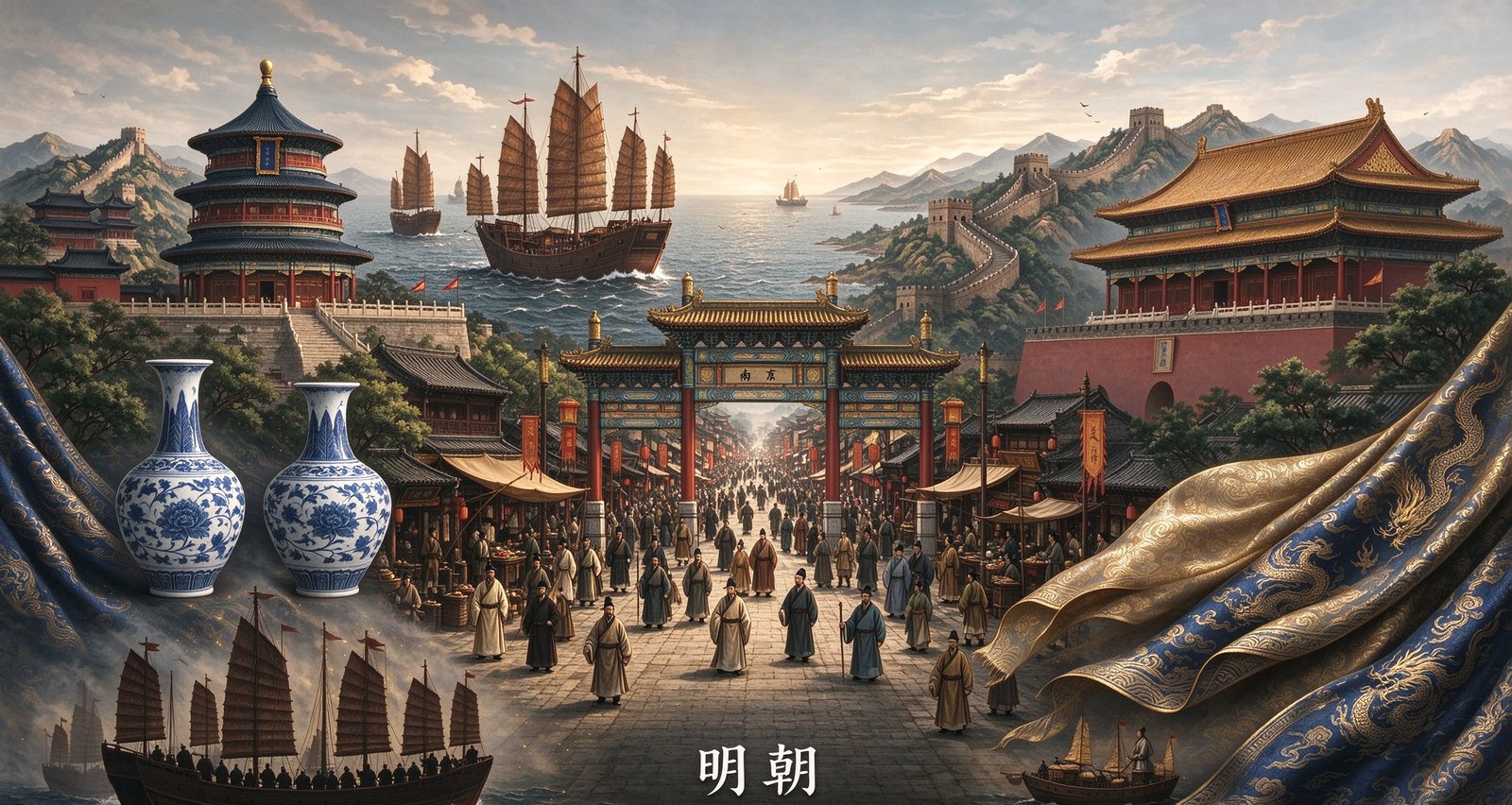
The Ming (1368–1644) was the last unified dynasty founded by the Han people, and a complete specimen of China on the eve of modernity. Zhu Yuanzhang, of commoner birth, expelled the Yuan and restored China, concentrating power unprecedentedly: he abolished the chancellorship, set up the Three Provincial Commissions, founded the Embroidered Uniform Guard — the ancestral injunction "let no later descendant establish a chancellor" changed five hundred years of political structure. The Yongle Emperor moved the capital to Beijing; Zheng He's seven voyages (the treasure fleets dwarfing contemporary Europe) and the *Yongle Encyclopedia* — the empire's maritime age briefly opened. The middle-late Ming saw unprecedented prosperity: the monetization of silver (global silver flowing in via the Manila galleons), Jiangnan market towns and handicrafts, the Single-Whip tax reform, the Four Great Masterworks of urban letters; in thought, Wang Yangming's School of Mind resounded through the ages; in technology, the *Compendium of Materia Medica*, the *Exploitation of the Works of Nature*, and Xu Xiake's *Travels*. But external peril mirrored internal rot: at Tumu the emperor was captured; wokou pirates and the rising Later Jin pressed; factional strife and eunuchs festered; Little Ice Age disasters drove refugees to the roads — in 1644 Li Zicheng took Beijing and the Chongzhen Emperor hanged himself on Coal Hill; "the sovereign dies with the state" became the dynasty's most sorrowful footnote.
Zhu Yuanzhang's design of power reached the ancient limit: in 1380, on the Hu Weiyong affair, he abolished the chancellorship — the six ministries answered the throne directly and the emperor served as his own premier; sixteen hundred years of the chancellorship ended. Locally, the Three Commissions (administration, surveillance, military command) checked one another; the Embroidered Uniform Guard and the later Eastern and Western Depots formed the secret police, and the court-beating rod stripped the scholar-official of his bodily dignity at court. He personally issued the *Great Warnings* and required every household to keep and study them — an emperor who taught his ruling philosophy to the whole people.
But one man's strength cannot run an empire: the vacuum of the abolished chancellorship filled with grand secretaries and eunuchs — Zhang Juzheng reformed "in fact a chancellor," Wei Zhongxian ruled as the "Nine Thousand Years." Here lies the Hongwu paradox: to prevent powerful ministers he abolished the chancellorship, and produced grand secretaries and eunuchs harder still to check — institutional blowback's finest specimen is the Ming.
From 1405 to 1433 Zheng He led fleets of over two hundred treasure ships and twenty-seven thousand men on seven voyages, reaching Malindi in East Africa — at more than ten times the scale of any contemporary European fleet, the greatest maritime mobilization of the fifteenth century. The fleets proclaimed tribute, exchanged goods, hunted pirates, escorted envoys — "ten thousand lands coming to court" spread across the South Seas and the Indian Ocean.
After 1433 the voyages stopped dead; the archives and plans were destroyed or banned, and the "not a plank to sea" prohibition hardened — eighty-seven years before Columbus, China gave up the ocean. The account was settled four centuries later: when European fleets came east, Chinese sea power was gone. Zheng He's legend became a national "what if" — had it continued? Had the charts not burned? The irony: mightiest of maritime nations, China quit the sea of its own accord.
From the sixteenth century China was caught in the global silver circuit: Spanish American mines, shipped by Manila galleon to Asia to buy Chinese raw silk, porcelain, and cotton cloth — more than half the world's new silver ended in China. Zhang Juzheng's Single-Whip reform commuted taxes and labor to silver payments; silver became legal money; the Jiangnan market towns (Suzhou, Songjiang, Huzhou) boomed on export orders, and "loom-owners put up the capital, weavers contribute the labor" — wage relations historians call the "sprouts of capitalism."
But the structure was fragile: China mined little silver; the money supply hung on American and Japanese mines. In the seventeenth century silver inflows crashed; the late-Ming fiscal crisis, the three added levies, refugees everywhere — an empire's collapse pulsed with the silver tide half a world away. The Ming was China's first true test subject of globalization: it enjoyed globalization's dividends and bore globalization's risks.
The late-Ming crises stacked: Little Ice Age disasters year after year (drought in northern Shaanxi), the Later Jin menace in Liaodong, the three added levies, postal-station layoffs (Li Zicheng thus lost his job), factional exhaustion. In the third month of 1644 Li Zicheng's Dashun army took Beijing; Chongzhen rang the bell and no minister came; with the eunuch Wang Cheng'en he hanged himself on Coal Hill (Jingshan), his last edict reading, "Let the rebels divide my corpse; touch not one of my people" — "The Son of Heaven guards the nation's gate; the sovereign dies with the state": the Ming honored its founding vow in the cruelest way.
The Southern Ming regimes resisted eighteen years more, until the Yongli Emperor was strangled at Kunming in 1662. The Ming's three hundred years left the Forbidden City, the *Yongle Encyclopedia*, the Four Great Masterworks, the Yangming school, and a silver economy — and one deep question: why could peaks of civilization and wealth not stop the rot of institutions and finance? The Qing inherited the question whole, to face its crueler version two hundred years on.