Date
c. 2800–600 BC
Sanxingdui lies at Guanghan in Sichuan and was...
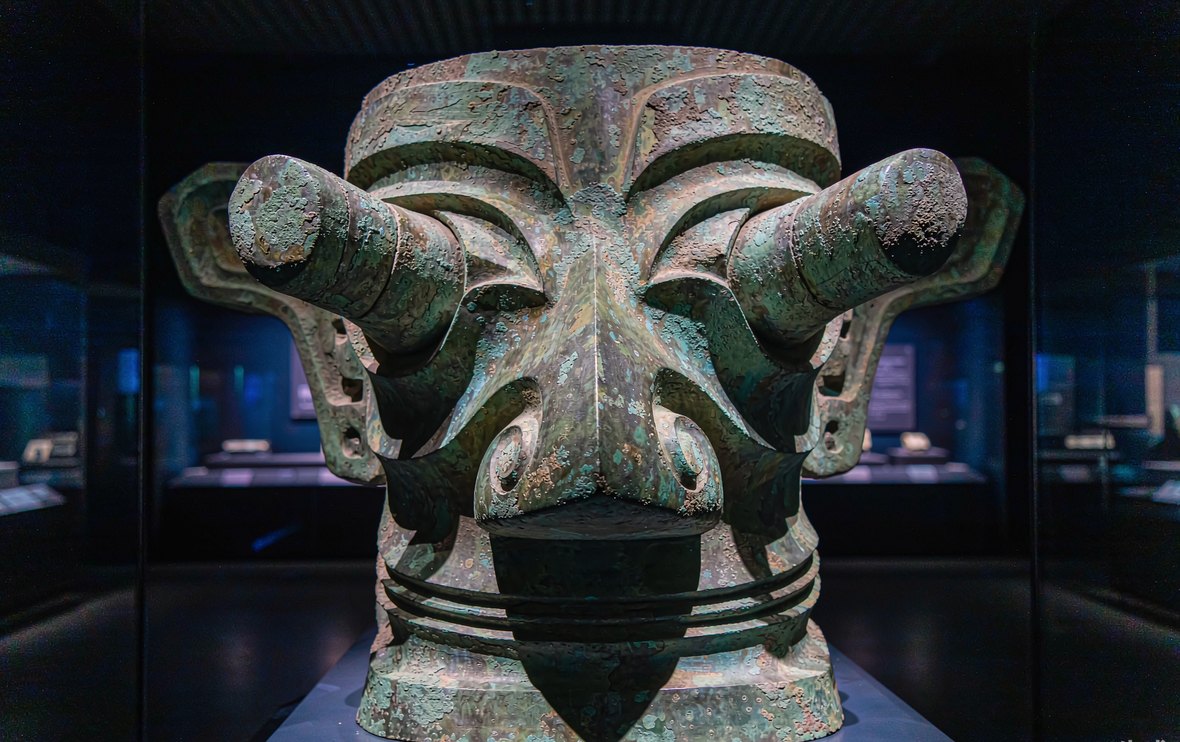
Sanxingdui lies at Guanghan in Sichuan and was the capital of the ancient Shu civilisation, c. 2800–600 BC. The discovery of two sacrificial pits in 1986 stunned the world: a bronze standing figure 2.62 metres tall, a mask with protruding eyes 1.38 metres wide, a bronze tree nearly four metres high, and gold staffs, gold masks, ivory and cowrie shells — a civilisation of the upper Yangzi that held Central Plains bronze technology and a religious system entirely its own. Pits opened from 2021 have yielded a gold mask, a grid-work vessel shaped like a tortoise shell and other spectacular objects. Sanxingdui proves the myriad-stars model of Chinese origins: the upper Yangzi stood beside the Central Plains, and bronzes, jade zhang blades and pottery show the two in exchange. Ancient Shu was no isolated kingdom of myth but the most mysterious and radiant member of a plural unity.
The cylindrical eyes of the bronze mask project sixteen centimetres, its ears spread like wings, and it spans nearly 1.4 metres. It is not a portrait but the face of a god. Texts say that Can Cong, a king of Shu, had “eyes that stood out”, and mask and legend confirm each other: the Shu gave the all-seeing eye its divine power. Gold foil masks were laid over bronze heads, an aesthetics of gold and authority quite unlike the Central Plains, yet faintly in accord with western Asia and Egypt.
The standing figure is 2.62 metres tall, crowned, barefoot on a square pedestal, hands curving around whatever they once held — an elephant tusk, a sacred object, nothing at all. King, high priest, or god? The unanswerable question is the charm of Sanxingdui: a spiritual world entirely coherent and entirely alien to us, standing on the upper Yangzi for a thousand years.
The first sacred tree stands nearly four metres high, nine branches bearing nine birds, a bronze dragon coiling down its trunk — an astonishing echo of the fusang tree and the ten suns in the *Classic of Mountains and Seas*, where the birds on the tree may be the golden crows that carry the sun. The Shu probably worshipped sun and sacred tree, using bronze to link heaven and earth: a model of the cosmos cast in metal.
The quantities of ivory, of cowrie shells from the Indian Ocean and of jade zhang blades show that Sanxingdui was never closed. It sat on a trans-plateau southwest corridor, exchanging goods with the middle Yangzi, the Central Plains and even South Asia. Mystery is not isolation: behind every puzzle at Sanxingdui lie traces of contact.
The nature of the pits is still argued: sacrifice, burnt offering, the burial of sacred vessels in time of upheaval, the deliberate destruction of bronzes at a change of regime. Many objects are burnt and smashed, yet laid in ordered layers. From 2021 the new pits were excavated inside sealed, climate-controlled chambers, yielding a gold mask, a bronze figure bearing a zun vessel on its head, an altar and other major finds, while scientific analysis supplied fresh evidence on date and formation.
The pits remain a puzzle, but the direction of the answer is clearer: these were acts of state ritual on a grand scale — a change of dynasty, a move of capital, a sacrifice to heaven. Whichever reading holds, the conclusion is the same: Sanxingdui possessed a mature state organisation and religious system. Not a wilderness, but a civilisation.
The jade zhang and cong, the bronze zun and lei of Sanxingdui descend from Shang prototypes of the Central Plains; the pottery relates to the middle Yangzi; bronze casting itself arrived with the diffusion of Central Plains technique. Absorbing the mainstream technology of China, ancient Shu developed a ritual language of its own. This is precisely the plurality-in-unity path of Chinese civilisation: regional cultures of independent origin, converging through exchange.
The Jinsha site in Chengdu succeeded Sanxingdui, and its gold sunbird ornament became the emblem of the city. After Qin annexed Ba and Shu, the region joined the Chinese world. “Asleep for three thousand years, waking to astonish the world”: what woke was not only the memory of Shu but a reimagining of what China is — never a single centre, but a galaxy in constant convergence.