Date
c. 1300–1046 BC
Yinxu, at Xiaotun village in Anyang, Henan, wa...
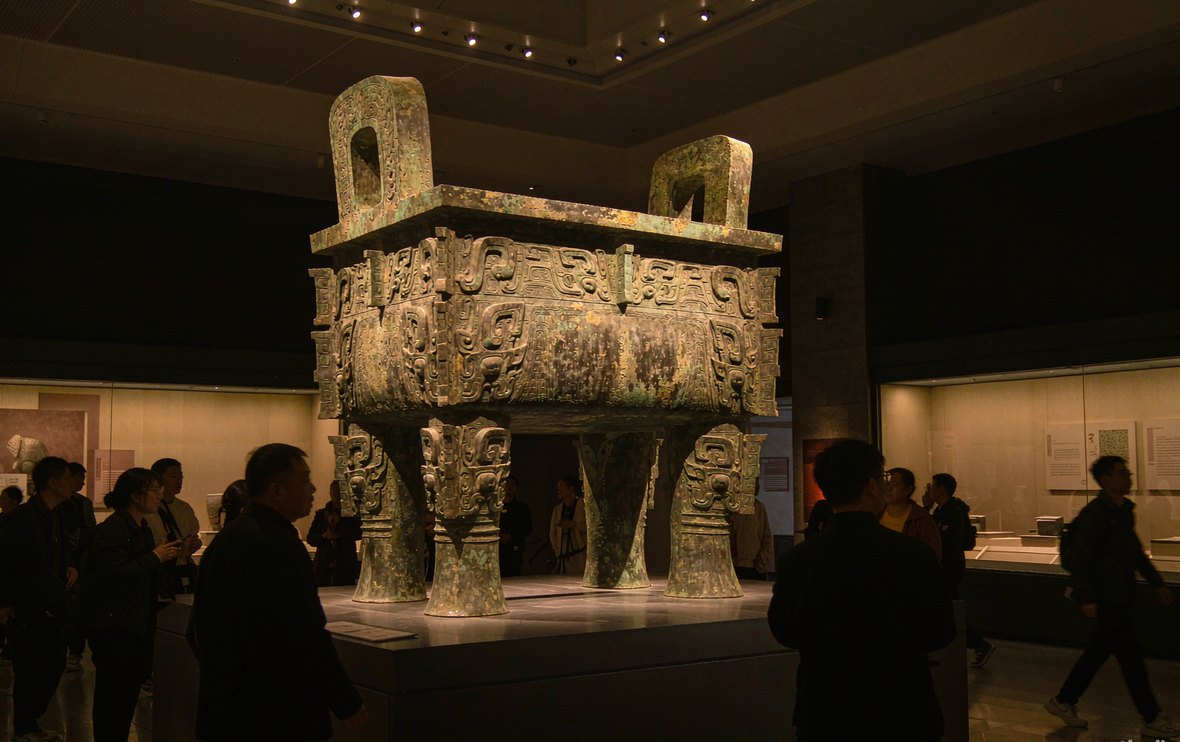
Yinxu, at Xiaotun village in Anyang, Henan, was the late Shang capital (c. 1300–1046 BC). Since Wang Yirong recognised the script on “dragon bones” in 1899, some 150,000 inscribed oracle bones have been recovered here, turning the Shang from legend into documented history. The site also holds the foundations of great palaces and ancestral temples, royal tombs, bronze foundries and sacrificial pits. The tomb of Fu Hao, the only intact royal Shang burial, yielded more than 1,900 objects; its occupant is the first woman commander in Chinese history whose existence is documented. Yinxu thus carries three identities at once: the birthplace of Chinese writing, the capital of Shang civilisation, and the cradle of Chinese archaeology. Inscribed in 2006, it remains the first place to stand in order to understand where Chinese civilisation came from.
The oracle bones of Yinxu are the divination archive of the Shang royal house: diviners scorched turtle shells and cut the inscriptions, recording sacrifice, campaigns, celestial signs, harvests, illness and childbirth, in a fixed sequence from preface and charge to omen and verification. The royal genealogy in the inscriptions matches the “Basic Annals of Yin” in the *Records of the Grand Historian* so closely that Wang Guowei's method of double evidence was founded on it — excavated and transmitted texts confirming one another, the standard method of Chinese historical scholarship ever since.
More than eighty per cent of oracle-bone characters are phonetic-semantic compounds: this is a mature script, not picture notation, and the maturity of Chinese writing was already achieved in the late Shang. From bone to bronze, to seal, clerical, regular, running and cursive script, the evolution has never once broken. Among the writing systems of the world, only Chinese has managed this.
Excavated in 1976, the tomb of Fu Hao is the only royal Shang burial never robbed. Fu Hao was a wife of King Wu Ding, and the inscriptions record her leading thirteen thousand troops against the Qiang — the first documented woman commander in Chinese history. The tomb held more than four hundred bronzes, among them two great square ding and four bronze axes, and over 750 jades; the axes are the insignia of supreme military command.
Fu Hao rewrote the imagination of Shang society: a queen could command armies, preside at sacrifices and hold her own fief and fortune. More than three thousand years ago a Chinese woman reached that political height, and the tomb is therefore a landmark in both gender history and military history.
The royal cemetery holds thirteen great tombs and thousands of sacrificial pits; the remains of human victims record the Shang institution of human sacrifice with cold clarity, splendour and cruelty in the same frame. The enormous ding of Si Mu Wu, later read Hou Mu Wu, came from this cemetery: 832.84 kilograms, cast by hundreds of hands, the heaviest bronze ever unearthed. The ding became the ultimate emblem of sovereignty, giving Chinese the phrases for coveting the throne and for founding a dynasty.
The foundry sites show an extreme division of labour — pattern-making, mould-making, smelting, pouring, each a specialism of its own: large-scale organised production already existed under the Shang. Royal power announced rank through the size, number and ornament of ritual vessels, and the political aesthetic of lodging ritual in bronze reached its first height at Yinxu.
In 1928 the Institute of History and Philology of the Academia Sinica opened the first scientific excavation at Yinxu, the first modern dig directed independently by Chinese scholars. Dong Zuobin, Li Ji and Liang Siyong established a Chinese paradigm of stratigraphy and typology here. Fifteen seasons trained the first generation of Chinese archaeologists, and Yinxu earned the name “cradle of Chinese archaeology”.
From a chance find in a pharmacy to the systematic archaeology of a capital, a century of digging at Yinxu is itself the growth story of modern Chinese scholarship. Today the Yinxu Museum and the archaeological park keep expanding: the source site of documented history is also a classroom of civilisation.