Dates
AD 618–907
The Tang was Huaxia civilization's high noon a...
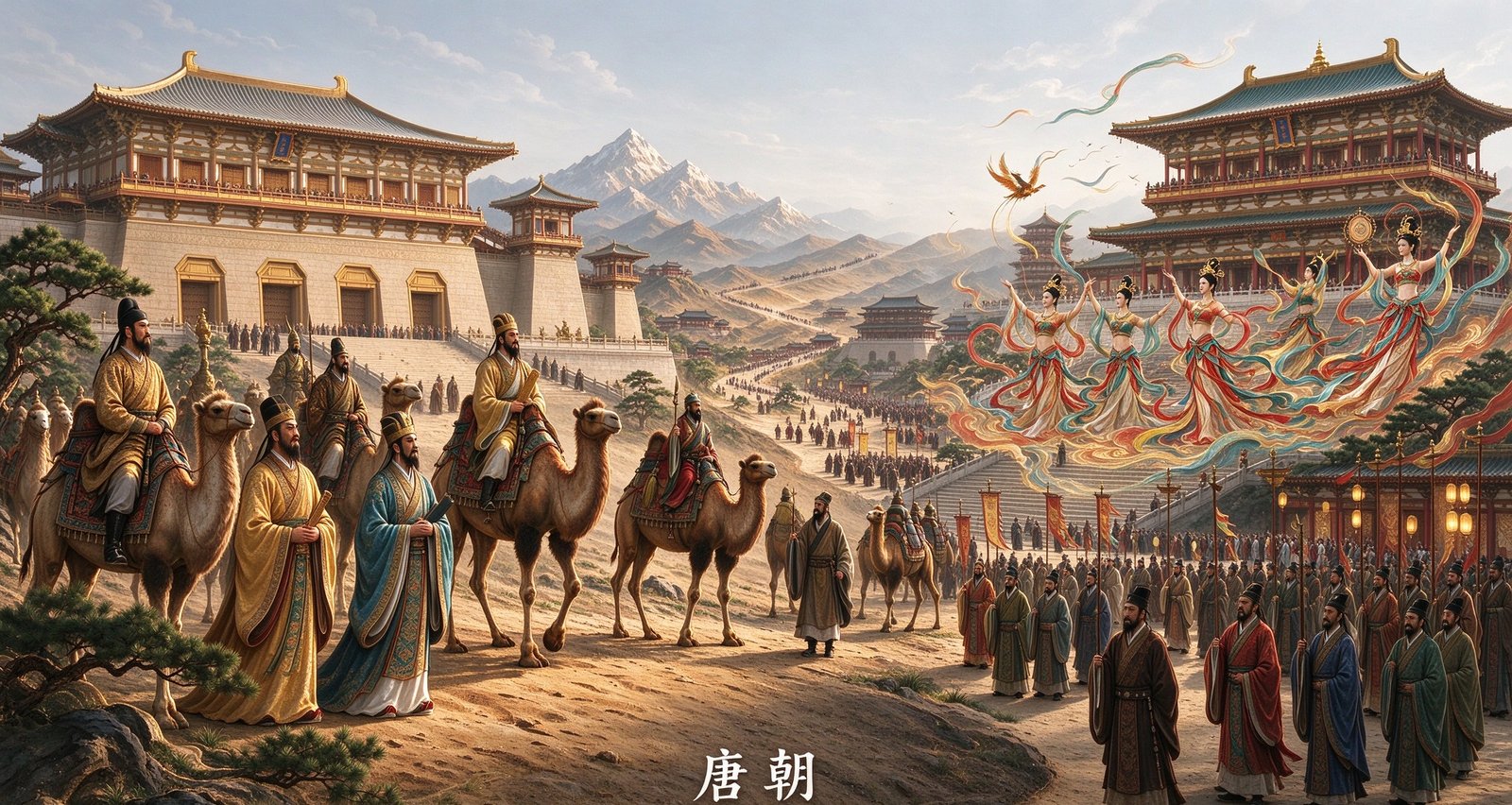
The Tang was Huaxia civilization's high noon and the mightiest, most open empire of its day. Across nearly three hundred years it climbed the summits of the Zhenguan and Kaiyuan orders and descended through the An Lushan Rebellion, the garrison warlords, eunuch power, and the Niu-Li factional strife, to end in Huang Chao's flames. Tang's internationalism was unprecedented: Chang'an held a million people — Sogdian caravans, Japanese envoys, students and monks; Silla servants and Persian Nestorian priests shared one city. Taizong was hailed "Heavenly Khagan"; the loose-rein prefectures reached beyond the desert and over the Pamirs. Nearly fifty thousand Tang poems became the poetic genome of the national tongue; calligraphy's Yan sinews and Liu bones, painting's Wu drapery, woodblock printing's first appearance, Wu Zetian's palace examinations — the Tang demonstrated a civilization's confidence: open rather than closed, fusion rather than exclusion. That confidence is the origin every later Chinese revival looks back to.
In 626 at the Xuanwu Gate Li Shimin killed his brothers and pressed his father — and with that stain spent twenty-three years doing something harder: taking Sui's fall as his mirror — "water can carry the boat and overturn it" — accepting remonstrance like a stream (Wei Zheng spoke to his face over two hundred times), lightening burdens, slimming the bureaucracy, perfecting the examinations. In the Zhenguan years "nothing was left on the roads, doors unbarred at night, travelers slept in the open fields"; the four quarters submitted, and Taizong was hailed Heavenly Khagan — a golden age whose hallmark was self-restraint.
Xuanzong's early Kaiyuan era was Tang's zenith: Yao Chong and Song Jing as chancellors, households doubling in number, "the least town hides ten thousand hearths"; Du Fu remembered "the perfect days of Kaiyuan." Between the two golden ages stood Wu Zetian — she reshaped the bureaucracy with harsh commissioners and the palace examination, banking institutions and talent for Kaiyuan. The recipe of golden ages became classic: restraint, remonstrance, light taxes, good appointments.
Tang Chang'an covered eighty-four square kilometers, the largest city on earth: the Vermilion Bird avenue one hundred and fifty meters wide, one hundred and eight wards laid out like a chessboard, the two markets thick with merchants. Turks, Sogdians, Persians, Arabs, Sillans, and Japanese lived side by side; Nestorian, Zoroastrian, Manichaean, and Muslim houses of worship stood beside Buddhist temples and Daoist abbeys — Tang did not demand that you become Tang, only that you keep the law and pay taxes. This "cultural openness under institutional confidence" was the wellspring of Chang'an's charm.
The exported civilization transformed East Asia: Japan's Taika reforms copied Tang wholesale (Heijokyo was a little Chang'an), Silla built its state on Tang institutions; the written word, law codes, Buddhism, and tea spread through the "East Asian cultural sphere." Jianzhen crossed to Japan six times to transmit the precepts; Kukai and Ennin came to Tang seeking the law — Chang'an was, for the seventh-to-ninth-century world, both Rome and Jerusalem.
In 755 An Lushan, jiedushi of three frontier garrisons, rose at Fanyang under the banner of "safeguarding the realm against crisis"; one hundred and fifty thousand iron cavalry rode south; Luoyang and Chang'an fell in turn; Xuanzong fled headlong to Shu, and at Mawei the beloved consort Yang was strangled. The rebellion lasted eight years; Guo Ziyi and Li Guangbi, with Uyghur aid, recovered the two capitals, but the Hebei garrisons submitted in name and ruled independent — a crack that never closed. "The state is shattered; hills and rivers remain; spring in the city, grass and trees growing deep" — high Tang's splendor broke on the war drums of Yuyang.
The deeper lesson of the An Lushan Rebellion was military imbalance: after the fubing militia dissolved, salaried armies and garrison commanders concentrated force at the frontier — light within, heavy without. Thereafter garrison separatism, eunuchs commanding the Shence army, and the Niu-Li strife combined, yet the dynasty survived its second half by more than a hundred years — Jiangnan's taxes and the canal were its lifeline. Du Fu's verse witnessed the turn: "Beacon fires three months running; a letter from home worth ten thousand gold."
The *Complete Tang Poems* collects nearly fifty thousand poems by over two thousand two hundred poets: Li Bai's heaven-sent ease, Du Fu's brooding weight, Wang Wei's Chan serenity, Bai Juyi's plain warmth, Li Shangyin's veiled depth — the full emotional spectrum of an age on record. "Read three hundred Tang poems well" — Tang poetry became the aesthetic bedrock of the mother tongue, every Chinese child's first lesson in language.
Cultural confidence showed in thought too: Han Yu resisted Buddhism, revived Confucianism, and launched the Ancient Prose movement — "writing to carry the Way" fixed the scholar's duty of discourse; Liu Zongyuan and Liu Yuxi, in exile, wrote the *Eight Records of Yongzhou* and the *Inscription of the Humble Room*. The Tang proved that a civilization's strongest hour is not when its arms are mightiest but when it throws its doors open to the world — a memory that became the prototype of every later "revival."