Date
AD 1256–1358
Yuan Shangdu stands on the Jinlianchuan grassl...
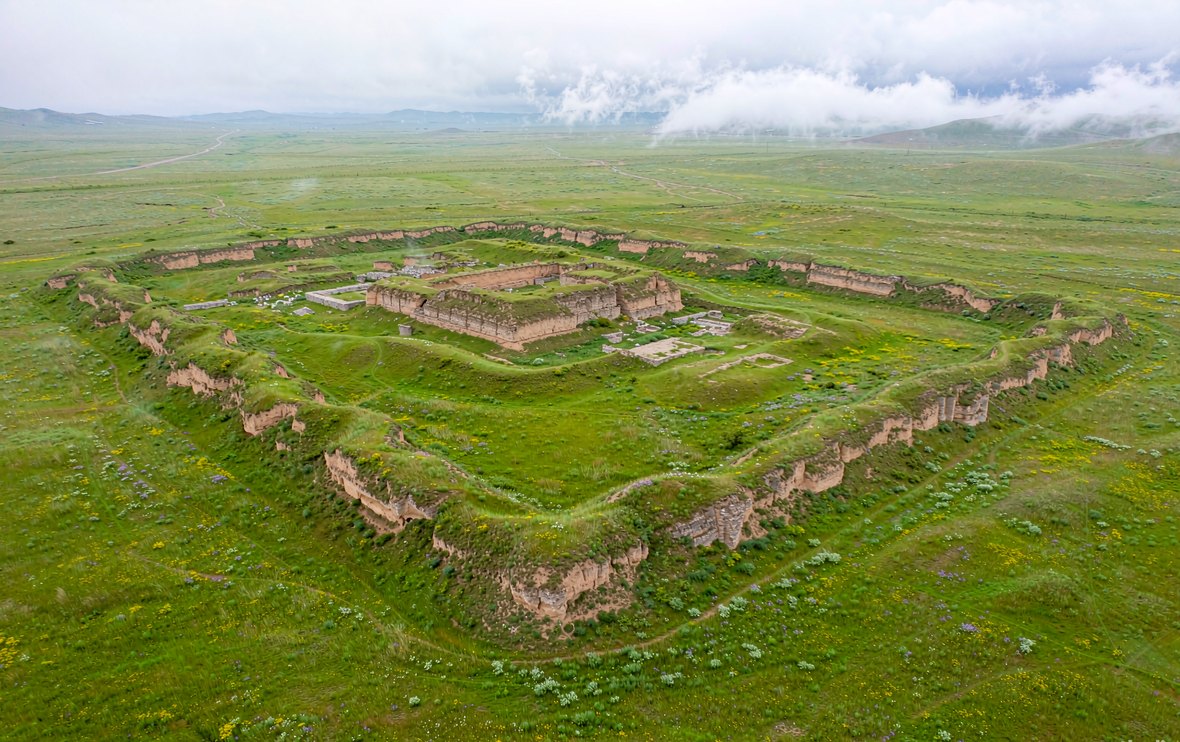
Yuan Shangdu stands on the Jinlianchuan grassland of Zhenglan Banner in Inner Mongolia and was the first capital of the Yuan dynasty, begun in 1256. Kublai Khan was enthroned here, and each summer and autumn the Yuan emperors travelled up to govern from Shangdu, making it the second heart of Yuan politics: a steppe capital paired with the Central Plains capital of Dadu, today's Beijing. The city was designed by the Han adviser Liu Bingzhong, with outer city, imperial city and palace city nested one inside another; within its walls stood both Mongolian tents and courts and Chinese halls and temples, steppe and agrarian civilisation joined. Marco Polo praised Shangdu extravagantly, and Xanadu entered the Western languages as a synonym for paradise, prompting Coleridge's famous poem. Burned in the wars after 1358, Shangdu lay lost in the grass until its inscription in 2012. It is a capital asleep in a sea of golden lilies, where the growth rings of nomadic and settled civilisation are still legible.
In 1251 Kublai was appointed to govern the conquered Han territories south of the desert and pitched his court at Jinlianchuan, the golden lily river, named for the flowers that cover it, gathering Chinese scholars around him. This Jinlianchuan secretariat — Liu Bingzhong, Yao Shu, Xu Heng and a generation of talent — built Shangdu. Kublai was enthroned here in 1260, and Shangdu became the first Chinese capital of the Mongol empire.
For the next century the Yuan emperors moved between two capitals each year: summer at Shangdu to escape the heat and govern, autumn back to Dadu to rule the plains — an imperial circuit from Beijing to the steppe. Shangdu was thus the political centre of the steppe world, where the great kurultai assemblies, the hunts and the sacrifices took place, and where the steppe character of the Mongol empire continued.
Outer city, imperial city and palace city nest one within another. The imperial and palace cities were built by Chinese craftsmen in rammed earth faced with brick, their streets and halls following Chinese rules; the outer parkland kept large open areas for pitching court tents — tents within the city, the nomadic habit of space set directly inside a fixed settlement. The Daan Pavilion, the principal hall, was reportedly built from timbers salvaged from the Xichun Pavilion at Kaifeng: Central Plains technique standing on the steppe horizon.
This double system is unique in the history of world capitals. It is neither simple sinicisation nor the mere preservation of tradition, but the coexistence of two civilisations in one urban space. Shangdu has accordingly been judged an outstanding example of the plural fusion of Mongol-Yuan civilisation.
Around 1275 Marco Polo reached Shangdu with his father and met Kublai in the Daan Pavilion; his *Travels* devotes a chapter to the marble palace, the bamboo pavilion and the busy markets, and Shangdu became the first coordinate of Western imagining about Eastern wealth. In 1797 Coleridge wrote *Kubla Khan*, singing of its stately pleasure-dome, and Xanadu entered English as a name for a gorgeous earthly paradise.
A travel book and a poem gave a steppe capital a second life in Western culture: Orson Welles named Kane's estate Xanadu in *Citizen Kane*, and brands and resorts have borrowed the name for their spaces. The spread of civilisations is full of accident: half of Shangdu's fame was in fact written for it by Western literature.
Burned in the early Ming and lost in the grassland for six hundred years, the site was known locally as Zhaonaiman Sumo. Systematic archaeology from the 1990s revealed the triple walls, the Daan Pavilion platform, the Muqing Pavilion and the palace gardens. Preservation is exceptional: no later city was built over it, which makes it the original negative of a Mongol-Yuan capital.
Inscribed in 2012 for embodying the fusion of nomadic and agrarian cultures, the site is open together with the Jinlianchuan grassland. Each summer, when the golden lilies bloom, visitors see wall and flower in one frame: the summer capital of six hundred years ago still keeping its own kind of summer.