Date
AD 634–904
The Daming Palace was the palace and political...
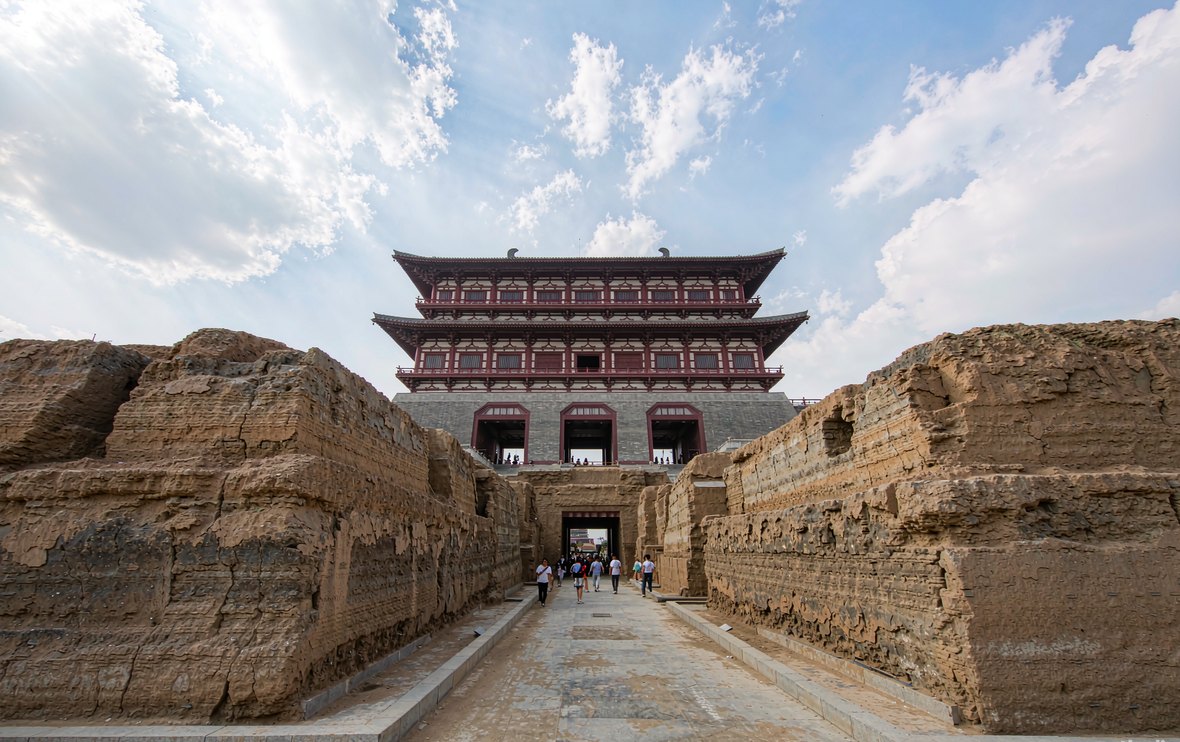
The Daming Palace was the palace and political centre of the Tang, from 634 to 904, on the Longshou plain north of Xi'an. Some 3.2 square kilometres in extent, four times the Forbidden City, it issued every edict of the empire's most brilliant two centuries. The Hanyuan Hall stood on a terrace at the southern edge of the plain, looking down on Kunlun and out to Zhongnan; the Dragon Tail Way coiled up before it in three flights, and envoys of ten thousand nations raised their eyes to China from its foot. Linde Hall was the greatest banqueting hall in Changan, and the Taiye Pool with its Penglai Mountain gave the palace the unity of garden and court that marks the High Tang. In 904 Zhu Wen forced Emperor Zhaozong to Luoyang, demolished Changan and burned the palace; the city became a field of rammed-earth platforms, silent for a thousand years. Listed among the first national key cultural sites in 1961, opened as a national archaeological park in 2010 and inscribed in 2014, the Daming Palace has lost its body, but the platform of Hanyuan Hall remains the closest place to the presence of the High Tang.
Hanyuan stood on the southern lip of the Longshou plain, on a platform more than ten metres above the ground, with the Dragon Tail Way climbing to it in three zigzag flights: officials and foreign envoys ascended step by step, raising their eyes to the jade throne as if to the Milky Way. Wang Wei's famous lines — the gates of heaven open on the palace, ten thousand nations bow to the tasselled crown — describe the New Year audience held here. The height of Hanyuan was itself political rhetoric: the ceremony of power was performed by architecture.
Reconstruction from excavation shows a hall eleven bays wide and four deep, with a surrounding veranda, flanked by the Xiangluan and Qifeng pavilions joined by flying corridors like the spread wings of a great bird: the summit of Tang timber imagination. Only rammed earth and column bases remain, yet standing on the platform one still understands what architecture as national strength means.
The Daming Palace ran some 7.6 kilometres around and covered 3.2 square kilometres, more than four times the Forbidden City. From south to north came the Danfeng Gate, the imperial way, Hanyuan, Xuanzheng and Zichen halls in sequence, with the Taiye Pool and Penglai Mountain closing the northern end. The pattern of court in front and residence behind, of palace and garden as one, was completed here and became the direct model for the Ming and Qing Forbidden City.
The Danfeng Gate site confirms the scale of the Tang capital's main gate, its five passages reserved to the emperor; the imperial way was 176 metres wide, broader than Chang'an Avenue in Beijing today. The sense of scale in the High Tang was a whole national aesthetic: space to declare bearing, engineering to write national strength.
Excavation at the Daming Palace has proceeded systematically since 1957, revealing Hanyuan, Linde, the Taiye Pool and the Danfeng Gate in turn; column bases and glazed tiles from Linde restore the bulk of Changan's greatest banqueting hall, eleven bays by seventeen. In 2010 a national archaeological park of 3.5 square kilometres opened: the largest central city park in the world, laid over one of the largest palace sites in the world.
The park-plus-site model has brought both argument and experiment: the relocation of residents and the measure of reconstruction are world-class problems in the protection of great sites. The Daming Palace answer has been restraint — no fake palaces, only guarded platforms, and the rammed earth left to speak for itself.
In 904 Zhu Wen forced Emperor Zhaozong to move the capital to Luoyang and ordered the people of Changan to follow by household register, pulling down houses and floating the timber down the Wei. The palaces became ruins: from now on no flowers, and no sorrow either, wrote Wei Zhuang. The burning of the Daming Palace was no accident but the physical end of the Tang empire; the destruction of the political centre is the last chapter of a dynasty.
Yet the palace lives on in another form: the court memories of Li Bai and Du Fu, the palace imaginings of Tang tales. In literature the Daming Palace is greener than in archaeology. Ruin and text feed each other, and the High Tang becomes a spiritual space one can enter again and again.