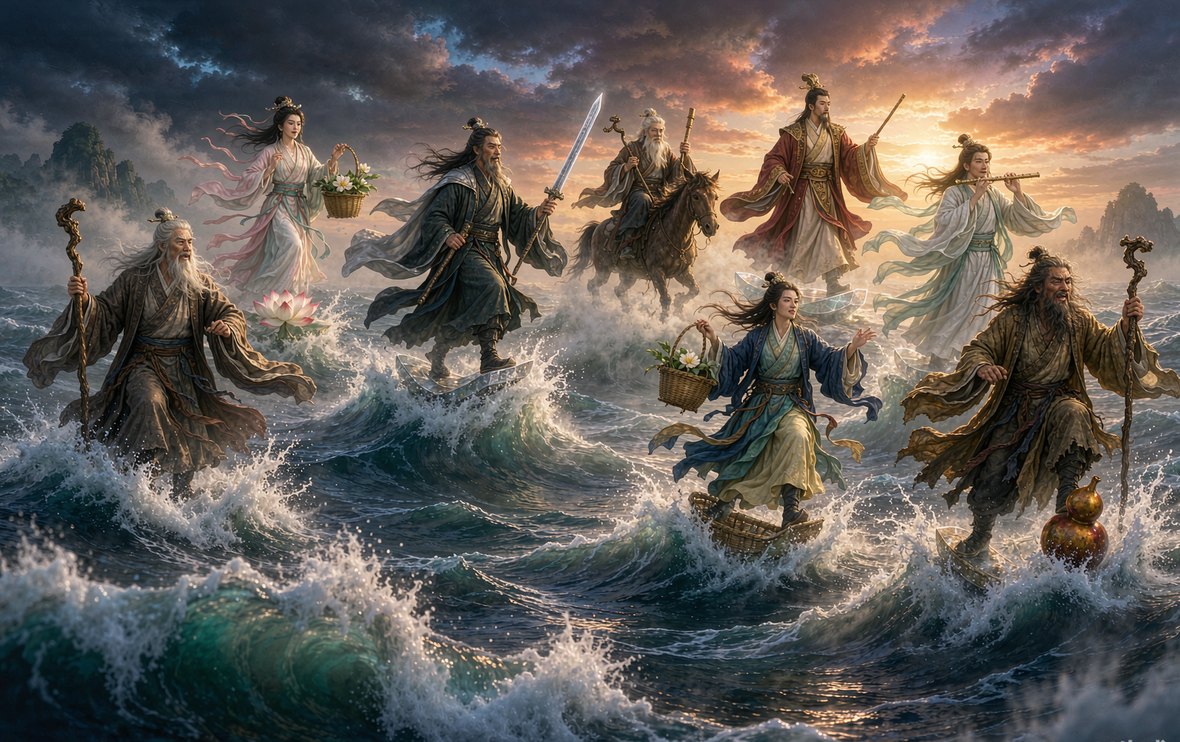
Eight immortals crossing the sea — why no boat? — Because "each shows his own powers" is what this story really wants to say.
The Eight Immortals each cross the sea by their own art. Everyone has a path of their own — arrive by your own strength.
Each finds his own way across.
Eight immortals of wildly different origins — Li Tieguai, Zhongli Quan, Zhang Guolao, Lü Dongbin, He Xiangu, Lan Caihe, Han Xiangzi, Cao Guojiu — returning drunk from the Peach Banquet, reach the Eastern Sea. Lü Dongbin proposes: no boat; each crosses by his own treasure. So Li Tieguai throws down his iron crutch, Han Xiangzi his flower basket, He Xiangu her lotus... each shows his powers, and they cross. There is no world-saving, no pathos in this story — only a company of utterly different characters, each crossing their own sea on their own ability.
What is most special about the Eight is that none of them looks like a god: a lame beggar (Li Tieguai), an old Daoist riding his donkey backward (Zhang Guolao), a youth with a flower basket (Lan Caihe), an imperial in-law (Cao Guojiu), and the one female immortal, He Xiangu. Ragged clothes, fond of wine and merriment — yet every one of them attained the Dao.
The message of this pantheon is thoroughly plebeian: godhood depends on neither birth nor looks nor gender, only on whether one has cultivated through to clarity. The Chinese brought their gods down off the altar and into the marketplace.
Lü Dongbin said: we are immortals — why not each cross on his own treasure instead of taking a boat? So each cast forth his implement and stepped across it. No single method, no queue; each by his own skill.
"The Eight Immortals cross the sea, each showing his powers" became a Chinese maxim for living: facing the same sea, different crossings are allowed. In it is a very Chinese tolerance — no demand for uniformity, only that each have something of their own to offer.
The story of the Eight is full of wine and laughter: banquets, drunkenness, contests of magic, the crossing itself. It preaches neither karma like the Buddhist tales nor cultivation like the Daoist scriptures; it is about liveliness, relish, the delight of a company of people each showing what they can do.
That is why the Eight became the most beloved immortal band in folk life: they belong not to the court, but to New Year prints, opera, porcelain, and the talk of ordinary people. The Chinese love of life came down to earth on these eight figures.