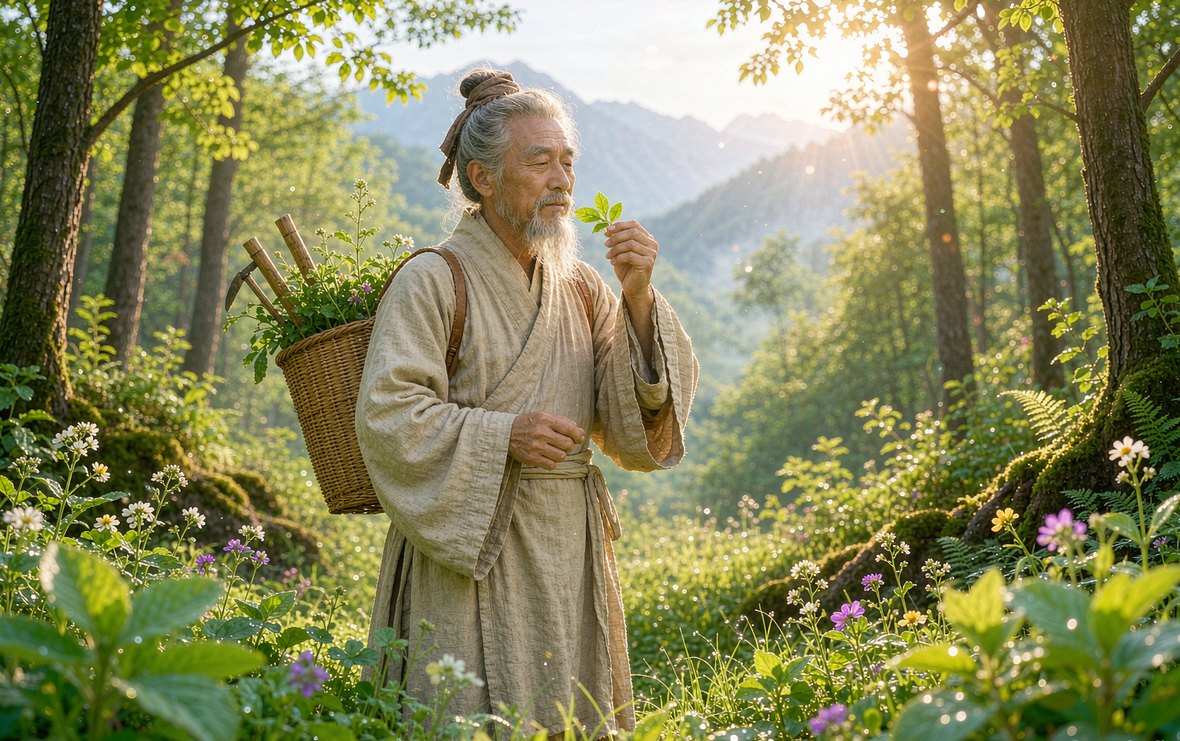
Why did China's god of medicine not simply bestow medicine on humanity, but taste every herb himself? — Because Chinese civilization believes truth is tested, not dropped from heaven.
He tastes herbs with his own body to find food and medicine. Selfless devotion; truth through exploration.
Sacrifice to bring blessings to all.
In high antiquity people gathered wild plants for food and were often struck down by poison. One sage, unwilling to see his people live by luck, tasted a hundred herbs himself — which were sweet and edible, which bitter yet healing, which deadly, he recorded with his own body. Legend says he was poisoned seventy times in a single day and still did not stop. The Chinese trace both farming and medicine to this Shennong who "experimented with his own tongue": the progress of civilization is not a gift from the gods, but something one man tested on behalf of everyone.
The Huainanzi records: "Shennong tasted the flavors of the hundred herbs and the sweetness and bitterness of the waters… and met seventy poisons in one day." The text does not make him an invulnerable god but a man who was poisoned again and again and tried again anyway. What we call divinity is simply sacrifice carried to its limit.
The seventy poisonings bought a "safety list" written in flesh. The Chinese honor Shennong not for what he discovered, but for daring to put the unknown into his own mouth — so that others need not take the risk.
Shennong distinguished the five grains and taught the people to sow them — Chinese agriculture begins there. He also classified the properties of herbs, their cold and heat, their pairing as sovereign and minister; later ages, in his name, compiled the Shennong Bencao Jing, first of the four great classics of Chinese medicine. Bowl and medicine chest come from the same pair of hands: food and medicine share one source.
From then on the word bencao — "roots and herbs" — became the very name of Chinese medicine. The Bencao Gangmu lists 1,892 drugs, each verified by someone who personally tested it — a path of "seeking truth with one's own body" that starts at Shennong's tongue.
The myth of Shennong answers a fundamental question: where does knowledge come from? The Chinese answer is startlingly plain — from practice, from sacrifice. No revelation, no heavenly book; only one sage and a hundred herbs.
Selfless devotion; truth through exploration. The words still burn today: behind every herb's recorded properties, remember that someone was poisoned seventy times first, on behalf of all under heaven.