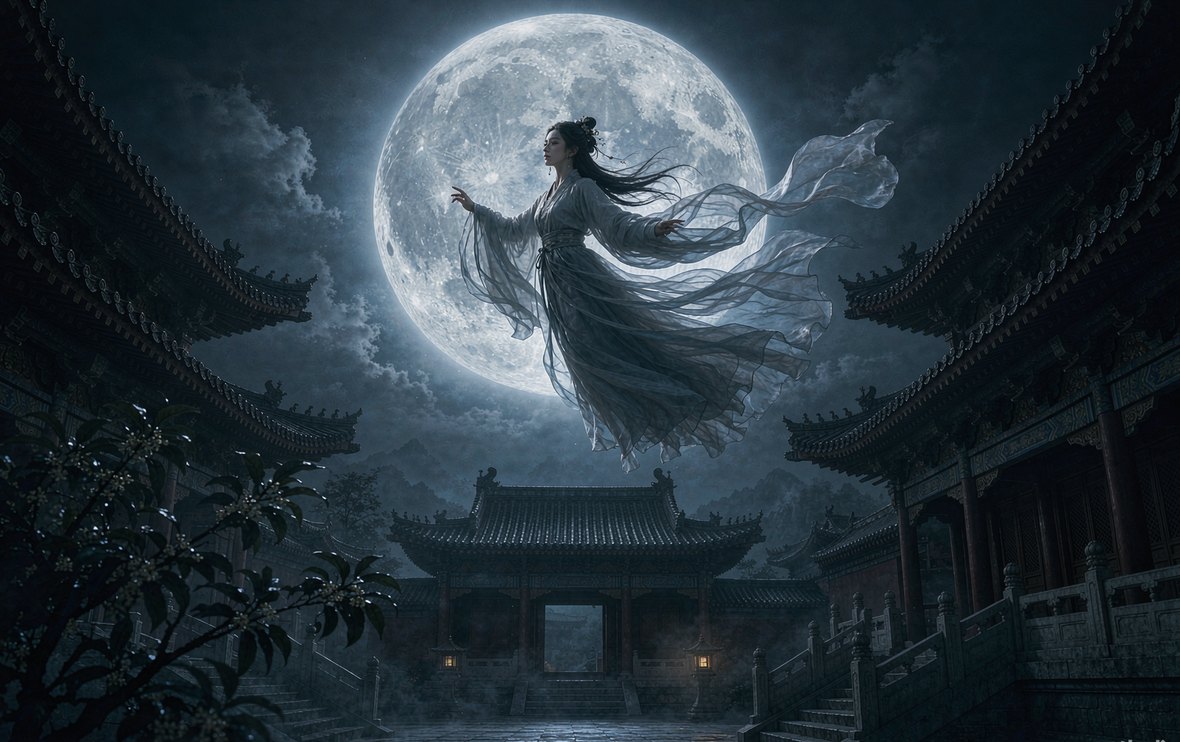
If immortality meant eternal loneliness, would you still swallow the pill? — With a whole moon palace, Chang'e answered this question for the Chinese.
She flies to the moon palace beyond the clouds. Yearning for a lofty and sacred ideal.
Fly upward toward the sacred heaven.
The mid-autumn moon is gentle because a woman of China's collective memory lives upon it. The story of Chang'e has many versions: some say she stole the elixir and ate it, some that she swallowed it to keep it safe, some that she was left no choice. Whichever it is, the ending is the same — she flies to the moon palace, parted forever from Houyi, leaving only the Jade Rabbit pounding the elixir and the cassia scattering its scent. It is a story of gaining eternity and losing what one loves; the Chinese used it to explain the moon, and to explain what is most precious.
Houyi obtained the elixir of immortality from the Queen Mother of the West and gave it to Chang'e to keep. There was only one dose; swallow it, and one ascends. Chang'e swallowed, grew light, and rose straight to the moon palace. The crux of the story is not "theft" but "choice": eternity or companionship — only one may be taken.
Chinese myth has always been restrained about immortality — deathlessness is often not a reward but a sentence. Chang'e gained the eternal, and gained eternal loneliness. This is Chinese culture's earliest meditation on "living forever."
The moon palace is cold and quiet: only the Jade Rabbit pounding the elixir, only Wu Gang forever felling the cassia. A Tang poet wrote, "Chang'e must regret the stolen elixir — sea of azure, endless sky, a heart alone night after night." That single word "regret" turns fairyland into a cage. The wistfulness the Chinese feel looking up at the moon begins here.
Yet folk tradition never made her a villain. At Mid-Autumn people worship the moon and offer up "moon-light steeds," asking her to bless family reunion — for she is the only god who has tasted eternal parting, and so best understands what the human world longs for.
The Chang'e myth merged with the equinox moon sacrifices and the Tang fashion for moon-viewing, crystallizing at last into the Mid-Autumn Festival. Mooncakes, osmanthus wine, the reunion dinner — every rite retells the story in reverse: those on the moon cannot reunite, so those on earth must.
This is how Chinese myth works: it offers no doctrine, only a vessel for feeling. When the moon is full and hundreds of millions look up, they are all watching the same story.