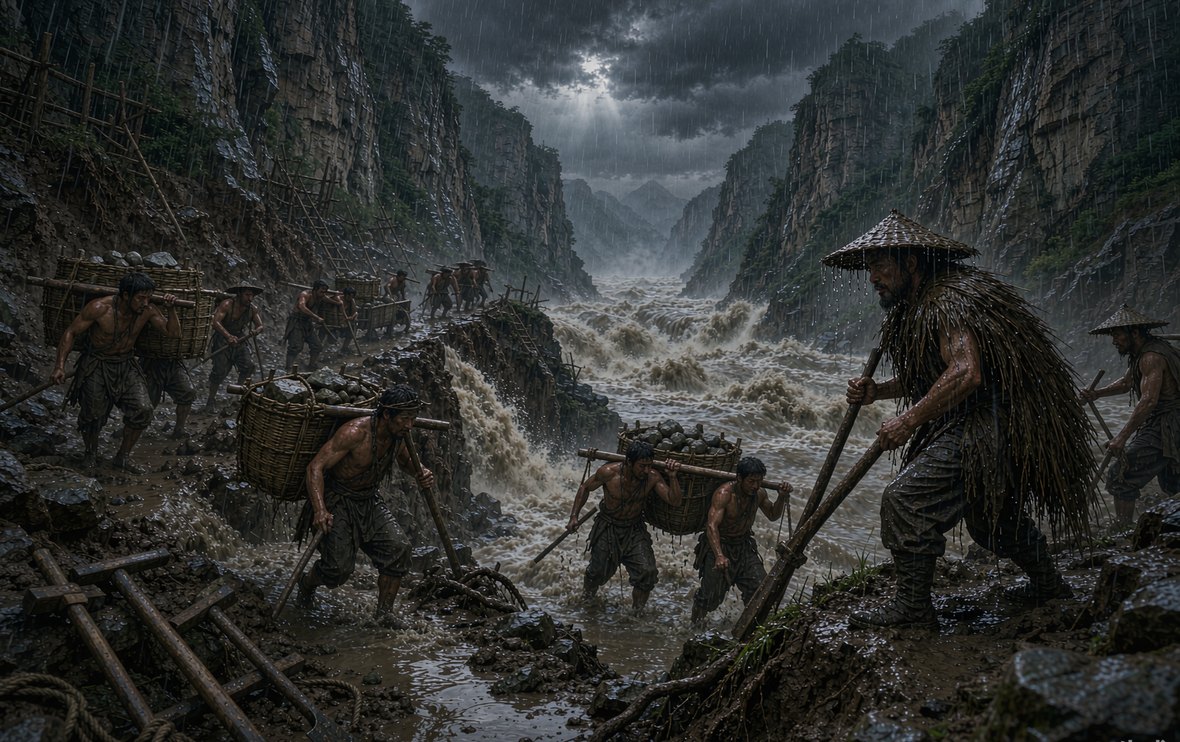
The father blocked for nine years, failed, and was killed; the son changed one word and succeeded — what exactly did Yu the Great change?
He channels the flood and brings peace to the Nine Provinces. Working with nature, building the homeland.
Wisdom calms chaos and builds home.
The flood rose to the heavens. Gun tried to dam it for nine years, failed, and was put to death. His son Yu took up the burden and switched to channeling — surveying the lie of mountains and rivers, cutting open the Longmen, splitting the Yique, guiding the nine rivers, and leading the flood to the sea. Away for thirteen years, he passed his own gate three times without entering. When the waters were tamed he demarcated the Nine Provinces, fixed the tribute, and became founder of the Xia dynasty. The story holds two of Chinese civilization's core lessons: follow the nature of things, and lead by example.
Gun fought the water by blocking — dikes and embankments; the more he blocked, the worse the breaches, nine years without success. Yu changed block to channel: following the lie of the land, he cut and guided until the water found its own way out, and in thirteen years the flood was stilled.
This is not a mere technical upgrade but a founding moment of Chinese philosophy: against an overwhelming force, head-on resistance fails; following its grain succeeds. The later wisdom of "guide by circumstance" and "channeling beats damming" traces back to this one flood.
Yu labored thirteen years and three times passed his gate without entering. Not because he did not love his home, but because duty came first. Folk legend says the first time, his wife had just given birth; the second, the child could call "father"; the third, the child could tug him home — and he never stopped.
Here was fixed the archetype of the "sage king" in Chinese political culture: a leader's title rests not on blood, but on how much he has borne for the many. Yu later received the abdication and founded the Xia on precisely this universally recognized achievement.
Taming the flood required mobilizing labor across regions, unified measurement, coordinated scheduling — a superproject that objectively midwifed the early capacities of the state. Yu demarcated the Nine Provinces by mountains and rivers, set graded tributes, and cast the nine tripods as their emblem.
Thus China's first dynasty was born bound to a flood-control project: first cooperation, then the state. This is the deepest geographic and engineering root of the Chinese tradition of "grand unity."