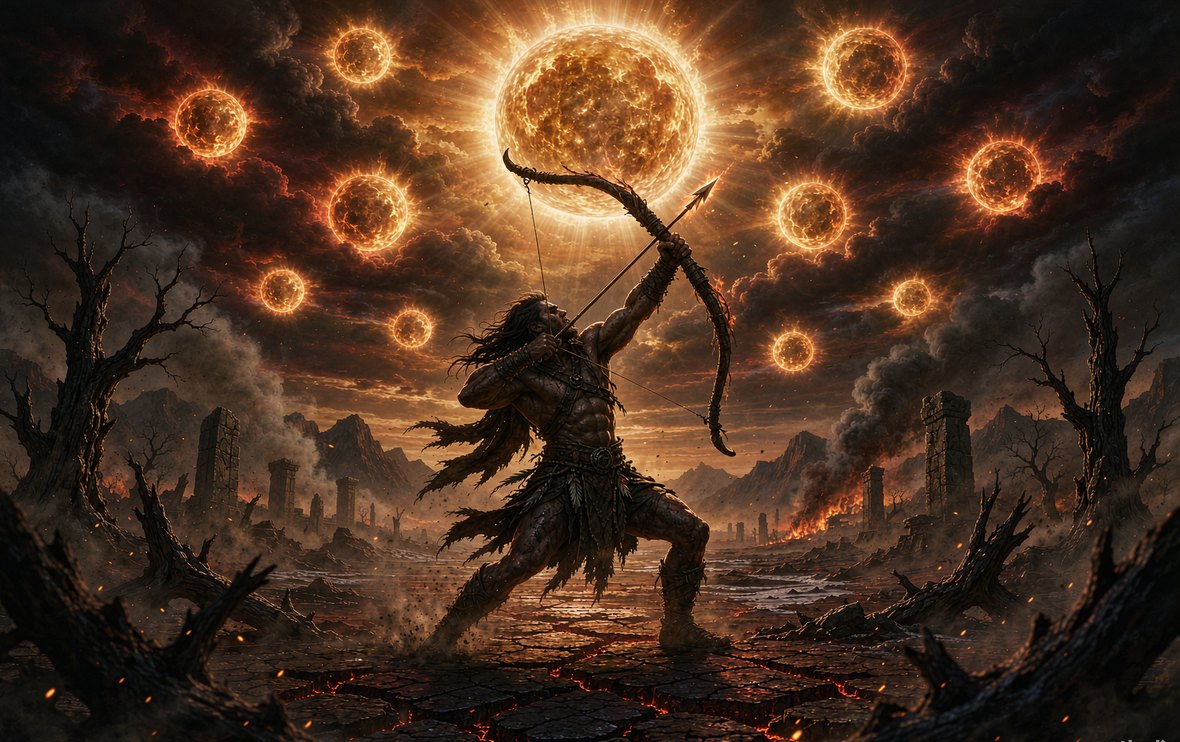
When ten suns filled the sky, the ancients reached not for prayer but for a bow — why is the savior in Chinese myth always someone who acts?
He shoots down the blazing suns and ends the calamity. Facing hardship head-on to protect the world.
Defeat disaster to protect the world.
This is the most "action-film" scene in Chinese mythology: ten suns appear in the sky at once, crops scorched, vegetation dead, rivers dried, the people with nothing to live on. Emperor Yao commands Houyi to bend his bow, and arrow by arrow he shoots down nine suns, leaving one to rise and set as before. The edge of the story lies not in divine power but in a plain question: when order fails, who sets it right? The answer — someone willing to step forward.
The Huainanzi records: in the time of Yao, ten suns rose together, scorching the crops, killing the grass and trees, leaving the people nothing to eat. Then came the monsters too — Yayu, Zaochi, Jiuying, Dafeng, Fengxi, the great serpents, each a scourge. This is not a mere disaster tale but the collective memory of extreme climate and survival crisis — drought, beasts, famine, all compressed into the single image of "ten suns."
The ten suns also carry an astronomical shadow: the ancients counted their days in ten-sun decades (xun), the ten celestial stems taking their turns — originally a calendrical concept. When the calendar fell into disorder and the sequence of seasons broke down, the sky "grew extra suns" — myth using the heavens to tell of order collapsing on earth.
Houyi shot down nine suns above and slew the beasts below; the people rejoiced, and Yao was enthroned as Son of Heaven. Note the order: disaster solved first, rule established after. Chinese myth grounds the legitimacy of rule in the concrete deed of removing scourges for the people.
More telling still: the archer was a man, not a god. Houyi was a marksman commissioned by Yao, armed with bow and strength, not with an oracle. From its very source, Chinese culture defined the hero as the one who gets things done: only those who solve problems deserve the name.
Houyi obtained the elixir of immortality; Chang'e swallowed it and flew to the moon palace, and husband and wife were parted forever. The hero shot down the suns but could not keep his own reunion — Chinese myth, at the very height of triumph, always adds one stroke of human lack. Houyi's story therefore ends not in victory alone, but with warmth and a sigh.
Folk custom still watches the moon at Mid-Autumn and invokes Yi in the fiercest heat of summer; the story has long outgrown the bounds of myth. It became a posture of the Chinese mind facing disaster: look up at the sky, then get to work.