Historical depth
c. 4,000 years · Mawangdui Han embroidery
Embroidery is the traditional art of stitching...
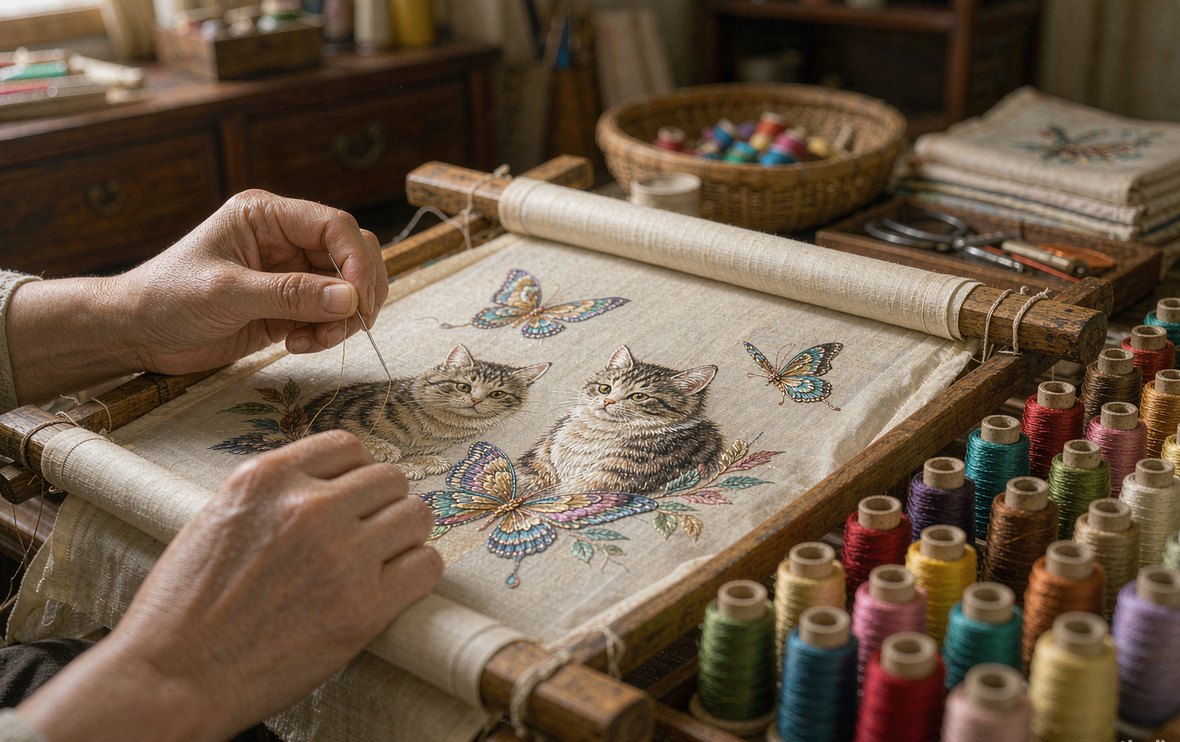
Embroidery is the traditional art of stitching patterns into cloth with needle and thread — the needle for a brush, the thread for ink. Its history in China reaches back four thousand years (*The Book of Documents* already records painting the upper garment and embroidering the lower), and the embroideries of the Mawangdui Han tomb are already exquisite. Its genealogy is organised around the four great schools: Su embroidery (fine, delicate, elegant, clean — the double-sided cat with living eyes), Xiang embroidery (lions and tigers, its mane stitch unrivalled), Yue embroidery (dense composition, gold and silver thread, opulent), Shu embroidery (strict stitching, even silken surfaces); beyond them Bian, Lu, Ou and Han embroidery each have a local manner, while the Miao, Qiang and Man traditions form aesthetic universes of their own. The stitch repertoire is vast — flat, random, seed, knot, braid, weave, appliqué, couching, more than a hundred in all — and a single silk filament can be split into sixty-four: a thread finer than a hair producing light of an optical quality. Contemporary embroidery has risen into art, with double-sided work in different colours and different images and portraits rivalling photography; the four great schools and the ethnic traditions are all on the national intangible heritage list — China on the point of a needle, delicate and immense.
The four great schools are four local temperaments expressed in thread. Su embroidery (Suzhou) is known for fine, delicate, elegant, clean work — graceful pattern, quiet colour; in double-sided embroidery a single stitch serves both faces, and the two pupils of the cat's eyes catch the light at different angles, the embroiderer having split her silk to a sixty-fourth, finer than a hair. Xiang embroidery (Changsha) excels in lions and tigers: the mane stitch gives fur that bristles with life and a domineering force. Yue embroidery (Guangzhou and Chaozhou) is full in composition and strong in colour, gold and silver couching standing proud like relief, "a hundred birds paying court to the phoenix" its classic. Shu embroidery (Chengdu) is strict and even in stitch, delicate in shading, its hibiscus and carp alive.
The division of the four is like that of the four great cuisines: soil and water raise the embroidery — Jiangnan tenderness, Hunan stubbornness, Lingnan blaze, Sichuan steadiness, each place embroidering itself, each beautiful in its own way.
The technical core is stitch and filament: flat stitch for evenness, random stitch overlapping (crossing lines to render light and shade, producing an oil-painting texture), seed stitch for granulation, couched gold for relief — a hundred stitches each with its strength. Splitting silk is the Su speciality: one filament divided in two, in four, down to sixty-four, so that skin, down and halo are rendered in threads the eye can barely see; a portrait may take months of splitting and a year or more of stitching.
Double-sided and three-difference double-sided embroidery are the limit: the same cloth showing different images, different colours and different stitches on its two faces, the embroiderer directing two pictures within a hair's breadth — work of different colour and different image on either side is regarded by the international craft world as an impossibility achieved.
The motifs are wishes stitched: dragon and phoenix for marriage, a hundred boys for many sons, the five poisons on a child's bellyband to guard the summer, pomegranate and grape for abundance. Purses and scent bags, embroidered insoles, bridal coats and veils — every threshold of a woman's life had its embroidery. Needlework was a required accomplishment for traditional women: an embroidered piece was both dowry and proof of character, and the embroidery of gentlewomen became a lineage of its own.
The ethnic embroideries are equally radiant: Miao work stitches the migration epic into a sleeve (Butterfly Mother, the horses fording the river), the Qiang cloud-patterned shoes, the Man pillow ends, the Shui horsetail embroidery — horsehair wrapped in silk, tough as leather, already on the UNESCO list. Embroidery is a language shared by the whole people.
Contemporary embroidery has risen on two lines at once, as commodity and as art: Su masters' portraits stand beside photographic realism (works by Ren Huixian, Yao Jianping and others have entered the order of state gifts), and the embroidery street at Zhenhu gathers thousands of needleworkers into a complete industry; vocational colleges teach Xiang and Yue embroidery, and young male embroiderers and crossover designers have broken the old pattern.
The digital age has opened new windows: digitised motif archives, livestreamed work, collaborations and runway shows with fashion houses — Su elements have appeared on international catwalks. The craft at the needle's point is entering contemporary life at a new density — stitch by stitch, still embroidering the undying legend of a hand.