Origin
Jing County, Xuancheng, Anhui
Xuan paper is the fine handmade paper made for...
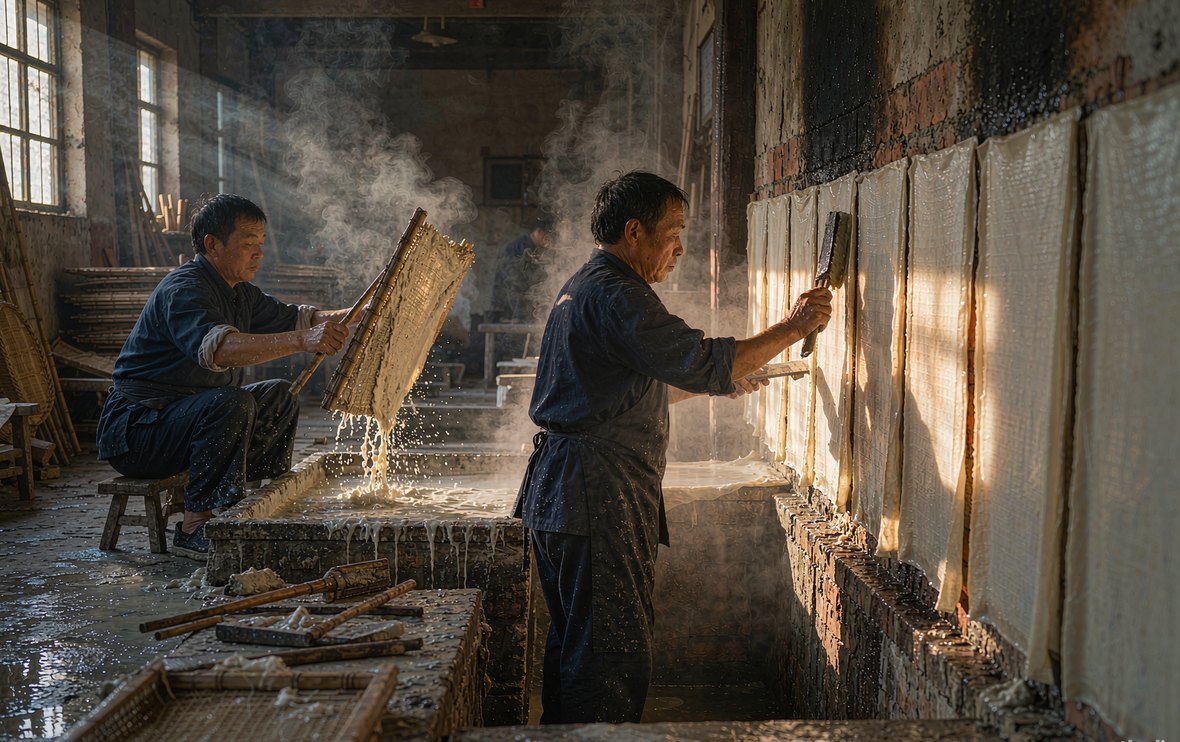
Xuan paper is the fine handmade paper made for painting and calligraphy, named for Xuanzhou prefecture, today's Jing County in Anhui: "light as a cicada's wing, white as snow, rustling like fine silk yet silent". Made from the bark of the blue sandalwood tree and sand-field rice straw, it passes through more than a hundred processes over two or three years and comes out tough yet receptive, smooth yet not slick, white and dense, pure in texture, unbroken when crumpled and superbly responsive to ink; it resists ageing, does not yellow, is seldom attacked by insects and lasts — hence "king of papers" and "a paper that lives a thousand years". Without xuan paper there would be no Chinese painting: the bleeding and settling of ink on the sheet, the five tones of ink, the wet abundance of wash all depend on its particular absorption — raw paper for expressive painting, sized paper for fine-line work, the character of the paper determining the method. The craft entered the national intangible heritage list in 2006 and went to the world in 2009 as part of the Chinese papermaking nomination; Red Star xuan paper is a world-class name among painters. The making of a single sheet takes more than two years.
Xuan paper keeps step with the history of painting: Zhang Yanyuan's *Record of Famous Paintings of Successive Dynasties* already advises the collector to "lay in a hundred sheets of xuan paper"; after the Song and Yuan the xuan of Jing County was famous everywhere, and in the Ming and Qing the paper of the Cao family was tribute. The Red Star brand was founded in 1951 and the industry became modern — a thousand-year craft joining a modern name. Its material philosophy is distinctive: sandalwood bark gives toughness and ink retention, straw gives softness and whiteness, and their proportions determine the grades — cotton stock, pure bark, special pure bark.
"A thousand years of paper" has a scientific basis: xuan is mildly alkaline and low in lignin, extremely resistant to oxidation and ageing, as tests on the paper of ancient paintings in the Palace Museum confirm. A sheet of xuan outlives most dynasties.
The process is close to a spiritual discipline: sandalwood branches are cut at three years, steamed, soaked and bleached by sun and rain (eight to ten months on the drying field); the straw is limed, spread and purified; then the two are blended, beaten, lifted, dried and cut. Lifting the sheet is the soul of the work: two masters carry the bamboo mould into the vat, dip and lift, and the pulp settles evenly on the screen — "one vat of water against the body, a second to break the heart", a mnemonic handed down for a thousand years. The dryer peels the sheets off the heated wall, hundreds a day, every movement earned by years.
In 2006 the craft entered the national intangible heritage list, and the Xuan Paper Cultural Park in Jing County is open to visitors, who can try lifting a sheet — "half a screen of flower shadows, a whole screen of poem": every sheet is a collective work of the hand.
Xuan paper and Chinese painting complete each other: raw paper drinks and bleeds the ink, so that a single stroke separates naturally into tones, and the wet abundance of expressive painting depends on it; sized paper, treated with alum, neither bleeds nor seeps, allowing the layer-upon-layer rendering of fine-line colour; bark paper sits between the two. The painter chooses technique according to the paper, so that paper is part of the method. "Ink that never repeats itself" says that xuan lets ink produce rich gradations: the same ink comes alive on the sheet.
The character of a material shapes the character of an art: the one-pass nature of xuan, which allows nothing to be painted over, produced the Chinese conception of the idea preceding the brush — once the stroke lands it is final, as a life cannot be repainted. That philosophy long ago spilled out of painting to become a ground tone of Eastern aesthetics.
Transmission runs on apprenticeship and lineage together: Jing County has hundreds of xuan workshops and firms, and the national-level bearers of the Red Star works lead the teaching of lifting, drying and other core steps; the plantations of raw material, sandalwood and sand-field straw, are protected in step — the ecological chain of material first and paper after is guarded whole.
Xuan paper is also a diplomatic calling card: paper for state-gift paintings, APEC merchandise and bespoke restoration paper made with the Palace Museum — a sheet from Jing County is now produced to the temperament of individual painters and to the recipes of original ancient papers. The promise of a thousand years is still being written.