Categories
Wood carving · brick carving · stone carving
The Huizhou Three Carvings is the collective n...
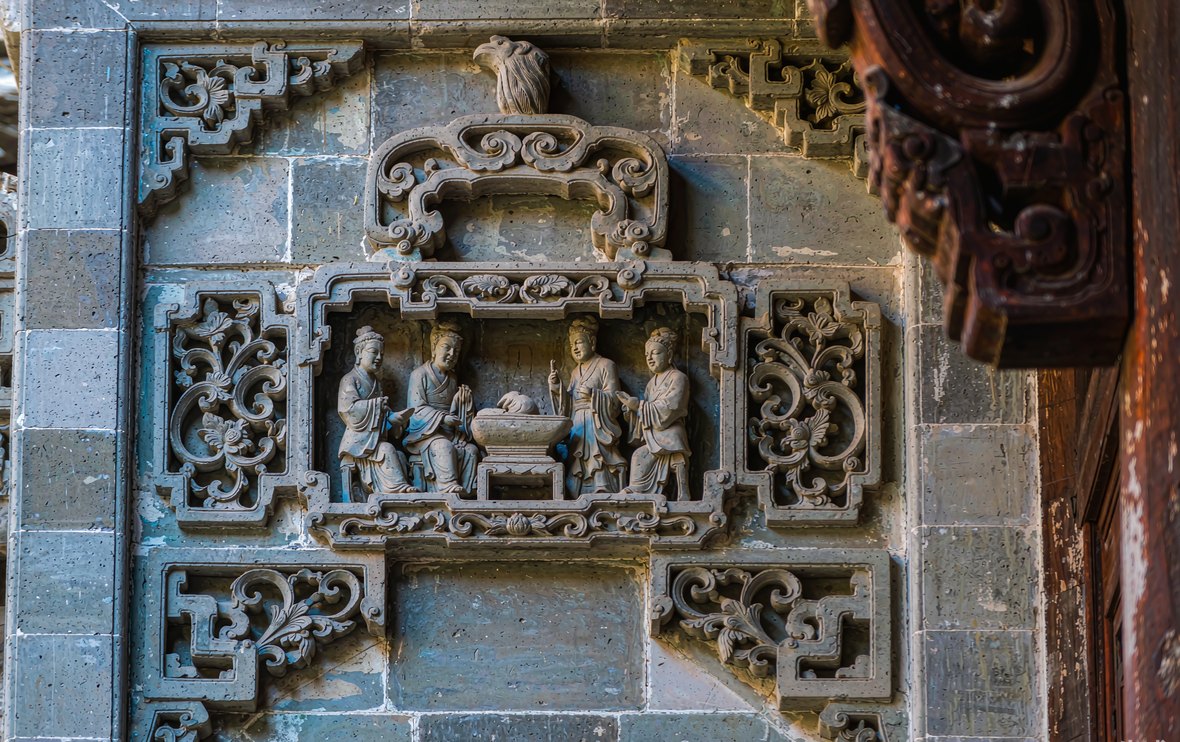
The Huizhou Three Carvings is the collective name for the decorative carving of Hui-style architecture: wood carving for beams, lintels, doors and windows; brick carving for gate towers and screen walls; stone carving for steps, column bases and memorial arches — stories, patterns and auspicious meanings are carved over every member, turning Hui-style houses into "solidified local gazetteers". The flourishing of the three carvings rested on the wealth of the Hui merchants and the learning of Huizhou: the Ming-Qing merchants were "traders who loved the Confucian way", and returning home in splendour they built on a grand scale, vying in fineness of carved beams and painted rafters. Since ritual rules capped the size of dwellings, wealth found its expression in depth of ornament — every stroke of knife and chisel was restrained ostentation. The subject matter forms its own lineage: opera scenes and figures (Three Kingdoms, the Twenty-four Filial Exemplars), antiquities and flowers-and-birds, landscapes with fishermen and woodcutters, the "hundred boys" motif, all composed with the flavour of Huizhou woodblock prints. In 2006 the three carvings entered the first batch of the national intangible heritage; the remains at Hongcun and Xidi in Yi County and at Tangyue in Shexian are the most resplendent — between white walls and dark tiles, wood, brick and stone carving are the most rewarding text.
The centre of Huizhou wood carving is the "exposed" members: moon beams, sparrow braces, tie beams, window lattices, balustrades — depth of relief is tuned to viewing distance: fine low relief like meticulous painting at close range, deeply undercut openwork of seven or eight layers high above. Opera scenes are the favourite: episodes from the *Three Kingdoms* and the *Water Margin* are compressed onto small window panels, every moustache and brow distinct; the "hundred boys" and "fisherman, woodcutter, farmer, scholar" carry every wish for progeny and ideals.
The craft sequence is rigorous: selecting timber (usually ginkgo, camphor or nanmu), roughing out, carving, refining, polishing — deep openwork requires "layered roughing", one slip and the whole piece is ruined; the wood carving of a great mansion could consume years of labour.
Brick carving is the first impression of Hui-style architecture: the gate tower and its canopy matter above all — "a thousand taels of silver, seven hundred on the gate"; the splendour of a gate's brick carving speaks the family's standing directly. On ground-polished grey bricks are carved festooned gates, inscribed plaques, layer upon layer of mouldings, with auspicious patterns and opera scenes as principal subjects — figure groups such as "Guo Ziyi offering birthday congratulations" are layered like a stage. Brick is brittle and hard, so the rule is "make the brick for the carving": bricks were fired to order, then ground mirror-flat before carving.
The depth is astonishing: gate-tower carving may be undercut to nine layers, "one brick, one drama", and it withstands centuries of sun and wind without crumbling — the clay recipe and firing of water-polished grey brick were secrets in themselves.
Huizhou stone carving is strongest at the memorial arches, ancestral halls and house foundations: the seven arches of Tangyue stand in sequence to Loyalty, Filial Piety, Chastity and Righteousness, their tie beams carved with dragons, phoenixes and lions, full of vigour after centuries of wind and rain; the column bases, lattice windows and drum stones balance delicacy with gravity — openwork stone windows "pictures in stone"; the fine-grained bluestone of Shexian is the choicest material.
Stone carries Huizhou's "monumentality": the stone drums at the ceremonial gates of halls, the commemorative function of the arches — stone is the ledger of honour of the Hui people.
The choice of subjects reveals the code of Huizhou culture: operas of loyalty and filial piety, antiquities of the four arts (qin, chess, calligraphy, painting), patterns hinting at "study and officialdom" — the self-image of merchants who "traded yet loved the Confucian way" is carved all over the walls. The constraint of ritual (dwellings must not exceed their rank) turned competition toward precision of craft — "outshining in grandeur" became "outshining in fineness", and hence the consummate level of the three carvings.
Transmission and protection advance together: the craft is on the national ICH list; artisans work in the restoration of old buildings and break out through cultural products; Hongcun and Xidi, as World Heritage, receive millions of visitors a year — tourists photographing close-ups of window lattices with their phones are the most vivid life-support this craft has.