Earliest evidence
Silk from Qianshanyang, c. 4700 years ago
The arts of sericulture and silk weaving turn ...
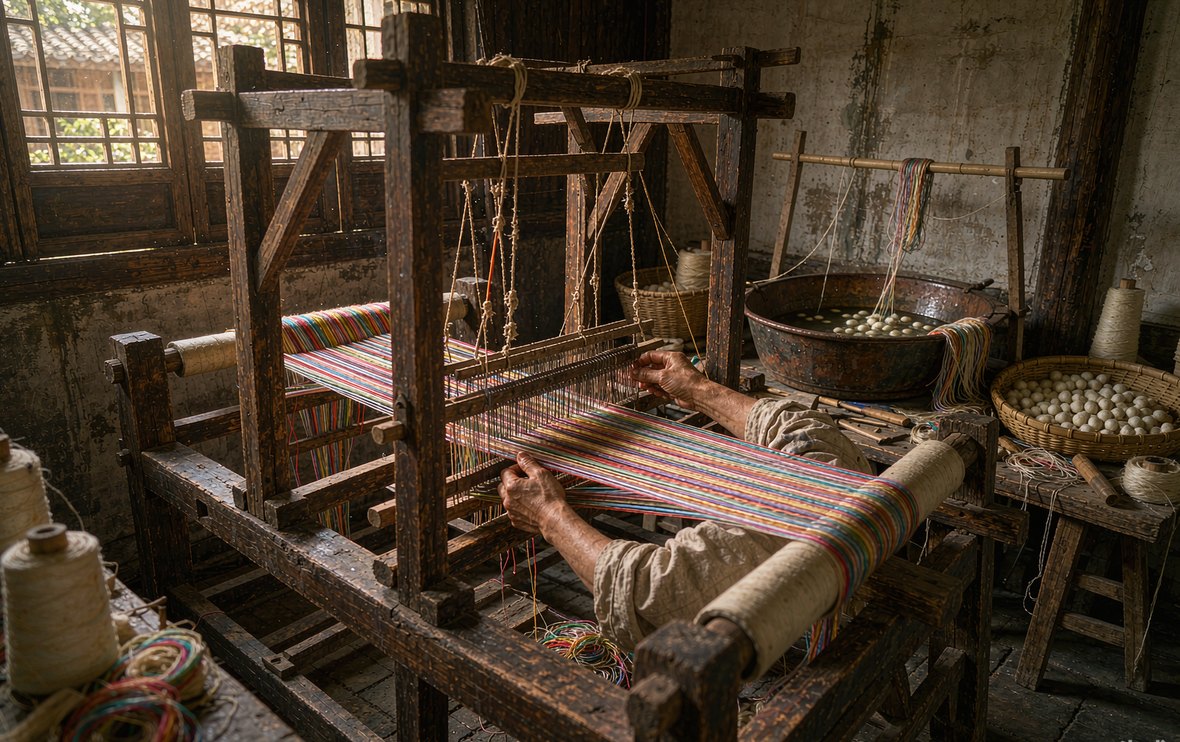
The arts of sericulture and silk weaving turn the thread of the silkworm into court dress and into a civilisational signature: planting mulberry, rearing worms, reeling, weaving, dyeing and printing. The Chinese domesticated the wild silkworm more than five thousand years ago, and the silk textiles unearthed at Qianshanyang in Zhejiang are the world's earliest surviving examples of domesticated-silkworm weaving. Silk was the first commodity to define China: the Greeks called the country Seres, the land of silk; after Zhang Qian opened the Western Regions in the Han, silk became the soul of that trade route — the Silk Road is named for it. The damasks and satins of the Tang were woven out of the splendour of the age; Song kesi, with its continuous warp and broken weft, could weave a painting; in the Ming and Qing the workshops of Jiangnan sent out ten thousand bolts a day to clothe the world, and Nanjing cloud brocade, Suzhou Song brocade and Sichuan Shu brocade were named the three great brocades (with Zhuang brocade, four). In 2009 Chinese sericulture and silk craftsmanship was inscribed as a whole on UNESCO's Representative List — a filament a twentieth of a millimetre thick, finer than a hair, drawing together the whole civilisation of agriculture, trade, technology and aesthetics.
The domestication of the silkworm is one of the greatest acts of bioengineering of the ancient world: the Chinese turned a wild moth into a domesticated one wholly dependent on human care, its cocoons many times heavier, its silk fine and consistent. Legend credits Leizu, consort of the Yellow Emperor, with teaching the people to rear worms and reel silk; archaeology points to the silk ribbons and threads of Qianshanyang, some 4,700 years old. The system is interlocking — mulberry management, temperature control in the rearing room, mounting the worms to spin, killing the pupae and reeling — and the "Garments" chapter of *The Exploitation of the Works of Nature* records every detail of Ming silk technology.
Sericulture also entered the deep strata of culture: the *Book of Songs* sings of gathering mulberry leaves, the rites of the silkworm god ran for a thousand years, and the silkworm month entered the agricultural almanac — rearing worms was the white economy of agrarian society and the leading sector of women's work.
The summit of silk weaving is in the loom and the named brocade. Han drawlooms could already weave complex patterns (the loom model from the Laoguanshan tomb is the earliest such object in the world); the cloud brocade's great tower loom takes two people, one pulling the pattern cords above and one weaving below, and produces only a few centimetres a day — "an inch of brocade, an inch of gold". Shu brocade is the oldest (traded into the Western Regions as early as the Han), Song brocade the elegant choice for mounting paintings, Zhuang brocade the proud, saturated textile of the Zhuang people.
Kesi is the limit of the weaver's art: continuous warp and broken weft let the maker work like a painter, an inch of kesi for an inch of gold, and the works of Zhu Kerou and Shen Zifan have always been treated as paintings — textiles attaining the artistic status of painting itself.
Silk drove the greatest trade network in human history: after Zhang Qian reached the Western Regions, Chinese silk travelled the Hexi Corridor to Central Asia, Persia and Rome; Roman nobles paid a pound of gold for a pound of silk, and Pliny complained that the wealth of the empire was draining east. The maritime route succeeded the land route, and from the Tang and Song silk and porcelain left Quanzhou and Guangzhou in the same ships — Seres, the land of silk, was China's first international nickname.
Silk carried technology and culture as well: the westward transmission of sericulture took a thousand years to complete (Byzantium obtained silkworm eggs in the sixth century), and looms and patterns travelled and exchanged along the way — a road named for a thread, a thread joining two continents of desire and imagination.
In 2009 the Chinese sericulture and silk craftsmanship, covering Hangzhou, Jiaxing, Huzhou and beyond, was inscribed as a whole: cloud brocade, Song and Shu brocade, kesi, Hangzhou leno and the silkworm-flower temple fairs all included — a complete ecology from technique to custom recognised. Nanjing cloud brocade has entered the order of state gifts (the garments of APEC leaders), and Suzhou kesi makers restore objects for the Palace Museum: old skills back at work.
China remains the world's largest producer of silk, with more than seventy per cent of mulberry cocoons. And the contemporary edition of the Silk Road, the Belt and Road Initiative, takes its name in direct homage. The story of one silk thread runs from the Neolithic into the diplomatic vocabulary of today.