Historical depth
Nearly 10,000 years of pottery · 1,800 of porcelain
Chinese ceramics is an art of clay and fire sp...
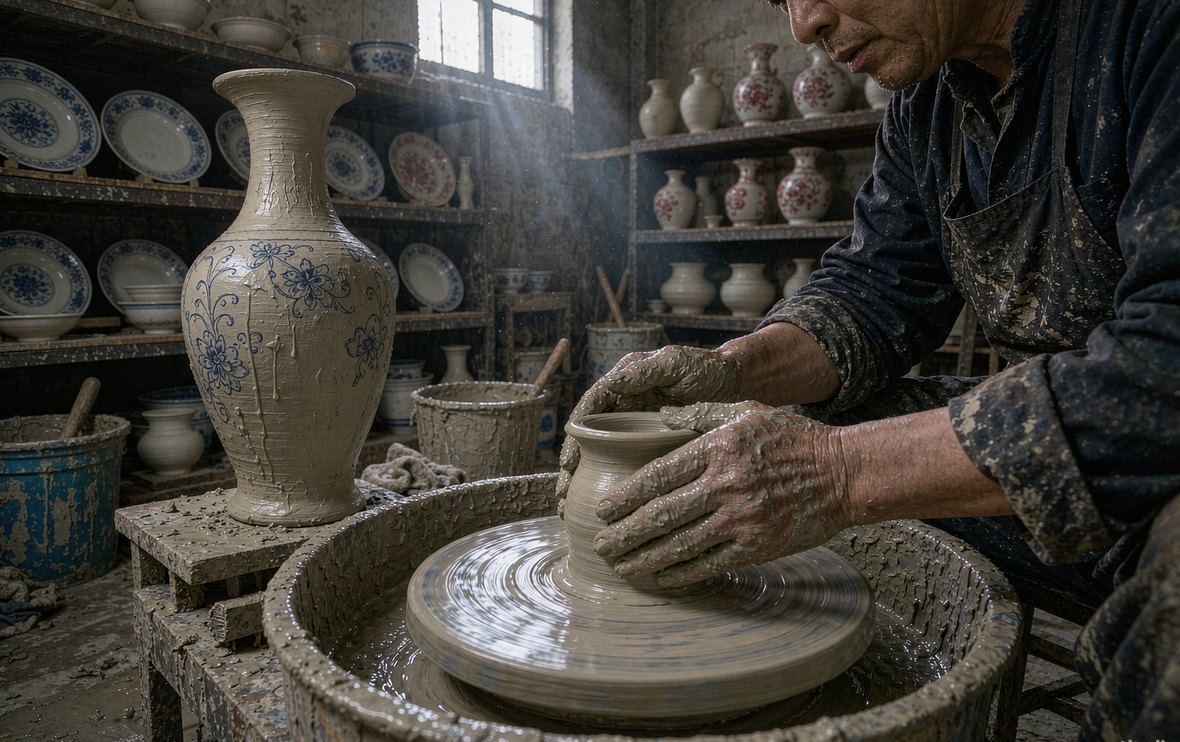
Chinese ceramics is an art of clay and fire spanning nearly ten thousand years: from the painted pottery of Yangshao and the black pottery of Longshan in the Neolithic, through the first light of proto-porcelain in the Shang, the mature celadon of the Eastern Han, the twin peaks of "celadon in the south, white in the north" in the Tang, the supreme refinement of the five great Song kilns (Ru, Guan, Ge, Jun, Ding), the sudden arrival of Yuan blue-and-white, to the dazzling technical feats of Ming and Qing polychrome (doucai, wucai, falangcai) — a history of ceramics is half the history of Chinese craft and half the history of world trade. Porcelain is the artefact that first gave China its name in the world: in English, china is both the country and the ware. Longquan celadon and Jingdezhen blue-and-white travelled the maritime Silk Road to Europe and Asia, and their qualities — white as jade, bright as a mirror, thin as paper, ringing like a chime — captivated the world; the courts of Europe spent a thousand years learning the method. Contemporary ceramics flourishes on two lines at once: the heritage crafts of the traditional kilns are transmitted in order, while studio ceramics have entered the international language of contemporary art — the dialogue of clay and fire continues.
Pottery and porcelain are two revolutions. Pottery (Neolithic; potsherds from Xianrendong in Jiangxi are some twenty thousand years old) is clay fired at low temperature — the first time humans changed the nature of a material. Porcelain requires three things: a body of porcelain stone and kaolin, a temperature above 1200°C, and a glaze. When the kilns at Shangyu achieved mature celadon in the Eastern Han, China held the technology of porcelain to itself for a thousand years. Proto-porcelain appeared in the Shang, the pattern of southern celadon and northern white formed through the Northern and Southern Dynasties, and by the Tang the white ware of Xing was "like silver, like snow" and the celadon of Yue "like jade, like ice" — the aesthetic range of the material opened fully.
A revolution in material was also a revolution in trade: porcelain survived sea voyages, could be made in quantity, and was easily made beautiful — it became the largest ocean commodity of the ancient world, and the cobalt for blue-and-white (sumali qing) came from Persia itself. The history of ceramics and the history of the world are locked together.
The Song is the philosophical moment of Chinese ceramics: the five great kilns each a distinct aesthetic personality — Ru with its sky-blue, "the colour of sky after rain where the clouds break"; Guan with crackles like splitting ice; Ge with golden threads and iron wire; Jun with transmutation, "one colour entering the kiln, ten thousand colours leaving it"; Ding with white incised like silk. Yaozhou's carved flowers are sharp, Longquan's powder-blue and plum-green like jade, Jian's hare's-fur bowls made for tea, Cizhou's black on white thoroughly popular — the beauty of Song ware is the utmost of the minimal: one glaze colour reaching infinite gradations.
This philosophy of monochrome runs in step with Song Neo-Confucianism: strip away the ornate, investigate things to reach knowledge. The plainness of Ru became the highest measure of later taste; the Qianlong emperor searched for Ru pieces and saw few; the proverb "better a shard of Jun than a fortune in the chest" says everything about the mystique of Song ware.
Yuan blue-and-white is the watershed: Jingdezhen, using a binary body of porcelain stone and kaolin, fired vessels of great size, and Persian cobalt drew scrolling lotus and figure narratives, so that the world language of blue and white was established. Ming wucai and doucai (the Chenghua chicken cup has become a legend of the auction room) added colour layer upon layer, and Qing falangcai and fencai pushed court porcelain to the limit of refinement — five hundred years of the imperial kiln at Jingdezhen made it the largest state art project in China.
Export porcelain was staggering in scale as well: hundreds of thousands of pieces a year left through Guangzhou in the Ming and Qing; European princes took pride in porcelain rooms; Meissen and Delft took two hundred years to succeed in imitation — a three-century technology chase that measures the standing of Chinese porcelain in the world.
The transmission system is complete: the traditional firing technique of Longquan celadon was inscribed on the UNESCO list in 2009, the only ceramic item so honoured; Jingdezhen hand-made porcelain, Yixing zisha, Jian ware and Dehua white ware are all national intangible heritage. Wood-kiln revivals, traditional wheel-throwing, master studios — the embers of the craft are still alight.
Studio ceramics has moved into another dimension: thousands of artists drawn to Jingdezhen gather around the Pottery Workshop, and the city has become a pilgrimage site for ceramicists worldwide; studio work has established its language in biennials and museums — traditional handwork and contemporary concept coexisting in the same porcelain capital, which is precisely the complete contemporary form of a ceramic civilisation.