Elements
Leather figures · lamplight · screen · narration
Shadow puppetry is an ancient art of light and...
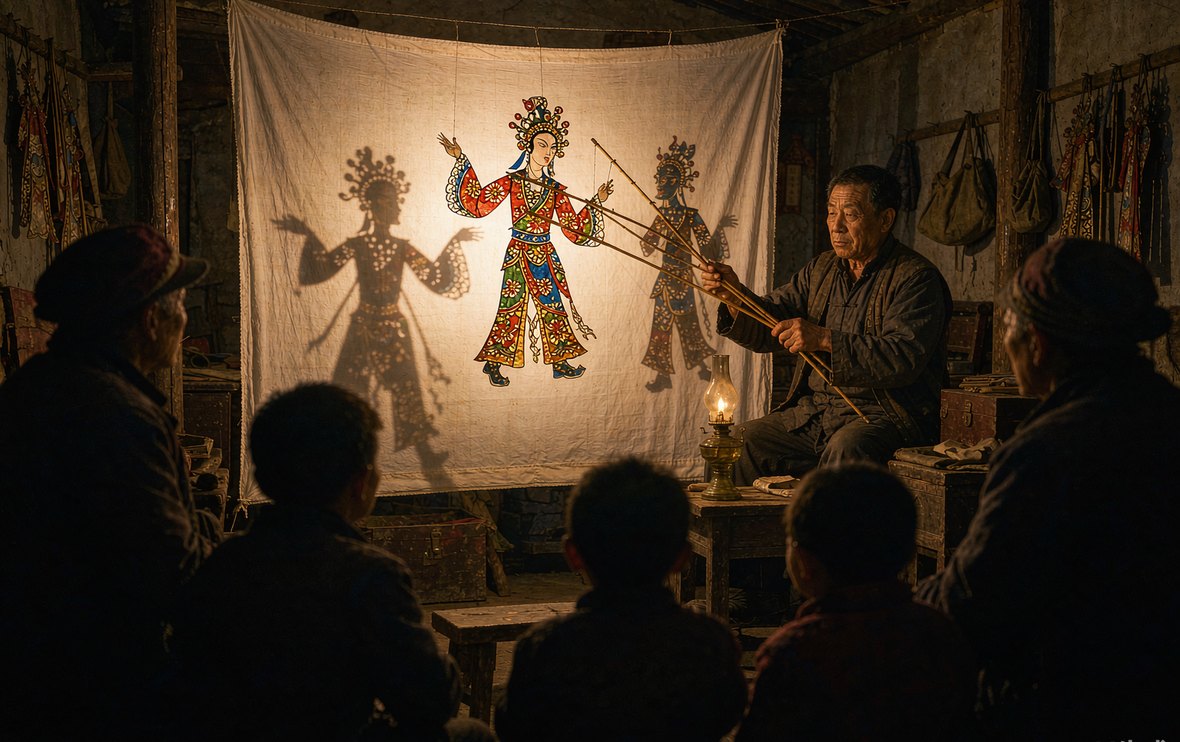
Shadow puppetry is an ancient art of light and leather: the performer manipulates carved leather figures, projects them by lamplight onto a white screen, and tells the tale in song and music — "one voice recounts a thousand years of story; two hands set a hundred thousand soldiers dancing". It is among China's oldest theatrical forms: a legend of summoning a spirit by shadow appears as early as the Han, the form matured in the Tang and Song, and the name "shadow play" is recorded in the entertainment quarters of Bianjing; in the Yuan and Ming it travelled with armies and caravans to Persia, Egypt and Turkey, and the shadow theatre of Southeast Asia (wayang) is kin to it. Its craft is a system of its own: ox or donkey hide scraped, carved, coloured and jointed, a single figure taking three thousand cuts. The schools are many: the archaic melodies of Hua County in Shaanxi, the extraordinary carving of Tangshan, the earthy play of the Jianghan plain in Hubei. In 2011 Chinese shadow puppetry was inscribed on UNESCO's Representative List — long before the invention of cinema, the Chinese had been showing shadow films for a thousand years.
The medium of shadow puppetry is light, shadow and screen — structurally identical to the cinema: a light source, figures blocking the light into image, a screen receiving it, and a performer whose sequencing is already montage. *An Account of the Splendours of the Eastern Capital* records the shadow theatres of Bianjing in the Song, troupes performing serial plays, audiences spellbound — eight hundred years before photography, the Chinese commanded every element of narrative light.
It is for this reason called the ancestor of film: early filmmakers studied the movement of shadow figures, and German scholars discussed it alongside cinema. China's contribution to the world history of the moving image is hidden behind that white cloth.
A figure is a composite poem of carving, cutting, dyeing and jointing: the finest ox or donkey hide is chosen and scraped to translucency; the "push the hide, guide the knife" technique keeps every line round and fluent; the pierced areas let light through while the solid areas carry colour — red, green, yellow, black, fixed to last a thousand years — and under the lamp the whole figure glows like glass. A single puppet may take more than three thousand cuts, its limbs jointed with thread so that it moves like a living body.
Tangshan is supreme for donkey-hide carving; Shaanxi for the elegance of Hua County design — everywhere the faces follow a coded typology shared with operatic make-up: sheng, dan, jing and chou, known at a glance.
The typical troupe is "five busy men": a chief manipulator, an assistant, a drummer with gongs, a string player and a supporting voice, all narration carried by a single throat. "One voice recounts a thousand years; two hands set a hundred thousand soldiers" describes the lead artist in earnest: he may work three or four figures at once, whispering through the civil scenes and tumbling through the martial ones. Melody varies by region: wanwan, laoqiang and the Tangshan shadow tunes are each a system of their own.
The laoqiang of Huayin survived as accompaniment to shadow plays and later became famous through the stage play *White Deer Plain* and Tan Weiwei's rock fusion — the sudden celebrity of an accompanying art proves how rich shadow puppetry is as a mother art.
The challenge today is the change of audience: votive and New Year performances decline, but other roads have opened — shadow puppetry in museums and academies (the China Academy of Art has a research studio), a growing market for children's shadow theatre, shadow elements in animation (*The Peach Blossom Spring*, a shadow-animated film, won international awards) and in game design. Resident shows at Yongxingfang in Xi'an and with the Longzaitian company in Beijing run all year, and its troupe of little people has become a model of social care.
Since the UNESCO inscription of 2011, digital archives have been built region by region and fine carvings have entered the art market — the thousand-year light on the screen is being lit in another way.