Practice type
Dynamic practice · Daoyin
Baduanjin (Eight Pieces of Brocade) is among t...
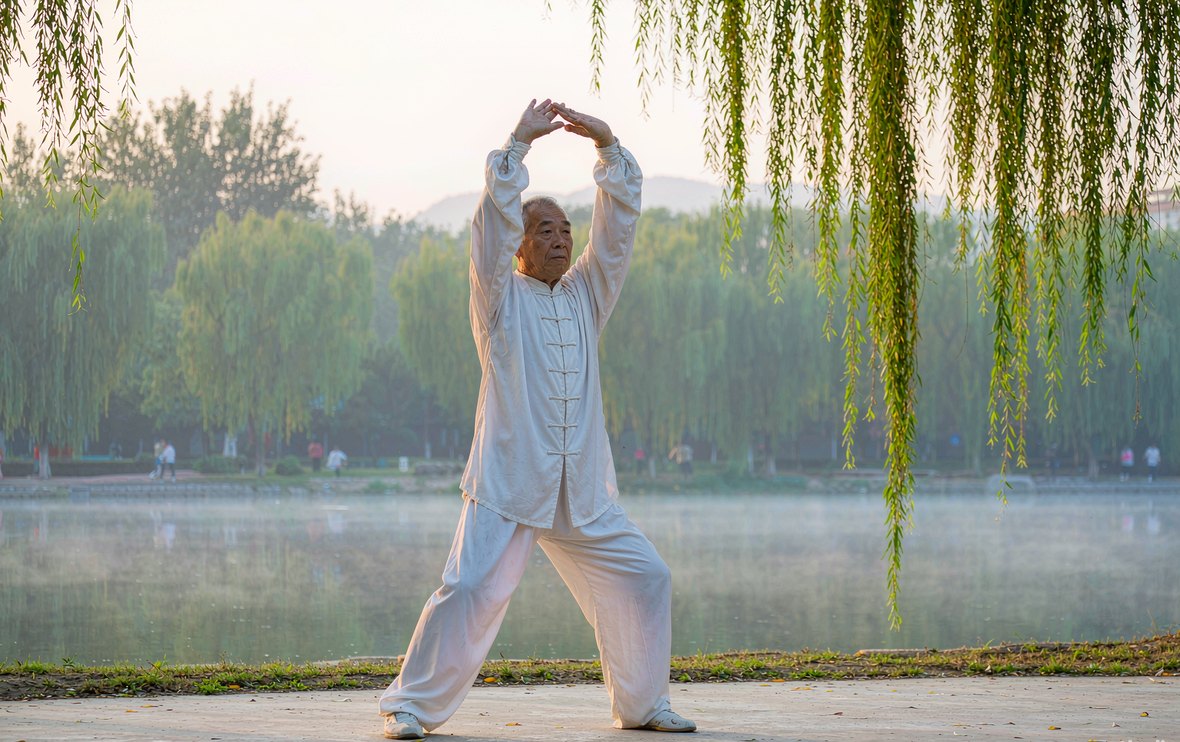
Baduanjin (Eight Pieces of Brocade) is among the most widely transmitted of traditional Chinese daoyin sets: eight movements, each with its own name and mnemonic verse — "Two hands hold up the heavens to regulate the triple burner; drawing the bow left and right like shooting the eagle; raise each arm alone to regulate spleen and stomach; look backward to ease the five strains and seven impairments; sway the head and swing the tail to release heart-fire; two hands grasp the feet to firm the kidneys and waist; clench the fists with flashing eyes to add strength; seven bounces on the heels dissolve a hundred ills." It is named for "brocade" (jin), evoking the smooth, continuous, unbroken quality of silk. Baduanjin took shape in the Song dynasty (its name already appears in Zeng Zao’s Dao Shu of the Southern Song), evolved over eight hundred years into a literary (seated) and a martial (standing) branch; its movements are simple, moderate in range, and indifferent to venue, making it the most popular of all public health practices — the standardized health-qigong version promoted by the General Administration of Sport counts its practitioners in the tens of millions.
The eight movements of Baduanjin are arranged in the order "upper — middle — lower — back — front — side — closing," covering the whole body: holding up the heavens opens the triple burner (the rise and fall of qi in the upper burner of heart-lung, the middle burner of spleen-stomach, the lower burner of liver-kidney); drawing the bow trains the lungs, chest, and back; the single-arm raise regulates the rise and fall of spleen and stomach; looking backward turns the neck and spine; swaying head and tail enlivens the waist and hips; grasping the feet stretches the back and hamstrings; clenching the fists trains liver-qi and sinew strength; the seven bounces close the set and vibrate the whole body — one round through, and the three burners above, middle, and below, the four directions before, behind, left, and right, no region is missed.
Every movement follows the rhythm "rise — extend — hold — return": after reaching the position, pause briefly (the "held posture"), letting qi and blood gather at the stretched site, then slowly withdraw — this pause is the key of daoyin and its greatest difference from broadcast calisthenics: exercises chase speed, daoyin chases "arriving fully" and "feeling fully."
Every movement of Baduanjin asks for the three regulations united: regulating the body (movements precise, range complete), regulating the breath (inhale on rising and opening, exhale on descending and closing — never holding the breath, never straining), regulating the mind (attention riding with the movement — where intent goes, qi goes). In "two hands hold up the heavens," for instance: the hands rise on the inhale, the eyes follow the backs of the hands, the mind envisions lifting the sky; as they descend, exhale and let qi sink to the dantian — only when form, breath, and mind move in sync does a movement become "gong" rather than "exercise."
The beauty of this formula is its "low threshold, high ceiling": beginners following the movements already loosen joints and free the flow of qi; deeper practitioners can trace in each posture the pathways of the jing-luo (meridians) and the felt movement of qi and blood — the same set can be practiced for a lifetime without repeating itself. This is the classic structure of Chinese daoyin: shallow to deep, cultivable for life.
阴平阳秘,精神乃治;阴阳离决,精气乃绝。 — When yin is even and yang is secure, spirit is ordered; when yin and yang part asunder, essence and qi are exhausted.——Huangdi Neijing · Suwen · "Shengqi Tongtian Lun"
The theoretical basis of Baduanjin is the visceral-manifestation (zangxiang) and jing-luo (meridian) doctrines of Chinese medicine: the triple burner governs qi transformation and the waterways; spleen and stomach are the pivot of qi’s rise and fall; liver and kidney share the lower burner and govern sinew and bone — through the flexions, extensions, and twists of the torso, the eight movements stretch and massage the corresponding regions, thereby "regulating the qi dynamic, freeing the jing-luo, harmonizing the organs." The verse’s "regulate the triple burner," "regulate spleen and stomach," "firm the kidneys and waist," "release heart-fire" all speak of adjustment at the level of the qi dynamic, not the treatment of any one disease.
In modern terms: slow whole-body stretching coordinated with breath improves joint range, sharpens proprioception, modulates autonomic tone, and promotes circulation — these are general physiological regulations, not "treatments." The wisdom of Chinese daoyin lies precisely here: it does not target a specific "illness" but adjusts the body’s overall "norm" — "when yin is even and yang is secure, spirit is ordered"; restore the norm and disease has nothing to attach to.
The documentary history of Baduanjin is clear: the name appears in Zeng Zao’s Dao Shu of the Southern Song, and Pu Qian-guan’s Baosheng Yaolu of the Song records a similar set; in the Ming and Qing, the literary (seated) and martial (standing) branches diverged and the verse stabilized; in the late Qing, printed books such as the Yijin Jing Tushuo carried it deep among the people. It never belonged to any one school — it was always "public knowledge of nourishing life."
Baduanjin’s third great popularization is contemporary: in 2003 the General Administration of Sport created the standardized Health Qigong · Baduanjin, with set music and a teaching system; since then it has entered communities, hospitals, schools, and workplaces, and during the pandemic became a common sight in makeshift hospitals and homes. In eight hundred years the movements have scarcely changed — what changed is who practices: from Daoists, literati, and martial masters to every ordinary Chinese person.