Structure of the art
Eight methods, five steps · Thirteen postures
Tai Chi Chuan (Taijiquan) is the emblematic ar...
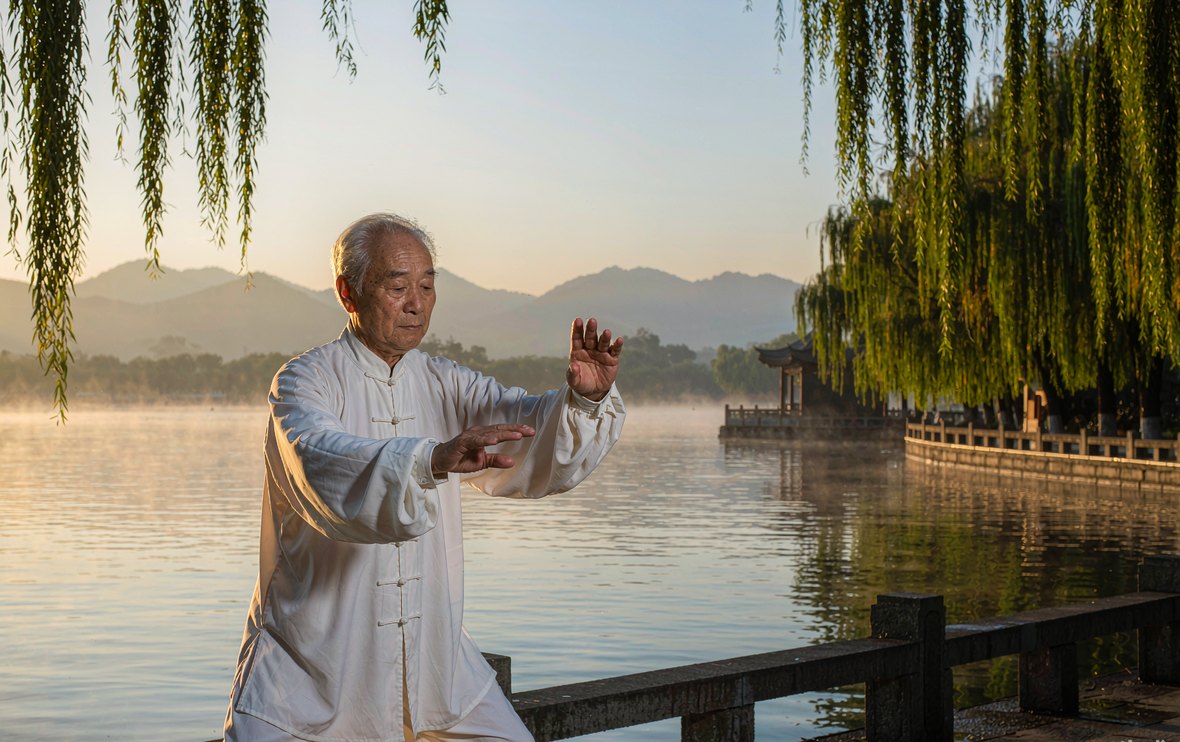
Tai Chi Chuan (Taijiquan) is the emblematic art of the internal school and the most widely practiced Chinese body art in the world: the eight methods of peng, lü, ji, an, cai, lie, zhou, and kao, joined to the five steps of advance, retreat, left-look, right-expect, and central stability, form the thirteen postures; the forms are slow, round, and unbroken, guided by "intent leads qi, qi moves the body." Created in the late Ming and early Qing (Chen Wangting is generally honored as founder; a legend also credits Zhang Sanfeng), it developed through the lineages of Yang Luchan, Wu Yuxiang, Wu Jianquan, and Sun Lutang into the five great schools: Chen, Yang, Wu (Wu Yuxiang), Wu (Wu Jianquan), and Sun. Tai Chi’s uniqueness is that it is three things at once: a fighting art (listening jin, neutralizing jin, borrowing force), a health practice (looseness, stillness, softness, slowness; regulating breath and nourishing qi), and a philosophical practice (yin-yang, empty-full, hard-soft, motion-stillness) — "Taiji is born of Wuji, the mother of yin and yang": one set of forms turns the abstractions of Chinese philosophy into bodily instinct.
The technical skeleton of Tai Chi is the thirteen postures: the eight methods (peng, lü, ji, an, cai, lie, zhou, kao) are eight ways of applying jin — trained quality of force; the five steps (advance, retreat, left-look, right-expect, central stability) are five footworks and directions woven together. Within the eight, peng is the mother jin (an upward, outward supporting force), lü is neutralizing (leading along the incoming line), ji is joining (two forces combined and issued), an is sinking (pressing down and forward) — each is not a "technique" but a "quality of force."
This view of technique — centered on jin rather than on choreographed moves — is the dividing line between internal and external boxing: forms can be memorized, jin can only be trained — "from familiarity with the forms one gradually awakens to jin; from understanding jin one ascends to enlightenment." The slowness of Tai Chi exists precisely so that you may sense the direction of force within the slowness: fast, and you can only use strength; slow, and you can see force.
Tai Chi’s fighting logic differs radically from Western pugilism: do not meet force with force, do not clash — "yield to the opponent and follow": lead the incoming force along its own direction so it falls into emptiness, then issue power upon its loss of balance — "lead in, land empty, unite and issue"; "four ounces deflect a thousand pounds." This logic rests on two abilities: "listening jin" (sensing through the point of contact the size, direction, and change of the opponent’s force) and "neutralizing jin" (rerouting force without meeting it or losing touch).
Mechanically, this converts the opponent’s straight line into an arc, converts opposition into guidance, replacing muscular contest with the rotation of structure — dissolving local straightness with the whole body’s circle. "Softness overcoming hardness" is therefore no moral fable but precise technique: soft is elasticity and adaptation; hard is stiffness without reserve — nothing under heaven is softer than water, yet nothing surpasses it in wearing down the hard.
太极者,无极而生,动静之机,阴阳之母也。 — Taiji is born of Wuji: the hinge of motion and stillness, the mother of yin and yang.——Wang Zongyue, Treatise on Taijiquan
The health value of Tai Chi rests on its movement characteristics: slowness (steady heart rate, minimal blood-pressure fluctuation), roundness (joints moved gently through full range), looseness and rootedness (muscles unclenched, mind unstrained), naturally deep breathing (large diaphragmatic travel), and focused attention (spirit gathered inward) — five points that map exactly onto what modern sports medicine prizes in low-intensity aerobic and mind-body training.
Chinese medicine explains it at the level of qi and blood: Tai Chi "leads qi with intent and moves the body with qi," using spiraling, coiling limb motion and long breath to keep qi and blood from stalling; the body requirements of "coccyx centered, qi sinking to the dantian" are in substance spinal alignment and core stability. What it tunes is not one function but the person’s entire "operating state" — the very value UNESCO’s citation emphasized when inscribing the art: fostering health and social inclusion.
Tai Chi’s highest pursuit is the "enlightenment" that follows understanding of jin: no longer thinking of techniques, responding to things naturally; no longer applying force, yet force arriving of itself. Wang Zongyue’s Treatise on Taijiquan opens with "Taiji is born of Wuji, the hinge of motion and stillness, the mother of yin and yang" — seating a boxing method directly on cosmology: empty and full are yin and yang; opening and closing are breathing; advance and retreat are waxing and waning. To practice the forms is to train the instinct for these transformations.
In 2020 Tai Chi was inscribed on UNESCO’s intangible heritage lists; its practitioners worldwide number in the hundreds of millions. What it exports is not merely movement but a Chinese philosophy of the body: do not oppose, do not flaunt, leave room, follow the moment — in an age that worships "faster and stronger," a slow art offers another imagination of power.