Practice type
Dynamic practice · Daoyin
The Yijin Jing (Muscle-Tendon Change Classic) ...
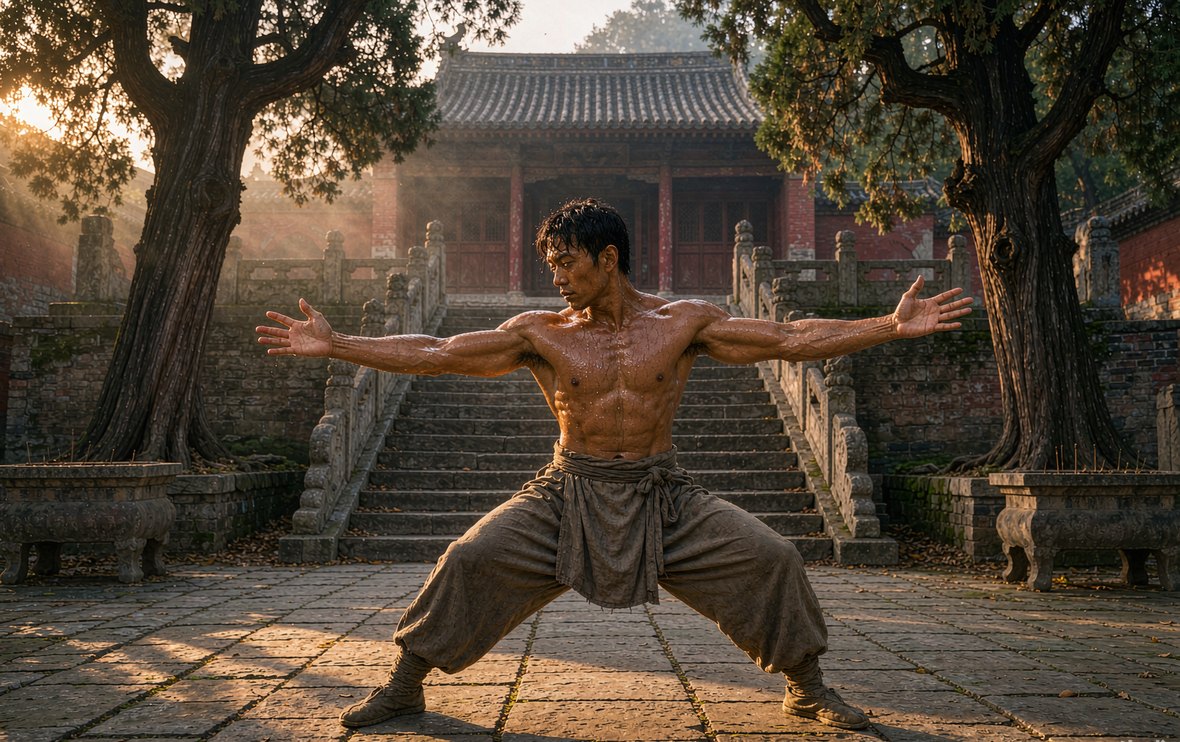
The Yijin Jing (Muscle-Tendon Change Classic) is the most celebrated set of exercises in the Chinese daoyin tradition, attributed to Bodhidharma (scholars generally hold that it took shape in the Ming dynasty, with his name attached to lend it weight). It takes its name from "yijin" — yi, to change; jin, the sinews, fascia, and tendons — meaning that through specific postures and breathing one transforms the quality of the sinews and bones and the body’s pattern of tension. The complete set has twelve postures, movements that are archaic, large in range, and slow in rhythm: Wei Tuo Presenting the Pestle, Plucking Stars and Exchanging the Dipper, Pulling Back Nine Oxen by the Tail, Nine Ghosts Drawing the Saber... Each posture centers on stretching, twisting, bending, and extending, coordinated with breath and intent, opening the long-curled and stiffened body joint by joint. Within the Shaolin system it ranks as superior internal work; among the people it is one of the most widespread health exercises — named alongside Baduanjin and the Five Animal Frolics as one of the three great daoyin sets.
The sequence of the Yijin Jing’s twelve postures is no arbitrary arrangement but a complete grammar of the body: the opening "Wei Tuo Presenting the Pestle" (three variations) settles the stance and the breath and opens the shoulders and arms; "Plucking Stars and Exchanging the Dipper" and "Pulling Back Nine Oxen by the Tail" open the sides of the torso through twist and counter-stretch; "Releasing the Claw and Spreading Wings" and "Nine Ghosts Drawing the Saber" extend the shoulders, back, and intercostals; "Three Plates Falling to Earth" and "Azure Dragon Extending Its Claw" work the legs, waist, and hips; "Crouching Tiger Pouncing on Prey," "Bowing in Salutation," and "Swinging the Tail" close the whole body through flexion and extension — from head to toe, torso to limbs, everything is addressed.
The keynote of every posture is "counter-pull": one hand up, one hand down; head forward, tail back — drawing the body taut like a string under tension. This "counter-pull" is the very essence of traditional Chinese body training: not building muscle through load, but reshaping structure through tension.
"Jin" (sinew) in Chinese medicine refers to the connective tissues — fascia, tendons, ligaments — the network that links the joints and binds the muscles. Those who sit or stand long develop adhesions and shortening in the fascia, a condition of "sinew contraction" — shoulders that cannot open, a waist that cannot bend, legs that cannot squat. Every movement of the Yijin Jing works in the opposite direction: lengthen what has shortened, separate what has adhered, untwist what has twisted — "changing the sinews" means re-programming this network.
Modern fascia research annotates this experience: fascia is an elastic, sentient, force-conducting continuous network, and long-held postures remodel it (creating "compensation patterns"); slow, large-range stretching coordinated with breath is precisely the most effective way to remodel it. The ancients had no microscope, yet with twelve movements they precisely "programmed" the body’s entire fascial chains.
骨正筋柔,气血以流,腠理以密,如是则骨气以精。 — When the bones are straight and the sinews supple, qi and blood flow freely, the interstices of the skin close firmly, and thus the essence of bone and qi is perfected.——Huangdi Neijing · Suwen · "Shengqi Tongtian Lun"
The Yijin Jing is outwardly a dynamic practice, yet inwardly it demands "seeking stillness within movement": the movements slow and even, the breath naturally deep and long (generally inhaling on rising and opening, exhaling on descending and closing), the attention fixed on the stretched region or the dantian. This trinity of "form moving, breath even, mind still" accomplishes stillness training even as it works the body — after one round, the body is warm and the mind cool and clear.
Herein lies its fundamental difference from calisthenics: exercises pursue range and repetitions, daoyin pursues "qi arriving" — the same movement, coordinated with breath and focus, produces an entirely different internal experience. The core of the Chinese view of the body stands revealed here: the physical frame is only the entrance; qi-blood and mind-spirit are the destination.
The transmission history of the Yijin Jing is the stuff of legend: the book appeared in the Ming dynasty, attributed to Bodhidharma with a translation credited to the monk Paramiti and bound with the Xi Sui Jing (Marrow-Cleansing Classic), circulating widely in martial and folk circles; in the Qing it was included in the Weisheng Yaoshu (Essentials of Preserving Health); after the Republican era, scholars such as Tang Hao dated its composition and gradually stripped away the myth, returning it to its nature as daoyin. Shaolin Temple still counts it among its traditional methods, and folk versions (such as the "twelve-form Yijin Jing") have many variants.
Today, as one of the health qigong sets promoted by China’s General Administration of Sport, the Yijin Jing has entered communities, hospital rehabilitation departments, and schools in standardized form; requiring no equipment and no space, it suits sedentary workers and older practitioners especially well. A method once mythologized as "peerless martial arts" has returned, in the plainest way, to its proper place: a daily practice for opening the body anew.