Practice type
Stillness practice · Post standing
Zhan zhuang (standing like a post) is the foun...
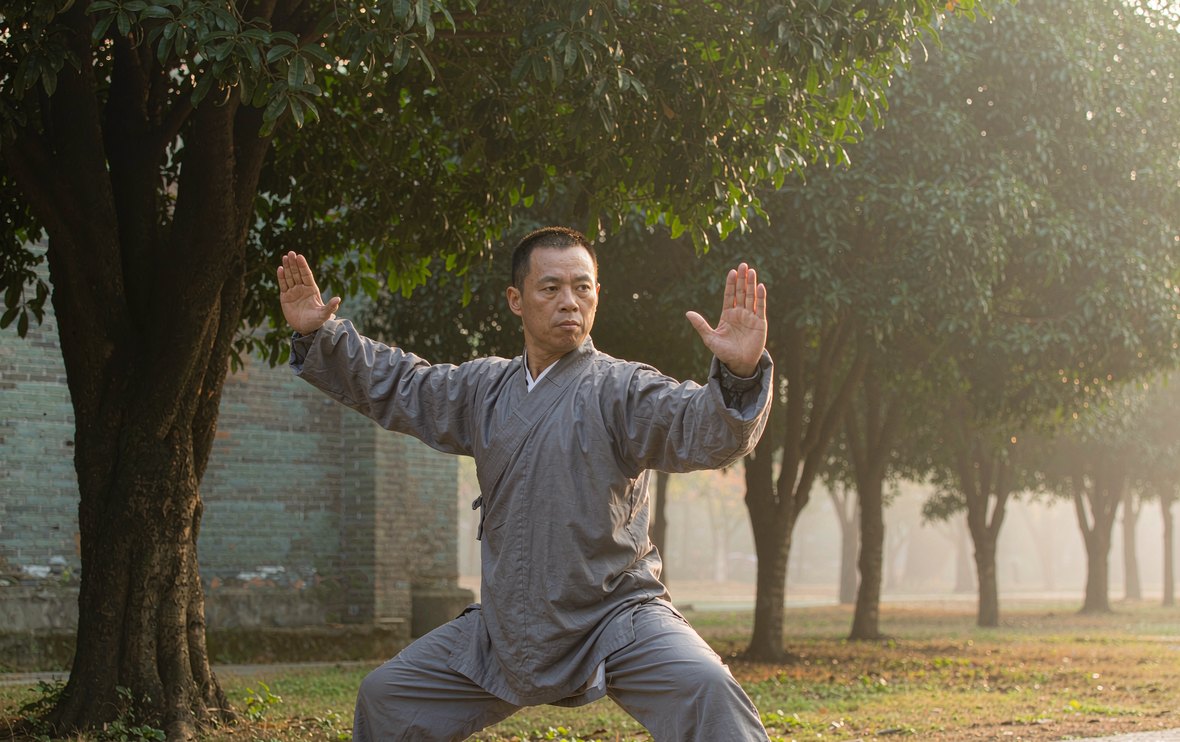
Zhan zhuang (standing like a post) is the foundational standing practice of the internal martial arts: feet apart, knees slightly bent, arms rounded as if embracing a ball — shaped like a wooden post, standing motionless. Outwardly it is simplicity itself; inwardly it is an entire system of precise self-regulation. It grew out of martial "post training" (one must stand firm before one can issue power), and was refined by lineages such as Xingyi Quan and Dacheng Quan into an independent health practice: governed by "looseness, stillness, naturalness," guided by the principles of "suspend the crown, sink the shoulders and drop the elbows, contain the chest and round the back, relax the waist and settle the hips," it builds structure, cultivates internal qi, and forges willpower within a motionless stance. As the boxing saying goes, "A hundred forms of practice are not worth one standing." Zhan zhuang turns "not moving" into the hardest kung fu of all: the form does not move, yet qi and blood move mightily; the body does not move, yet mind and spirit settle profoundly.
The first lesson of zhan zhuang is structure: suspend the crown as if drawn by a thread (xu-ling ding-jin), sink the shoulders and drop the elbows (no shrugging, no clamping), contain the chest and round the back (chest not thrust out, back not hunched), relax the waist and settle the hips as if sitting on a high stool, knees slightly bent and never past the toes — the aim of all these points together is this: let the bones bear the load and the muscles release, reassembling a collapsed body into a mechanical tower.
When the structure is right, a remarkable sensation appears: the body feels both light and heavy — standing without fatigue, yet faintly warm. Practitioners call this "integrity" (zheng): a continuous connection from top to bottom, inside and outside as one. What zhan zhuang trains is not muscular strength but "structural force": power rises from the ground, travels through legs, waist, and spine to the hands, joint by joint, link by link — this is the shared foundation of all internal power issuance.
The two great hurdles of zhan zhuang are song (looseness) and jing (stillness). Song is not collapse; it is "loose yet not slack": muscles without tension, joints never locked, ready at any instant to respond — like a bowstring tuned to exactly the right tension. Beginners often grow stiffer the longer they stand, because the very thought "I want to relax" is itself tension; true song is "letting go," not "achieving."
Jing is not the absence of movement but "movement within stillness": during zhan zhuang the torso sways in infinitesimal ways (the body’s inner self-adjustment), qi and blood flow distinctly within, palms grow hot, fingertips swell, the body sweats faintly — all signs of "movement arising within stillness." The saying goes: "Great movement is inferior to small movement; small movement is inferior to no movement; the movement within no movement is the movement of unending life." Zhan zhuang turns the Chinese philosophical principle that "stillness is the master of restlessness" into bodily experience.
提挈天地,把握阴阳,呼吸精气,独立守神,肌肉若一。 — Hold up heaven and earth, grasp yin and yang; breathe in essence qi, stand alone and guard the spirit, till muscle and flesh become one.——Huangdi Neijing · Suwen · "Shanggu Tianzhen Lun"
The nourishing principle of zhan zhuang lies in "using form to guide qi, and intent to steer qi": the specific frame spreads the jing-luo (meridians) and frees the flow of qi and blood (especially the Ren-Du and Belt channels); deep natural breathing lowers the diaphragm and gently massages the internal organs; and "holding intent" — resting attention lightly inside the body (at the dantian, the soles, the palms) — trains the mind’s capacity to gather inward. Form, breath, and intent unified: this is the core formula of traditional daoyin.
Chinese medicine holds that "when upright qi abides within, external evils cannot intrude," and zhan zhuang cultivates precisely this "inner qi": not a mystical energy, but the integrated coordination the body displays in a state of relaxed alertness — improved circulation, corrected posture, deepened breathing, a settled spirit. Its efficacy comes not from "doing something" but from "not doing": shed the excess tensions, stray thoughts, and compensations one by one, and the body returns by itself to its original order.
Zhan zhuang holds a place of the highest importance in the martial arts: Xingyi students stand in Santishi for three years before anything else, and Dacheng Quan makes post work its entire foundation — the old saying "stand three years before entering the gate" speaks to the primacy of the root: when the lower body is stable the whole body is stable; when the structure is right, power flows. Post standing thus became a common method across schools: Tai Chi has its Chuan-character post, Xingyi its Santishi, Shaolin its horse stance — different names, one principle.
In daily life, zhan zhuang is the most space-efficient of health practices: one square meter, ten minutes, anytime. It calibrates not only posture but state of mind — standing motionless, one is forced into one’s own company; the tensions, anxieties, and fatigue that busy days bury will surface one by one in stillness, and then be breathed away.