Compiled
Eastern Han (attributed to Shennong)
The Shennong Bencao Jing (Divine Farmer’s Clas...
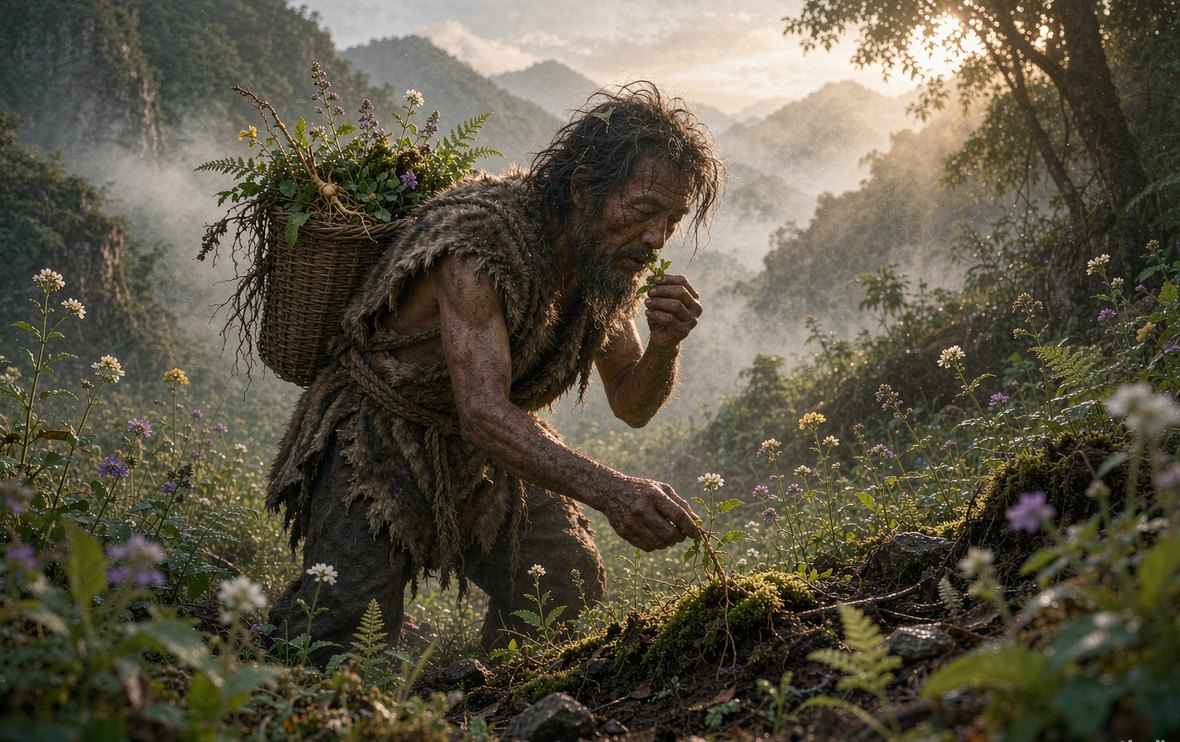
The Shennong Bencao Jing (Divine Farmer’s Classic of Materia Medica) is the earliest surviving pharmacological monograph of China, compiled in the Eastern Han (attributed to Shennong, gathering drug knowledge from pre-Qin through Han). It records 365 substances, classified into "upper, middle, and lower" grades: one hundred twenty upper-grade substances "nourish life in accord with heaven, are non-toxic, and harm no one taken long or in quantity"; one hundred twenty middle-grade substances "nourish the nature in accord with man, toxic or non-toxic as befits each"; one hundred twenty-five lower-grade substances "treat illness in accord with earth, are mostly toxic, and must not be taken long." What it established was not prescriptions but a theory of medicinal properties: the four natures (cold, hot, warm, cool), the five flavors (sour, bitter, sweet, pungent, salty), the seven affinities of combination, and sovereign-minister-assistant-envoy — a cognitive system that folded plants, minerals, and metals into the framework of yin-yang and the five phases. Only by reading the Benjing does one grasp why Chinese medicine says "each herb has its own specialty; a formula’s marvel lies in combination."
The classification logic of the Benjing is singular: not by botanical family but by "level of effect on the human being," in three grades — the upper grade nourishes life (suitable for long-term use, supporting upright qi and extending years), the middle grade nourishes the nature (supplementing deficiency and harmonizing function, used with discernment), the lower grade treats illness (attacking evil and breaking accumulations, mostly toxic, stopped once the illness yields). The ranking reveals Chinese medicine’s deepest value judgment: the highest use of a medicine is not "curing disease" but "nourishing life."
The three grades correspond in turn to the three powers: upper accorded heaven, middle accorded man, lower accorded earth — pharmacology seated directly in cosmology. To modern eyes the scheme looks unscientific, yet it contains a profound ethics of use: a strict separation between "what one may take every day" and "what one may only use on occasion" — precisely the lesson modern people most need.
The four natures describe a substance’s cold, hot, warm, or cool character (with a neutral class besides): cooling herbs clear and release, warming herbs warm and unblock — the natures describe the direction in which a substance affects the body’s "thermal pattern." The five flavors — sour, bitter, sweet, pungent, salty — describe its "mode of motion": sour gathers (astringing and securing), bitter drains (clearing, descending, drying), sweet supplements (tonifying and easing), pungent disperses (releasing the exterior, moving qi), salty softens (dissolving hardness, moistening downward).
Cross the four natures with the five flavors and a two-dimensional coordinate appears: among cold substances, bitter-cold and sweet-cold act in different ways; among pungent ones, pungent-warm and pungent-cool move in opposite directions. Choosing a Chinese medicine, in essence, means finding within these coordinates the matching point for a concrete "pattern of imbalance" — not "this drug cures that disease" but "this property corrects that deviation." Here lies the deepest divide between Chinese herbal thinking and antagonistic therapy.
上药一百二十种为君,主养命以应天,无毒,多服久服不伤人。 — Of the upper medicines, one hundred twenty are sovereign: they nourish life in accord with heaven, are non-toxic, and harm no one taken long or in quantity.——Shennong Bencao Jing · "Xulu" (Preface)
The Benjing set out the "seven affinities": used alone, mutually potentiating, mutually assisting, mutually fearing, mutually killing, mutually restraining, and mutually opposing — seven relations that arise when two herbs meet. Those that potentiate or assist enhance one another’s effect; those that fear or kill rein in one another’s toxicity; those that restrain or oppose weaken each other or even cause harm — a complete "combinatorics of pairing."
The seven affinities’ deep meaning: a herb’s value lies not in the single substance but in the relation. The formula doctrine of "sovereign, minister, assistant, envoy" institutionalized precisely this science of relations — the sovereign herb directs the thrust, ministers support it, assistants restrain it or attend to secondary matters, envoys guide and harmonize. A prescription is a team with divisions of labor, not a heap of herbs. This "relational thinking" is the Benjing’s most precious legacy to later ages.
The Benjing’s format was expanded generation after generation: Tao Hongjing’s Collective Commentary on the Bencao Jing raised the count to 730 and pioneered natural classification; the Tang-era Xinxiu Bencao became the world’s first state pharmacopoeia; Li Shizhen’s Bencao Gangmu recorded 1,892 substances and is honored as "the great Eastern pharmacopoeia" — a clear evolutionary chain of bencao scholarship, all flowing from the Benjing’s 365 entries.
Today bencao studies are undergoing modern transformation: compound analysis, pharmacology, quality standards — the discovery of artemisinin drew its inspiration from the Zhouhou Beiji Fang. Yet the Benjing’s way of thinking still holds: value properties, not merely compounds; value combination, not lone action; value safety grading for long-term use — these ancient cautions are wisdom modern drug development must relearn.