Compiled
Warring States to Han (attributed to the Yellow Emperor)
The Huangdi Neijing (Yellow Emperor’s Inner Cl...
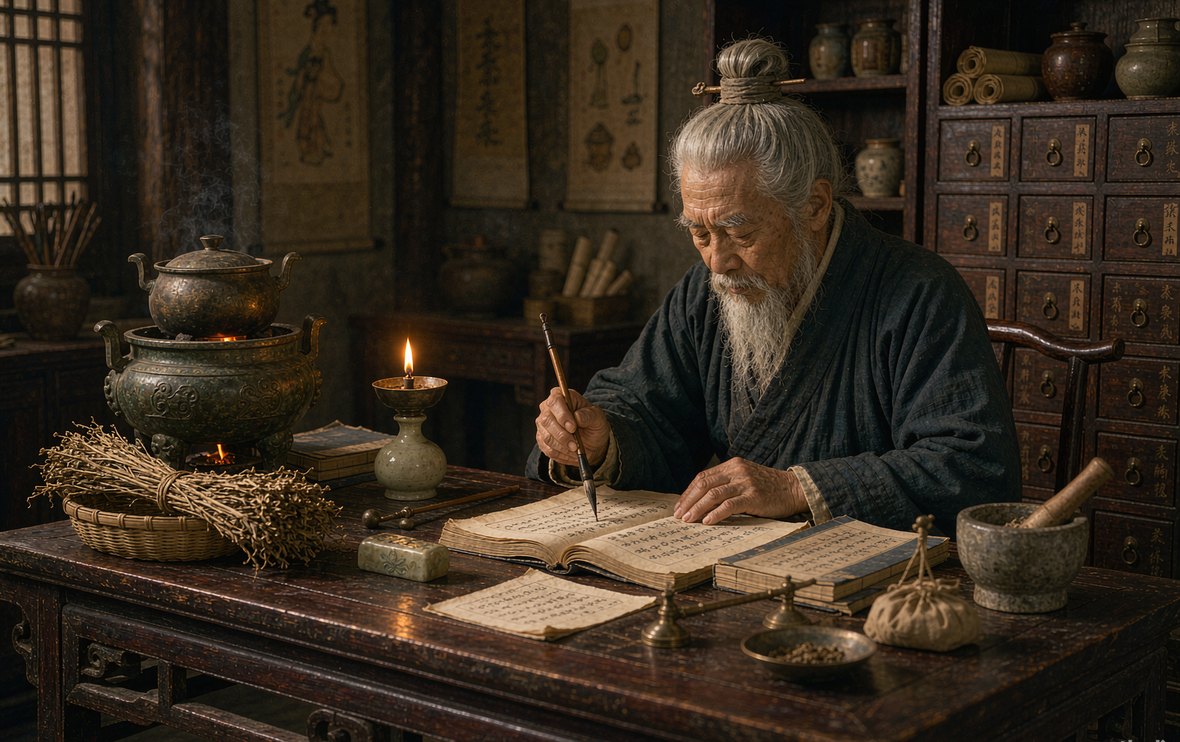
The Huangdi Neijing (Yellow Emperor’s Inner Classic) is the fountainhead of Chinese medical theory, compiled from the Warring States through the Han dynasty and framed as dialogues between the Yellow Emperor and Qi Bo. It divides into the Suwen (Basic Questions) and the Lingshu (Spiritual Pivot), eighty-one chapters each — and it is more than a medical book: it is the first systematic Chinese philosophy of life, body, and the human relation to heaven and earth. Its central question is not "what disease to treat" but "how should a human being live": humans are born of the qi of heaven and earth and completed by the laws of the four seasons, so nourishing life means following the seasons, regulating the spirit, eating with moderation, and rising and resting with regularity; diagnosis must "observe the complexion and press the pulse, first distinguishing yin from yang," judging where imbalance lies within the whole pattern. Yin-yang and the five phases, the visceral-manifestation system and jing-luo (meridians), qi-blood and fluids, causes and mechanisms of illness, diagnostic method and principles of treatment, nourishing life and preventing disease — nearly the entire theoretical skeleton of Chinese medicine was laid down in this one book. To read the Neijing is not to learn how to write prescriptions, but to learn a way of seeing the world.
The Neijing’s first principle is "correspondence of human and nature" (tianren xiangying): humans are born of the qi of heaven and earth and completed by the laws of the four seasons — the rise and fall of the body’s qi dynamic, the functions of its organs, its physiological rhythms, are all homologous with the waxing and waning of heaven’s yin and yang. Spring births, summer grows, autumn harvests, winter stores, and the body’s yang qi floats and sinks in step; within a single day, human qi rises at dawn, peaks at noon, and ebbs at dusk — time is not an external backdrop but a force dwelling inside the body.
This outlook determines the stance of Chinese medicine: it does not examine isolated organs but "the human being’s position between heaven and earth." Hence the Neijing always discusses medicine through season, geography, and constitution: the "people of the northwest" and the "people of the southeast" differ in endowment, and the same imbalance manifests differently in different bodies — individualization was the methodological ground of Chinese medicine from the very beginning.
Yin and yang are the Neijing’s basic coordinates for describing states of life: yin governs stillness, interior, cold, and storage; yang governs motion, exterior, heat, and transformation. Health is "yin even, yang secure" — not a static half-and-half balance but a dynamic accord of mutual generation and mutual restraint; imbalance brings excess or deficiency, and the direction of treatment is "taking equilibrium as the goal": drain what is in excess, supplement what is in insufficiency.
The five phases (wood, fire, earth, metal, water) supply the model of organ relationships: the five zang organs belong to the five phases in order, generating and restraining one another in an ordered cycle — liver-wood generates heart-fire, heart-fire generates spleen-earth, while liver-wood restrains spleen-earth and spleen-earth restrains kidney-water. This lets Chinese medicine string scattered signs into a web of relations: an imbalance in one place sends ripples through the network. The five phases are not five substances but a thinking tool about "relationship."
阴阳者,天地之道也,万物之纲纪,变化之父母,生杀之本始,神明之府也。 — Yin and yang are the Way of heaven and earth, the ordering principle of the ten thousand things, the parents of transformation, the origin of birth and destruction, the treasury of spirit and illumination.——Huangdi Neijing · Suwen · "Yinyang Yingxiang Dalun"
"Zangxiang" (visceral manifestation) is Chinese medicine’s distinctive organ doctrine: zang refers to the organs within, xiang to the signs without — "the viscera dwell within, their forms appear without"; from complexion, pulse, tongue, emotion, and the body’s surface one infers the state of inner function. Zang and fu are not anatomical organs but named functional systems: the liver governs the free flow of qi, the heart governs the blood vessels, the spleen governs transformation and transport, the lung governs diffusion and descent, the kidney governs the storage of essence — five functional dimensions of life together.
The jing-luo (meridians) are the channel network linking inner and outer: the twelve regular channels and the eight extraordinary vessels attach inward to the organs and extend outward to the limbs and joints, circulating qi and blood and connecting surface and interior. The doctrine’s significance is that it provides a framework of "integrated connection" — a region of the body surface is bound to an organ within, so external treatment (needling, moxibustion, tuina) can act on the interior, and inner illness can surface outward. This is the shared map of Chinese diagnosis and treatment.
The Neijing laid down the framework of the four examinations: wang (observing spirit, color, and form), wen (listening to sounds and breath, smelling odors), wen (asking about daily life and emotions), qie (feeling the pulse and skin) — only when the four are considered together can one "know where the illness resides." The core of diagnosis is not hunting for a single indicator but assembling a set of evidence, then organizing the pattern through yin-yang, exterior-interior, cold-heat, deficiency-excess — the fountainhead of the later "eight principles" differentiation.
On treatment, the Neijing set out "treat the root of illness," "restore the balance of yin and yang," "adapt to person, season, and place," and its most famous maxim: "The sage does not treat those already ill but those not yet ill" — adjusting before imbalance takes form, intervening before the pattern collapses. This moved the center of Chinese medicine from "cure" forward to "nourish" and "prevent," and explains why the culture of nourishing life flourished so early: the finest medicine is the one that makes medicine unnecessary.