Author
Lu Yu (c. 733–c. 804)
Written by Lu Yu (c. 733–c. 804) of the Tang a...
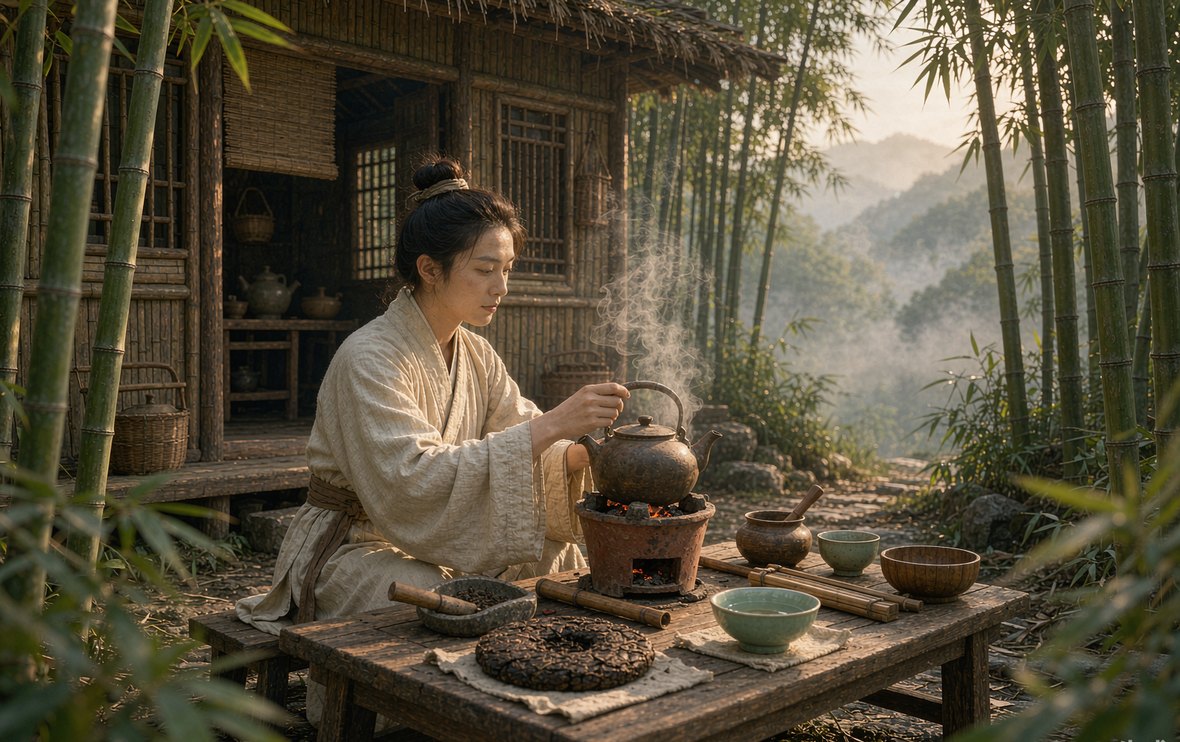
Written by Lu Yu (c. 733–c. 804) of the Tang around 780: three juan, ten chapters, some seven thousand characters, the first monograph on tea in the world. It lifted Chinese tea drinking from a thirsty habit into a complete discipline — origin, implements, manufacture, vessels, boiling, drinking, history, producing regions, simplification and illustration: the nature of the leaf, the craft of picking and processing, the utensils of boiling, the quality of water and fire, the way of tasting — "tea as a drink suits best the man of disciplined conduct and frugal virtue." Lu Yu was a foundling raised in a monastery who refused office and gave himself to tea, "building a hut on the bank of the Tiao Creek and shutting the door to books", and posterity made him the Sage of Tea. After the *Classic*, drinking tea became an art of living; the splendour of Tang and Song tea culture, the origins of the Japanese way of tea, and the seven daily necessities of Chinese households all begin here. Seven thousand characters rewrote the daily life of half of Asia.
Before the *Classic*, tea was medicine, soup, a way to quench thirst: the legend of Shennong, who "met seventy-two poisons in a day and was cured by the tea plant", the Han records of tea boiled into broth — the leaf stayed on the level of use. Lu Yu did three revolutionary things. He defined its nature: "tea is a fine tree of the south", opening by treating it as a plant worth knowing in itself. He defined its method: when to pick, how to steam and press into cakes, how to roast, grind, sift and boil — a whole process with rules. And he defined its way: "as a drink it suits best the man of disciplined conduct and frugal virtue", joining tea to the cultivation of character.
These three steps completed a thousand-year leap from thirst to aesthetics. In the Tang "every household drank"; the tea tax became revenue of state; the tea-and-horse trade linked the frontier. The Song turned whisking and tea contests into an art. The *Classic* is the source of every later tea book — Emperor Huizong's *Treatise on Tea*, Xu Cishu's *Notes on Tea*, Lu Tingcan's *Continuation* — all within its frame. Seven thousand characters drew a watershed of civilisation.
The chapter on vessels lists twenty-four implements for boiling and drinking, each with material, dimensions and use. The wind stove is cast in bronze or iron in the shape of an ancient tripod, its three legs bearing the words "Yi Yin's broth" and "Lu's tea" with trigram signs — a whole cosmology in one object. The cauldron "has square ears, to keep it upright; a wide rim, to reach far". For bowls, Yue celadon is best, "like jade", "like ice", with Xing white ware second — the Tang taste for "celadon in the south, white in the north" was fought out over tea bowls.
The significance of the set is that tea drinking acquired, for the first time, a complete ritual of objects. The vessel carries the way: the trigrams on the stove teach from within the object, the celadon bowl sets off the colour of the liquor. Every later Chinese aesthetics of implements — Song tea bowls, Yixing stoneware, the lidded bowl — starts here. When the Japanese monk Eisai carried tea seeds home and Murata Juko founded the thatched-hut tea ceremony, the object aesthetic at its root can be found in the *Classic*; half the prehistory of Sen no Rikyu's harmony, respect, purity and tranquillity lies in Tang celadon.
不羡黄金罍,不羡白玉杯。不羡朝入省,不羡暮入台。千羡万羡西江水,曾向竟陵城下来。 — I envy no jar of gold, no cup of white jade; I envy no morning at the ministry, no evening at the tower. A thousand envies, ten thousand envies for the west river's water, which once ran down past Jingling town.——Lu Yu, "Song of Six Envies"
The chapter on boiling is almost severe about water and fire. Mountain water is best, river water next, well water last; from the mountains, take the slow flow over rock pools fed by sweet springs, never a waterfall. Water boils in three stages: "fish-eye" bubbles with a faint sound is the first; a string of pearls along the rim is the second; surging waves are the third — "beyond the third the water is old and unfit to drink." When to add the leaf, how to stir, how to pour into the cups so that one "sips bitter and swallows sweet" — all are fixed. It is a standard operating procedure for Tang tea, and the earliest record of the science of flavour.
In modern terms the experience matches the chemistry: living water holds more oxygen and tastes livelier, and by the third boil that oxygen is gone; sweet spring water carries trace minerals that lift the aroma. Lu Yu cannot have known why, but he systematised the observation of how to make it taste better — the Chinese empirical tradition is present even in a teacup. The Japanese sencha way, the gongfu tea of Chaozhou, the gestures of the modern tea house are all descents of this Tang procedure.
Lu Yu's life is a legend. A foundling, he was picked up on the riverbank by the monk Zhiji of Longgai Temple at Jingling, who cast the hexagram jian — "the wild goose gradually advances to the shore, its feathers can be used in the rite" — and so gave him the surname Lu and the name Yu. He learned Buddhism as a child but refused to become a monk, ran away to join a troupe of actors, was noticed by the prefect Li Qiwu and sent to a school; after the An Lushan rebellion he took refuge at Huzhou, "built a hut on the bank of the Tiao Creek and shut the door to books", befriended the monk Jiaoran and the calligrapher Yan Zhenqing, and studied tea for decades until the *Classic* was finished.
He refused office all his life. Summoned to posts at the court of the heir apparent and at the Grand Temple, he accepted neither — a recluse in tea, made a sage by tea. The Tang already made him a deity: "tea sellers moulded his image and set it among the stoves, and worshipped it as the god of tea." After the Song, tea houses kept his likeness, and tea people everywhere claim him as founder. A foundling taken from a riverbank, honoured as a sage by half of Asia: a fate like tea, bitter first and sweet after — the most vivid gloss on the *Classic of Tea*.