Author
Li Daoyuan (c. 470–527)
The commentary by Li Daoyuan (c. 470–527) of t...
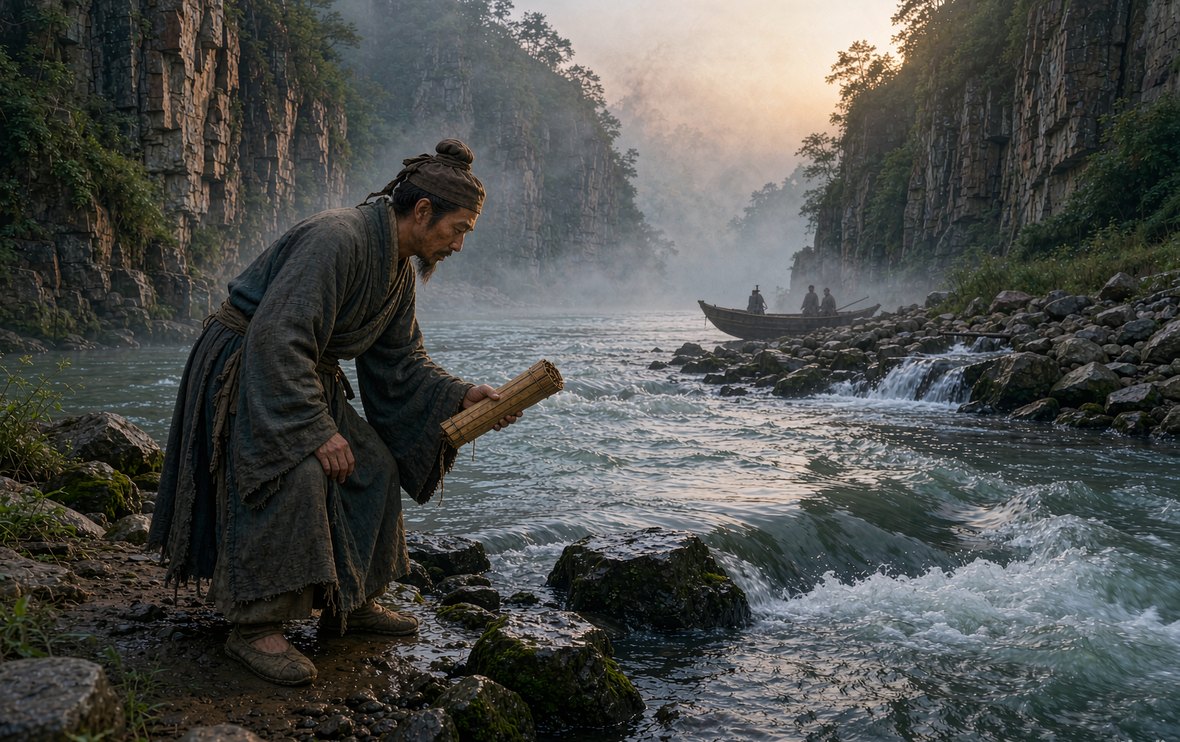
The commentary by Li Daoyuan (c. 470–527) of the Northern Wei on the Han dynasty *Water Classic*: forty juan, more than 300,000 characters — twenty times the length of the original, so that a thin outline of waterways was transformed into the most systematic geographical work of ancient China. Rivers are its armature: 1,252 waterways are traced from source to mouth, and within each basin are gathered mountains, cities, products, antiquities, customs and legends — "by water to verify place, by place to preserve antiquity". Li served as a local official throughout the lands south of the Great Wall and north of the Huai, and read more than four hundred works, matching fieldwork to texts. His prose is the summit of landscape writing: the chapter on the Three Gorges, "white rapids and green pools, clear reflections turning", has been recited for fifteen hundred years. A commentary greater than its classic: the founding work of Chinese hydrography and the highest peak of Southern and Northern Dynasties landscape prose, where the bone of science and the beauty of literature are one.
The structure is the invention. Rivers are the warp; for each, the source, course, tributaries and basin are described in turn, and along each waterway are strung the mountains, cities, fords, monuments, people and legends of its valley. The genius of the water-system frame is that rivers were the natural network of the ancient world, into which administrative divisions, economic life and transport were all woven. To read the *Commentary* is to travel the south and north of China along twelve hundred rivers.
Li's principle is "by water to verify place, by place to preserve antiquity": water confirms where a place was, and place preserves what happened there. City ruins, tombs and steles, old battlefields are all entered under their rivers. The dangers of the gorges, the course of the Hong Canal, the plan of Ye city, the marshes of Huguang — geography and history meet on the two banks. The method established the Chinese tradition of commenting on waterways; Gu Zuyu's seventeenth-century *Essentials of Historical Geography* and Yang Shoujing's nineteenth-century sub-commentary both descend from it.
Li came from an official family and served in Jizhou, Luyang and Eastern Jingzhou, and wherever he went he "sought out the channels and searched the streams" — direct survey was his first source. He also read enormously: the *Commentary* cites 437 books and more than 300 inscriptions, and steles of the Qin and Han, temple tablets of the Han and Wei, survive in name because he quoted them. He knew how paper errs, and often corrected it from experience: testing the claim that the Yellow River "comes out at Mengmen", settling the dispute over the old course of the Si, correcting the mountains and waters of the *Classic of Documents* — "tracing the breathing of each branch, feeling the ground along its road".
This double method of text and field was far ahead of its time in the fifth century. In his own preface he writes that "having much leisure, and not wishing to waste the years, I have expounded the *Water Classic* and broadened what came before". Every stage of official travel became a geographical survey. Later scholars — Dai Zhen and Yang Shoujing in the Qing, Chen Qiaoyi in our own day — have marvelled at the accuracy of his collation: a Northern Wei book can still be used to reconstruct ancient watercourses and to test the history of the Yellow River's shifts. Its scientific value has not faded in a thousand years.
素湍绿潭,回清倒影。绝巘多生怪柏,悬泉瀑布,飞漱其间。 — White rapids and green pools, clear reflections turning. On the sheer peaks grow strange cypresses; hanging springs and waterfalls fly and wash between them.——Li Daoyuan, Commentary on the Water Classic, on the Yangtze
The beauty of the writing made it the ancestor of the landscape essay. The chapter on the Yangtze describes the Three Gorges: "For seven hundred li from the Three Gorges, the mountains on both banks join, with no gap anywhere… white rapids and green pools, clear reflections turning… At dawn after clear weather or on a frosty morning, the woods are cold and the streams austere, and often a gibbon cries from on high, long and mournful, echoing in the empty valley, fading away and returning. So the fishermen sing: the Three Gorges of Badong, Wu Gorge is longest; three cries of the gibbons and tears wet your clothes." Three hundred characters hold the grandeur, strangeness, danger and grace of the gorges for all time.
He writes a waterfall as "a hanging stream pouring into the gorge, ten feet or more, straight down like thunder"; a lake as "a great sea swallowing the current, breathing in a hundred rivers". Verbs exact, rhythm struck, every word a picture. The landscape essays of the Tang and Song, Liu Zongyuan's *Eight Records of Yongzhou*, and the late-Ming sketches of Yuan Hongdao and Zhang Dai are all extensions of this vein. A geographical work that is also a literary model: the great Chinese tradition in which letters and natural knowledge are not divided is at its purest here.
Its service in preserving material is immense. Many of the four hundred works it cites are lost, and fragments survive only in Li's quotations — the Han *Shizi* and *Yan Danzi*, the Northern Wei *Record of the Nine Provinces*. The cities and monuments he describes — the Bronze Sparrow Terrace at Ye, the Golden Valley at Luoyang, the Kunming Pool at Chang'an — are leads for archaeology and historical geography today. Hou Renzhi and Tan Qixiang, founders of the modern discipline in China, took the *Commentary* as a basic source.
It also preserves a wealth of legend and custom: Zhuge Liang's shrine on the Wuzhang Plain, Meng Jiangnu at Shanhaiguan, the dragon gate of the Yellow River. Folktales are entered with the waterways and make the book a treasury of folklore. It is now translated into several languages; Chen Qiaoyi devoted a life to annotating and translating it, and international scholarship calls Li Daoyuan a master geographer of the Middle Ages. The commentary on a river became the trunk of a civilisation's geographical memory.